You’ve decided it’s time. The paper job cards aren’t working anymore. The spreadsheets are a mess. You’re losing track of quotes, chasing invoices manually, and spending your weekends on admin instead of with the family.
So you start looking at garage management software. And suddenly you’re drowning in options. Systems built for American auto shops. Enterprise platforms designed for dealership networks. Free tools that look promising until you realise they haven’t been updated since 2019.
How do you actually choose? What matters, and what’s just marketing fluff?
We’ve talked to hundreds of Irish garage owners over the years. Here’s what we’ve learned about finding software that actually works for independent workshops.
Start with your actual problems
Before you look at a single demo or pricing page, write down what’s actually broken in your current setup. Be specific.
Is it that you can’t find job cards when customers call? That quotes disappear into email threads and never get followed up? That you have no idea which jobs are making money and which are costing you? That invoicing takes your entire Sunday?
Different software solves different problems. Some systems are brilliant at scheduling but weak on invoicing. Others handle parts beautifully but have terrible reporting. If you don’t know what you’re trying to fix, you’ll end up buying features you don’t need while missing the ones you do.
Make a list of your top five frustrations. These become your evaluation criteria.
Look for software built for your market
This matters more than most people realise. Software built for the UK market will reference MOT instead of NCT. American systems will talk about ZIP codes and measure everything in miles. Australian tools will have the wrong tax settings.
These seem like small annoyances, but they add up. Every time you have to mentally translate, every time you need to work around a feature that doesn’t quite fit, you’re losing time and creating friction.
For Irish garages, the big differentiator is whether the software was designed for your market or bolted on after the fact. Key things to check:
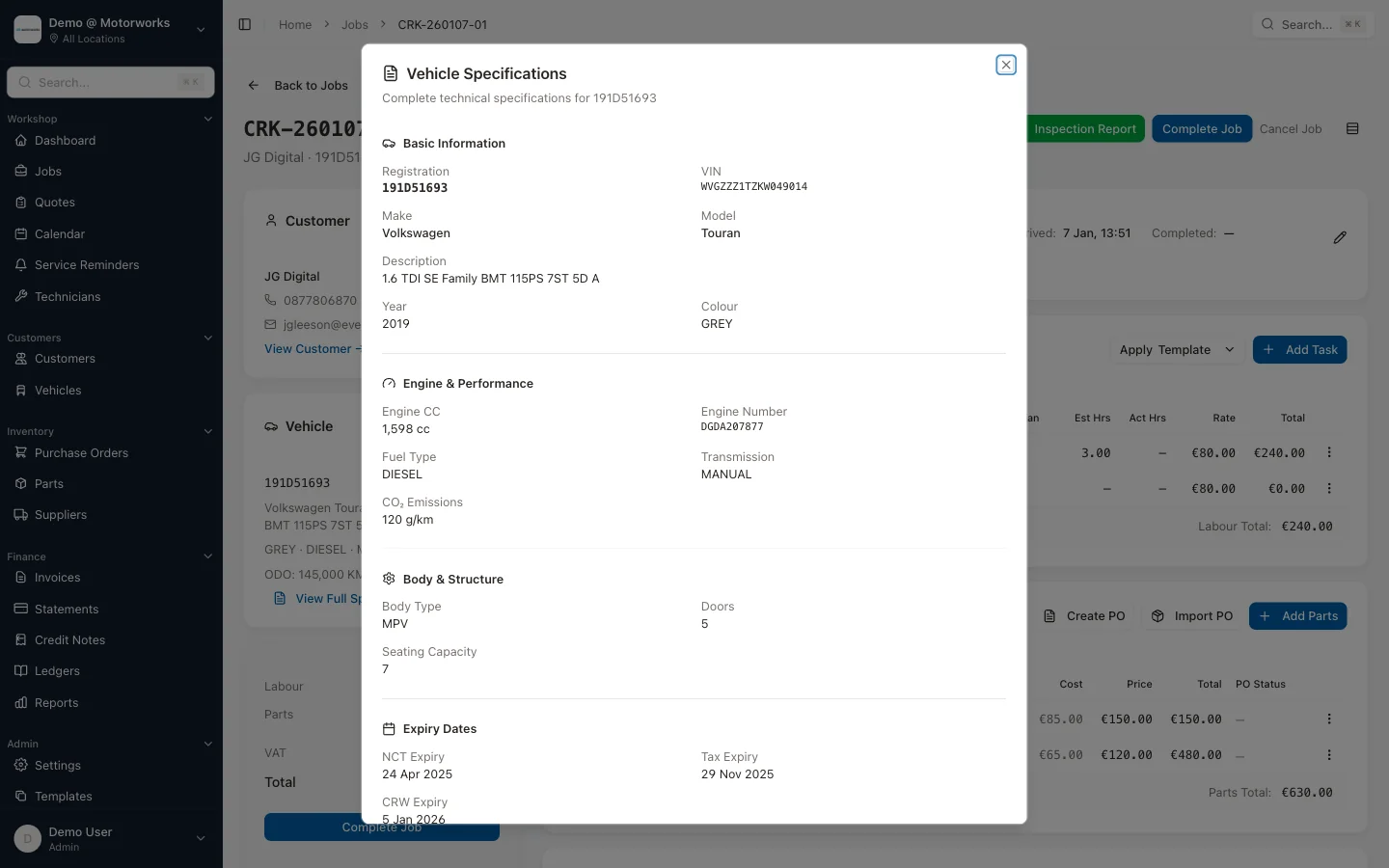
- Irish vehicle registration lookups — does it integrate with providers like Motorcheck.ie or 4tonic so you can pull vehicle details from a reg number? Or do you have to enter make, model, and year manually every time?
- Eircodes for customer addresses — not UK postcodes or US ZIP codes
- Terminology that matches your world — NCT not MOT, boot not trunk, kilometres not miles
The basics like correct VAT rates and Euro currency should be a given, but you’d be surprised how many systems get these wrong out of the box. If you’re evaluating software from outside Ireland, ask specifically how it handles these things. “You can configure it” isn’t the same as “it works out of the box.”
Understand the real cost
Software pricing can be deliberately confusing. Here are the questions to ask:
Per-user fees: Does the price increase as you add team members? Some systems charge per user, which sounds reasonable until you realise it discourages you from giving everyone access. Your whole team should be using the system, not just one person at the front desk.
Feature tiers: Are the features you actually need included in the base price, or hidden in an “Enterprise” tier that costs three times as much? Ask specifically about reporting, multi-location support, and integrations.
Contract length: Monthly or annual? What happens if the software doesn’t work out? Some providers lock you into 12 or 24-month contracts. Others let you pay monthly and cancel any time.
Implementation fees: Is there a setup cost? Data migration fee? Training charges? These can add hundreds or thousands to the real cost.
Hidden costs: SMS notifications, email sending, storage, support — some providers charge extra for things you’d reasonably expect to be included.
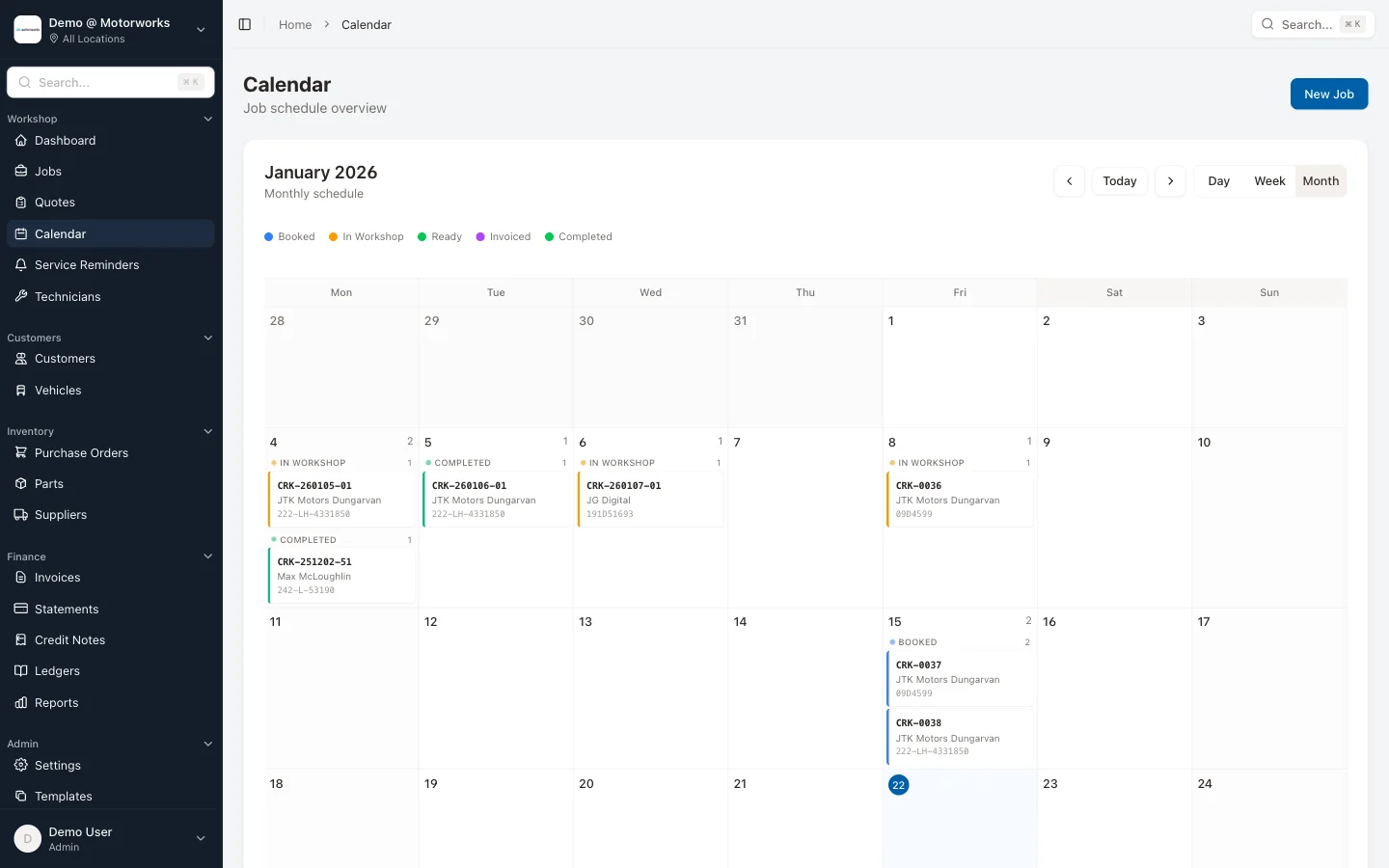
Get the total annual cost in writing before you commit. Not the “starting from” price on the website. (MotorWorks, for example, publishes transparent pricing with all features included and no per-user charges.)
Test it with your actual workflow
A demo where the salesperson clicks through perfect scenarios doesn’t tell you much. What you need is hands-on time with the system, using your real work.
During a trial period, try to:
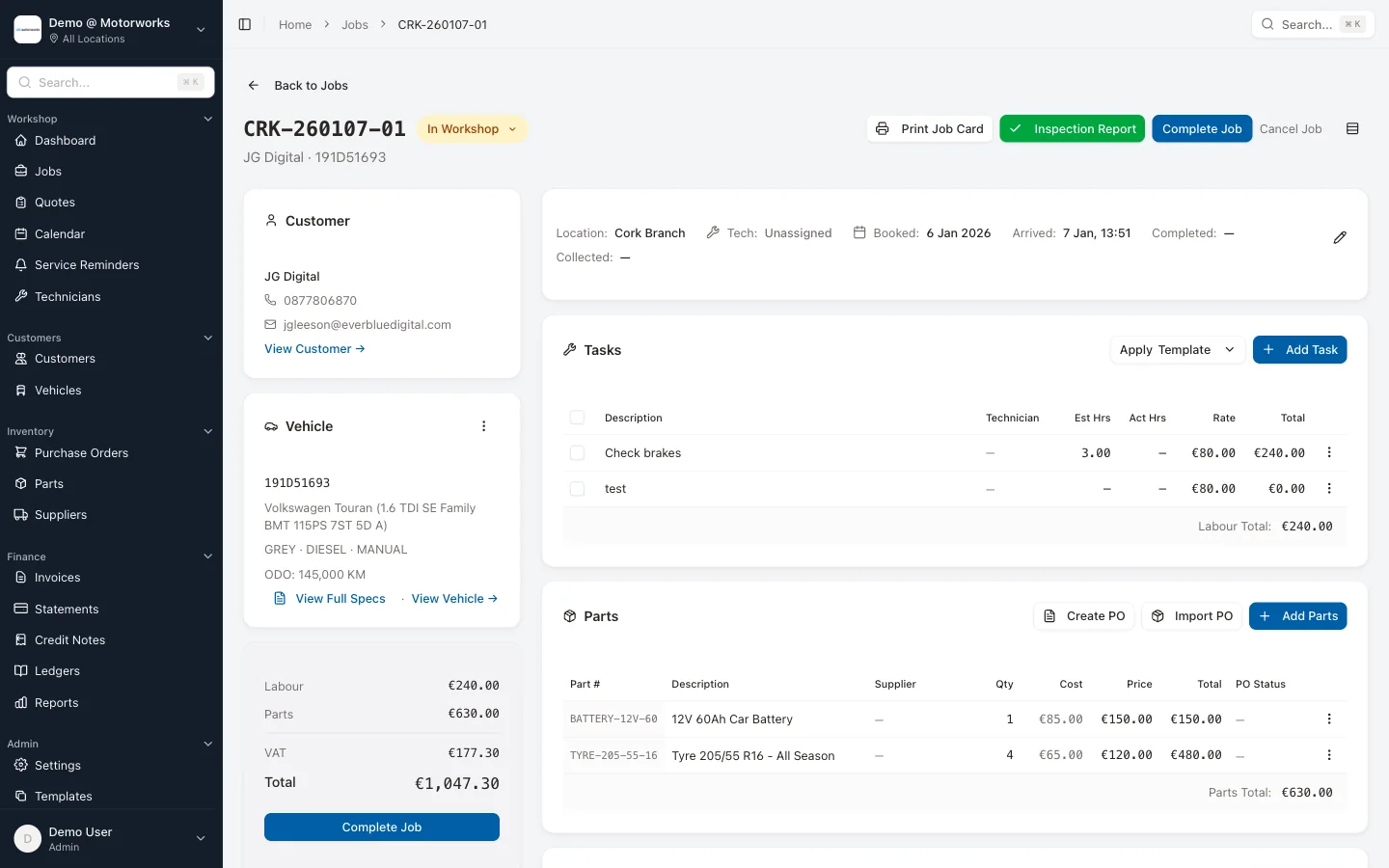
- Create a job card for an actual vehicle in your workshop
- Send a quote to a real customer (or yourself)
- Process that quote through to invoice — how many steps does it take?
- Look up a vehicle by registration
- Create a purchase order for parts and see if the cost flows through to the job
- Run a profitability report you’d actually use
- Use the system from a phone or tablet on the workshop floor
Pay attention to how many clicks things take. Notice when you get confused or have to hunt for a feature. Watch for moments where the software assumes you work differently than you actually do.
The best predictor of whether software will work for you is whether it feels natural during the trial. If you’re fighting it from day one, that’s not going to improve.
Ask about support
When something goes wrong at 4pm on a Friday and you’ve got cars to get out, who do you call?
Find out:
- What are the support hours? (Irish time, not American Pacific)
- Is support included in the price, or is it an add-on?
- Phone, email, or chat?
- What’s the typical response time?
- Will you talk to someone who understands garages, or a generic tech support person reading from a script?
Also ask about onboarding. Will someone help you get set up, import your existing data, and train your team? Or are you left to figure it out from YouTube videos?
Good support isn’t a luxury. It’s the difference between software that actually gets used and software that gets abandoned after two frustrating weeks.
Check what happens to your data
Your customer list, vehicle records, job history, and invoices are your business. Make sure you understand:
Can you export your data? If you ever want to leave, can you take your information with you? Some systems make this deliberately difficult.
Where is the data stored? Cloud-based systems store data on servers somewhere. For GDPR compliance and peace of mind, you probably want that to be in Ireland or at least the EU.
What happens if the company shuts down? It’s an uncomfortable question, but worth asking. Do you have regular backups? Can you access your data if the service stops?
Red flags to watch for
After years of hearing garage owners’ software horror stories, certain patterns keep appearing:
“We’re adding that feature soon.” If a crucial feature doesn’t exist yet, don’t buy based on promises. Software roadmaps change. Wait until the feature actually ships.
Pressure to sign quickly. “This discount expires Friday” or “We only have three onboarding slots left this month.” Good software sells itself. High-pressure tactics usually mean the product can’t.
No free trial. If a company won’t let you test the software before paying, ask yourself why. What are they worried you’ll discover?
Terrible reviews about support. The software itself might be great, but if every review mentions impossible-to-reach support or issues that never get fixed, believe them.
Last updated years ago. Check when new features were last added. Software that isn’t actively developed will eventually become a problem as technology and regulations change.
Make the switch manageable
Once you’ve chosen software, the transition matters as much as the selection.
Don’t try to migrate everything at once. Start with new jobs only. Let your team get comfortable with the basics before adding complexity.
Pick a quiet week if you can. Starting new software during your busiest period is asking for trouble.
Expect a productivity dip. For the first week or two, things will be slower as everyone learns. This is normal. It gets better.
Keep your old system running in parallel for a month. Don’t delete anything until you’re confident the new system is working.
The bottom line
The right garage management software should make your life easier, not harder. It should fit how you actually work, not force you to change everything. It should free up the hours you currently spend on invoicing, chasing payments, and doing month-end reconciliation. (If you’re still on the fence about whether you need software at all, these five signs might help you decide. And if you’re specifically looking at accounting and financial features, our guide to garage accounting software goes deeper on that.)
Take your time with this decision. Ask hard questions. Test thoroughly. Talk to other garage owners who use the systems you’re considering. For a closer look at what workshop management software should actually do on the floor, see our guide to what independents actually need.
And remember: the best software in the world is useless if your team won’t use it. Simplicity and ease of use matter more than having every feature imaginable.
If you’re evaluating options and want to see how MotorWorks approaches these challenges, we’re happy to show you around. Book a demo or start a free trial and test it with your real workflow. No pressure, no hard sell — just an honest look at whether it’s the right fit for your workshop.