You’re booked solid one week, quiet the next. You’ve thought about marketing your garage but most of the advice you find assumes you have a budget, a marketing team, and about forty free hours a week. You have none of those things. What you do have is a good workshop, skilled technicians, and customers who trust you.
That’s actually a lot to work with.
The best garage marketing ideas aren’t expensive. They’re consistent. This post covers ten practical, low-cost tactics that any independent Irish garage owner can start this week — no agency, no jargon, no nonsense.
1. Optimise your Google Business Profile
If you do nothing else on this list, do this. Your Google Business Profile is the single most valuable marketing asset an independent garage can have, and it costs nothing.
When someone in your area searches “garage near me” or “car service [your town],” Google decides which businesses to show based largely on how complete and active your profile is. A half-finished profile — missing hours, no photos, no description — gets buried. A well-maintained one gets clicks.
Here is what to do right now:
- Claim your profile at business.google.com if you have not already
- Fill in everything. Business category (Garage, Auto Repair), address, phone, website, opening hours
- Add photos. Outside of the building, inside the workshop, your team. Real photos outperform stock images. Aim for at least ten
- Write a proper description. Two or three sentences about what you do, who you serve, and where you are. Include the name of your town or area naturally
- Add your services. Brakes, tyres, NCT preparation, full service — list them individually. Google can show these directly in search results
- Keep your hours accurate. Nothing damages trust faster than a customer turning up when Google says you are open and you are not
Once your profile is complete, check it monthly. Make sure nothing has changed and add new photos every few weeks. Consistency matters more than perfection.
2. Make Google reviews part of your routine
Reviews are free advertising that runs forever. A garage with forty recent five-star reviews is almost impossible to compete with on Google, regardless of what a competitor spends on ads.
The problem most garages have is not that customers are unhappy — it is that happy customers need to be asked. A satisfied customer drives away and forgets to leave a review. An unhappy one remembers.
Fix this with a simple habit: ask at the point of collection.
When a customer picks up their car and everything went well, say: “If you are happy with the work, it would mean a lot if you left us a Google review — it only takes a minute.” Then hand them a card with the review link on it, or text it to them after they leave.
A short URL or QR code that goes directly to your Google review page makes this frictionless. You can generate a link for your specific profile by going to your Google Business Profile dashboard and selecting “Get more reviews.”
Set a goal. If you aim for two new reviews per week, you will have over one hundred in a year. That changes where you rank in local search results significantly.
What about negative reviews? Respond to all of them, calmly and professionally. A thoughtful response to a negative review often does more for your reputation than the negative review damages it. Anyone reading your reviews will see how you handled it. We’ve written a full guide on how to handle negative Google reviews with response templates you can use straight away.
3. Send service reminders to lapsed customers
This is the most underused garage marketing idea in Ireland. You already have a database of past customers. They have already trusted you with their car. You do not need to convince them of anything — you just need to remind them you exist.
Most vehicles need a service every twelve months. Most customers do not track this themselves. If you reach out before they think to book, you win the job. If you wait for them to remember on their own, you are gambling on timing — and another garage’s reminder might land first.
The maths are straightforward. If you have five hundred past customers and a third of them are overdue for a service, that is potentially over one hundred and sixty jobs available to you right now without spending a single euro on advertising.
A text message or email saying “Hi [Name], it has been about twelve months since your last service — would you like to get it booked in?” converts at a surprisingly high rate. These are warm customers. They already trust you. You are doing them a favour by reminding them.
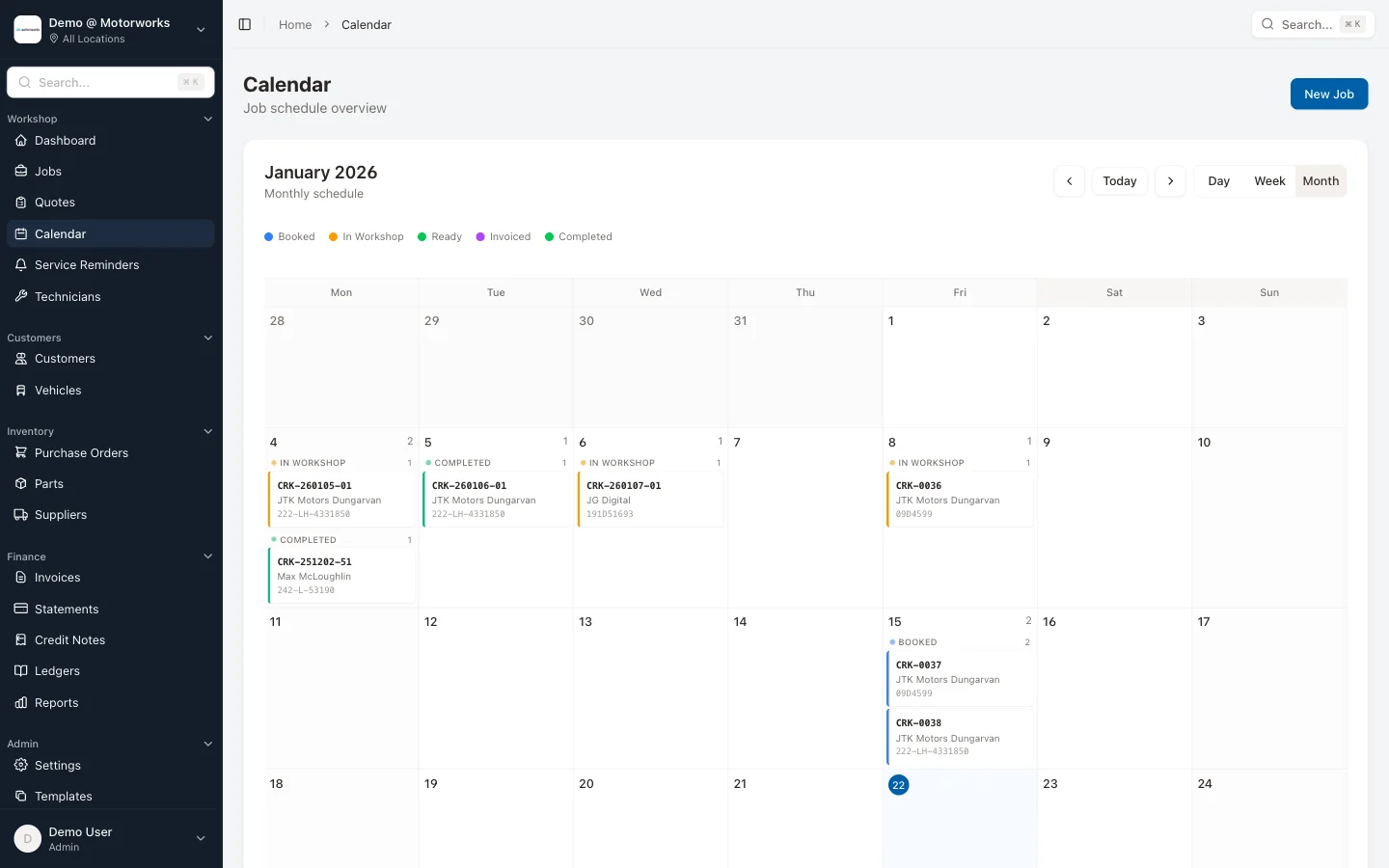
MotorWorks has a built-in service reminders tool that automatically identifies which customers are overdue based on their last visit. You can review the list and send reminders in bulk — it takes a few minutes, not hours. You can also prioritise: customers who are twelve months overdue get a different message than those at eighteen months.
If you want to understand the revenue impact of service reminders in more detail, our post on how automated service reminders drive revenue breaks it down with real numbers.
If you are not yet using software to track this, start a simple spreadsheet. Note the customer name, vehicle, and service date after every visit. Even a basic system beats no system.
4. Build local SEO with a proper website
Your Google Business Profile gets you into the map pack. Your website is what convinces people to actually call you.
You do not need a complicated or expensive website. You need one that does a few specific things well:
Rank in local search. Include your town name and county naturally throughout your content. Not crammed in, just natural: “We have been serving drivers in Mullingar and the surrounding area since 2004.” Google uses this to understand who you serve.
Answer the questions customers ask. What services do you offer? How much does a full service cost? Do you work on electric vehicles? What areas do you cover? A simple FAQ page on your site can rank for these searches and bring in customers who would never have found you otherwise.
Make it easy to contact you. Your phone number should be visible without scrolling on every page. A click-to-call button on mobile is essential. Every extra step between “I need a garage” and “I am calling this garage” costs you customers.
Show up for your services specifically. A page for each of your main services — “NCT preparation Athlone,” “car air conditioning service Cork” — can rank for specific searches and bring in customers looking for exactly what you offer.
If your website is more than five years old or looks bad on a phone, that is worth fixing. Most local business customers are searching on mobile.
5. Use social media to show the work, not sell
Most independent garages approach social media the wrong way. They post offers and promotions and get little engagement, then give up.
The content that actually builds an audience is the work itself.
People find cars interesting. A rusted brake calliper that needed replacing. A timing chain that was weeks from failure. The before-and-after of a full detail. Behind-the-scenes photos of the workshop on a busy Monday. A short video explaining why your NCT preparation check is worth doing before the test.
This kind of content does several things at once. It demonstrates expertise. It builds familiarity — people who follow you locally feel like they know you. And it gives customers something to share: “I use this garage, they do great work.”
You do not need to post daily. Two or three times a week on Facebook is enough for a local audience. Take a photo during the job, write a line or two about what it was and why it mattered, and post it. That is it.
A few ideas to get started:
- “This is what a service looks like at twelve months versus eighteen months” (filter photos work well)
- “Common NCT failure points we see this time of year”
- “Before and after — came in with a scraping noise, left with new pads and rotors”
- Introduce a team member with a short caption
- Share a genuine five-star review with a thank-you
Do not overthink the photography. A clear phone photo in good light is fine. Authenticity beats production value for local audiences.
6. Start a referral programme
Word of mouth is the oldest marketing tactic there is, and it still works better than almost anything else for independent garages. The challenge is that most garages rely on it happening passively, rather than actively encouraging it.
A simple referral programme can double the word-of-mouth you already generate.
The structure does not need to be complex. Something like: “Refer a friend and you both get ten euro off your next service.” Print it on a small card, put it on your counter, mention it when customers collect their car.
The offer does not have to be financial. Some garages offer a free tyre pressure check, a free car wash with next service, or priority booking for customers who refer. Figure out what your customers value and use that.
The key is to make the referral easy and the reward clear. Customers will not go out of their way to refer you unless the path is obvious and the incentive feels fair.
Track where new customers come from. Ask every new customer how they heard about you and record it in their customer record. If you know referrals are working, you can invest more in the programme. If nobody is claiming the reward, change the offer or make it easier to refer.
7. Make your signage work harder
Your building is advertising, whether you treat it that way or not. Drivers pass your garage every day. Some of them need a garage and have no idea you are there.
Signage is a one-time investment that pays indefinitely. A few things worth reviewing:
Is your name and what you do visible from the road? “ABC Garage — Car Servicing, NCT Prep, Tyres” is better than just “ABC Garage.” Tell people what you do before they have to stop and look.
Is your phone number legible from a moving car? This is more important than your web address. Large numbers, high contrast. If someone can read your number driving past at 60km/h, you might get a call.
Do you have an A-board or pavement sign? A simple A-board at the entrance with a current offer — “NCT pre-checks from €39 — call now” — costs very little and can bring in a steady trickle of walk-in enquiries.
What does your workshop look like from outside? Cleanliness and organisation visible through the door or windows create an impression. A tidy forecourt signals professionalism. It sounds minor, but it affects whether someone pulls in or drives past.
8. Sponsor something local
Community sponsorship is one of the most cost-effective garage marketing ideas available to an independent business, and it builds exactly the kind of goodwill that advertising cannot buy.
Sponsoring a local GAA club, Tidy Towns group, school fundraiser, or community event puts your name in front of people who live and work near you. More importantly, it positions you as part of the community — not just a business trying to extract money from it.
A kit sponsorship for a local under-12s team might cost a few hundred euro. In return, your name appears on jerseys worn at matches every weekend for a season. Parents see it. Coaches see it. Families see it. Many of those people drive cars and need garages.
This does not need to be an ongoing commitment. A one-off contribution to a local event can get your name in a programme, on a banner, or on social media to an audience that is exactly where your customers live.
The key is to sponsor things where your name will actually be seen, not just listed on a website nobody visits. Physical presence at local events — even just turning up with a branded gazebo at the parish summer festival — is worth more than most online ads for a local business.
9. Use email and SMS to stay top of mind
A customer who serviced with you last year and has not been back is not a lost customer. They are a dormant one. Staying in touch keeps you at the front of their mind when they next need a garage.
You do not need a big campaign. A short, well-timed message is enough.
Service reminders: As covered above, these are the highest-value messages you can send. Timed to when a customer is likely due, they convert well because they are genuinely useful.
Seasonal prompts: “Winter is coming — have you had your tyres and battery checked?” in October. “Planning a long drive this summer? A full service before you go gives you peace of mind” in May. These feel helpful, not pushy, and they often land at exactly the right moment.
Post-service follow-up: A message two days after a service to ask if everything is OK. Most customers will not reply, but those who do give you a chance to fix a problem before it becomes a negative review. And customers who get the message feel looked after.
NCT reminders: If you know when a vehicle’s NCT is due — and if you are using workshop management software, you should — you can send a reminder a few weeks before. Offer to do a pre-test inspection. Many customers will take you up on it, and it earns genuine loyalty.
The key with email and SMS is relevance and timing. A generic “happy Christmas” message from a garage does nothing. A message that arrives when it is actually useful feels like good service, not marketing.
MotorWorks handles service reminders and scheduling in one place, so you can set these up once and let the system manage the timing. Customers get reminded when they are actually due, not just when you happen to think of them.
10. Reduce friction at every touchpoint
The last garage marketing idea on this list is not about getting new customers — it is about keeping the ones you already have. Because the best marketing a garage can do is simply making it easy to do business with you.
Think about every point where a customer might hit friction:
Booking: Can customers book outside business hours? Most people think about their car in the evenings. If your only booking option is calling during the day, you are losing people who would have booked if they could do it that night. Online booking is available through MotorWorks scheduling — customers can book any time, and it goes straight into your calendar.
Waiting on information: A customer who drops their car off and then spends the day wondering what is happening will call you repeatedly. A brief update when the diagnosis is done — “We found the issue, here is what it will cost, we can have it ready by 4pm” — eliminates those calls and massively improves their experience.
Collecting the car: Is the invoice clear? Do they understand what was done and why? Can they pay by card easily? A confusing invoice or a queue to pay creates a bad last impression.
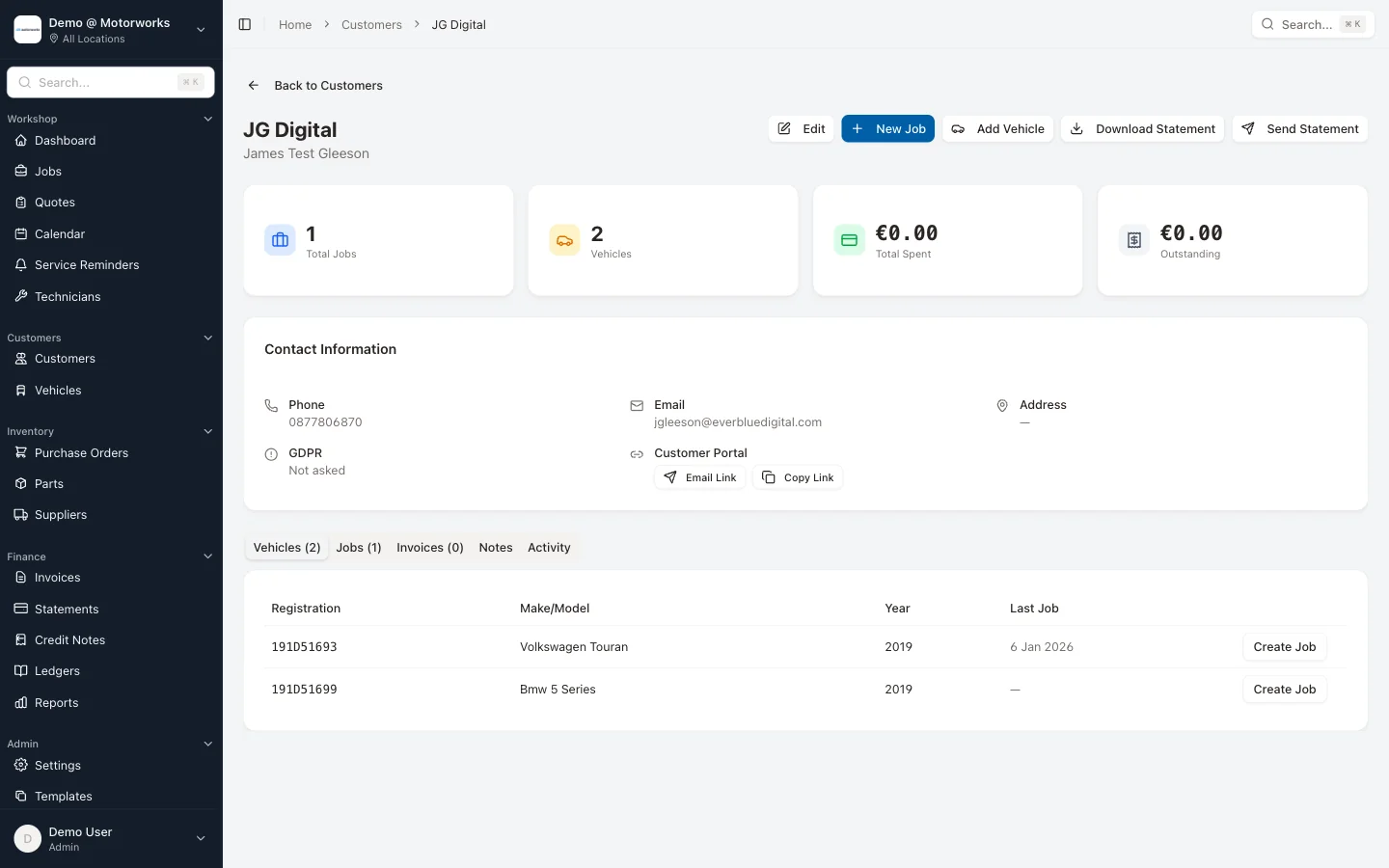
After the visit: Can customers see their service history when they need it? A customer portal that lets them view past invoices and upcoming appointments reduces support calls and makes customers feel looked after.
None of these things require a marketing budget. They require attention and, in some cases, the right tools. But a customer who finds you easy to deal with will come back. And they will tell others.
Reducing no-shows is also part of reducing friction — if you have not already read how to reduce no-shows with online booking, it covers this in more detail.
Putting it together
You do not need to do all ten of these at once. Start with two or three that feel most relevant to where your garage is right now.
If your Google presence is weak, start there. If you have a strong Google profile but no system for staying in touch with past customers, service reminders are your biggest opportunity. If everything is working but growth has stalled, a referral programme might be the lever you need.
The common thread across all of these garage marketing ideas is that they are things a garage owner can actually do. No agency fees. No complicated campaigns. Just consistent effort applied to the right things.
Most independent Irish garages that grow do not do so because they outspent their competitors. They do it because they built a reputation — through good work, good communication, and the small things that make customers feel valued.
That is all marketing really is, in the end.
Want to make some of this easier? MotorWorks gives independent Irish garages the tools to handle service reminders, online booking, customer communication, and scheduling in one place. There’s also a customer portal where your customers can book, view invoices, and check job status — which reduces friction at every touchpoint. Book a demo and see how it works in practice.