You’re having a decent Tuesday. Workshop’s busy, the lads are getting through the jobs, and you grab two minutes to check your phone over a cup of tea.
Then you see it. A one-star review on Google. Posted this morning. The reviewer’s name doesn’t ring a bell immediately. The complaint? Something about waiting too long for a part. One star. No attempt to contact you first. And now it’s sitting right at the top of your Google Business profile for every potential customer to see.
That sinking feeling is real, and every garage owner has experienced it. But here’s the thing: how you handle that review in the next 24 hours matters more than the review itself.
Why Google reviews matter more than you might think
Before we get into what to do, it’s worth understanding why garage Google reviews carry so much weight.
When someone in your area searches “garage near me” or “car service [your town]”, Google pulls up local results. The number of reviews you have, your average star rating, and how recently you’ve been reviewed all factor into how prominently you appear. Garages with more reviews and higher ratings consistently appear higher in local search results.
But ranking is only half of it. Once someone clicks through and looks at your profile, reviews are often the deciding factor. Research consistently shows that most people read reviews before choosing a local service business. For garages specifically, where people are handing over their car and their trust, reviews carry enormous weight.
A single unanswered one-star review doesn’t just represent one unhappy customer. It’s a visible signal to every person who looks at your profile. Left unaddressed, it suggests you either don’t care or don’t notice. Neither is the impression you want to give.
The good news: a well-handled negative review can actually work in your favour. Prospective customers don’t expect perfection — they expect professionalism. Seeing a garage owner respond thoughtfully and try to make things right often builds more trust than a page full of five-star reviews with no responses at all.
The rules before you respond
Before we get to templates, a few ground rules. Break these and you’ll make the situation significantly worse.
Never respond when you’re angry. The review might be unfair. It might be completely inaccurate. You might know exactly who this customer is and exactly why they’re wrong. It doesn’t matter. Write your response when you’re calm, not when you’re fuming. A defensive or aggressive response is permanently public and will do far more damage than the original review.
Don’t argue the facts in public. Even if you’re right. Even if their version of events is completely wrong. Your public response isn’t really for the unhappy customer — it’s for every future customer reading the exchange. Being measured and professional is always more convincing than being correct.
Never post fake reviews. This is obvious, but it’s worth saying. It’s against Google’s policies, it’s dishonest, and businesses do get caught. The reputational damage of being exposed for fake reviews is catastrophic compared to any negative review.
Respond to every review, positive or negative. It takes ten seconds to thank someone for a positive review and it signals to Google (and potential customers) that you’re active and engaged.
How to respond to negative reviews: a step-by-step approach
Step 1: Acknowledge and thank them
This feels counterintuitive, but start by thanking the reviewer for taking the time to leave feedback. It signals that you take customer experience seriously and immediately de-escalates the situation.
Step 2: Apologise for their experience — without admitting fault
There’s a difference between “I’m sorry we got this wrong” and “I’m sorry you had a frustrating experience.” The second version expresses empathy without necessarily agreeing with the complaint. Use this distinction carefully.
Step 3: Take it offline
Offer to resolve the issue directly. Provide a name and phone number or email. This shows you’re willing to address it properly, and moves the conversation away from a public forum where it can spiral.
Step 4: Keep it short
Your public response doesn’t need to tell the full story. It needs to show professionalism and a willingness to resolve things. A few sentences is enough. Don’t write an essay.
Response templates you can use today
Copy these, adapt them to your garage, and keep them somewhere accessible. The faster you respond, the better.
Template 1: General complaint (vague or unfair)
Hi [Name], thank you for taking the time to leave your feedback. We’re sorry to hear your experience wasn’t what you expected — that’s not the standard we hold ourselves to. If you’d like to talk through what happened, please give us a call at [phone number] and ask for [your name]. We’d genuinely like the chance to make it right.
Template 2: Waiting time complaint
Hi [Name], thank you for the feedback. We understand how frustrating delays can be, especially when you’re depending on your car. Parts availability can sometimes catch us out, and we’re sorry if communication wasn’t as clear as it should have been in this case. Please feel free to call us on [phone number] — we’d like to hear more about your experience and see what we can do.
Template 3: Price complaint
Hi [Name], thanks for sharing this. We always aim to be upfront about costs before any work begins, so we’re disappointed to hear pricing felt unclear in your case. We’d be happy to go through the invoice with you if there are any charges you’d like explained. Give us a ring on [phone number] or drop in and we’ll sort it out.
Template 4: Work quality complaint
Hi [Name], thank you for letting us know. We take any concerns about our workmanship seriously and want to investigate this properly. Please contact us on [phone number] and ask for [your name] — we’d like to look at this with you and make it right if something’s not as it should be.
Template 5: Factually incorrect review (suspected mistaken identity or wrong garage)
Hi [Name], thank you for the review. We want to make sure we address this properly, but we’re having difficulty matching your name to a booking in our records. It’s possible there may be some confusion with another garage. Could you call us on [phone number]? We’re happy to look into this straight away.
Template 6: Responding to a positive review (don’t skip this)
Thank you so much, [Name] — really appreciate you taking the time to leave a review. Great to hear the [service type] went smoothly. We’ll see you next time!
When you should NOT respond
There are situations where responding makes things worse, not better.
Trolls and fake reviews. If a review is clearly from a competitor or someone who has never been near your garage, don’t engage. Report it to Google using the flag option on your Business Profile. Responding can draw more attention to it.
Reviews that invite an argument. If the reviewer is clearly looking for a fight, your best response is a brief, professional message offering to take it offline. If they reply with more aggression, leave it. Don’t get pulled in.
Reviews with ongoing legal implications. If a customer is disputing an invoice or threatening further action, don’t discuss specifics publicly. Keep your response neutral and brief, and speak to your solicitor if needed.
How to get more positive reviews (the right way)
The best way to dilute a negative review is to get more positive ones. This isn’t cynical — it’s accurate. A garage with 80 reviews at 4.7 stars is far less vulnerable to a single bad review than one with 12 reviews at 4.2 stars.
The problem is that happy customers rarely leave reviews unprompted. Unhappy customers are far more motivated. So you have to make it easy and ask.
Ask in the moment. The best time to ask for a review is when the customer picks up their car and they’re pleased with the work. A simple “If you have a minute, we’d really appreciate a Google review — it helps us a lot” is all it takes. Most people are happy to do it.
Follow up by text or email. A short message after the visit with a direct link to your Google review page removes all friction. People are much more likely to leave a review if they don’t have to go looking for where to leave it.
Make it part of your process. Service reminder messages are an ideal way to stay in touch with customers after a visit. A follow-up message a few days later thanking them for the visit and including a review link is low-effort and genuinely effective.
Don’t just ask once. A customer who’s been coming to you for five years and has never left a review isn’t unwilling — they’ve just never been asked. It’s never too late.
What you should never do: offer discounts, cash, or any kind of incentive in exchange for reviews. This is against Google’s guidelines and looks exactly as manipulative as it is if anyone notices.
How your customer experience affects your reviews
This might sound obvious, but it’s worth saying clearly: the best review strategy is delivering a good experience. Everything else — the follow-up texts, the review links, the professional responses — is secondary.
The garages with consistently strong Google reviews tend to have a few things in common. Customers know what to expect before the work starts. They’re not surprised by the bill. Someone tells them their car is ready before they have to call and ask.
A lot of this comes down to communication. When customers can see their service history, check on the status of their car, and access their invoices without having to ring you, they feel informed and in control. That feeling shows up in reviews.
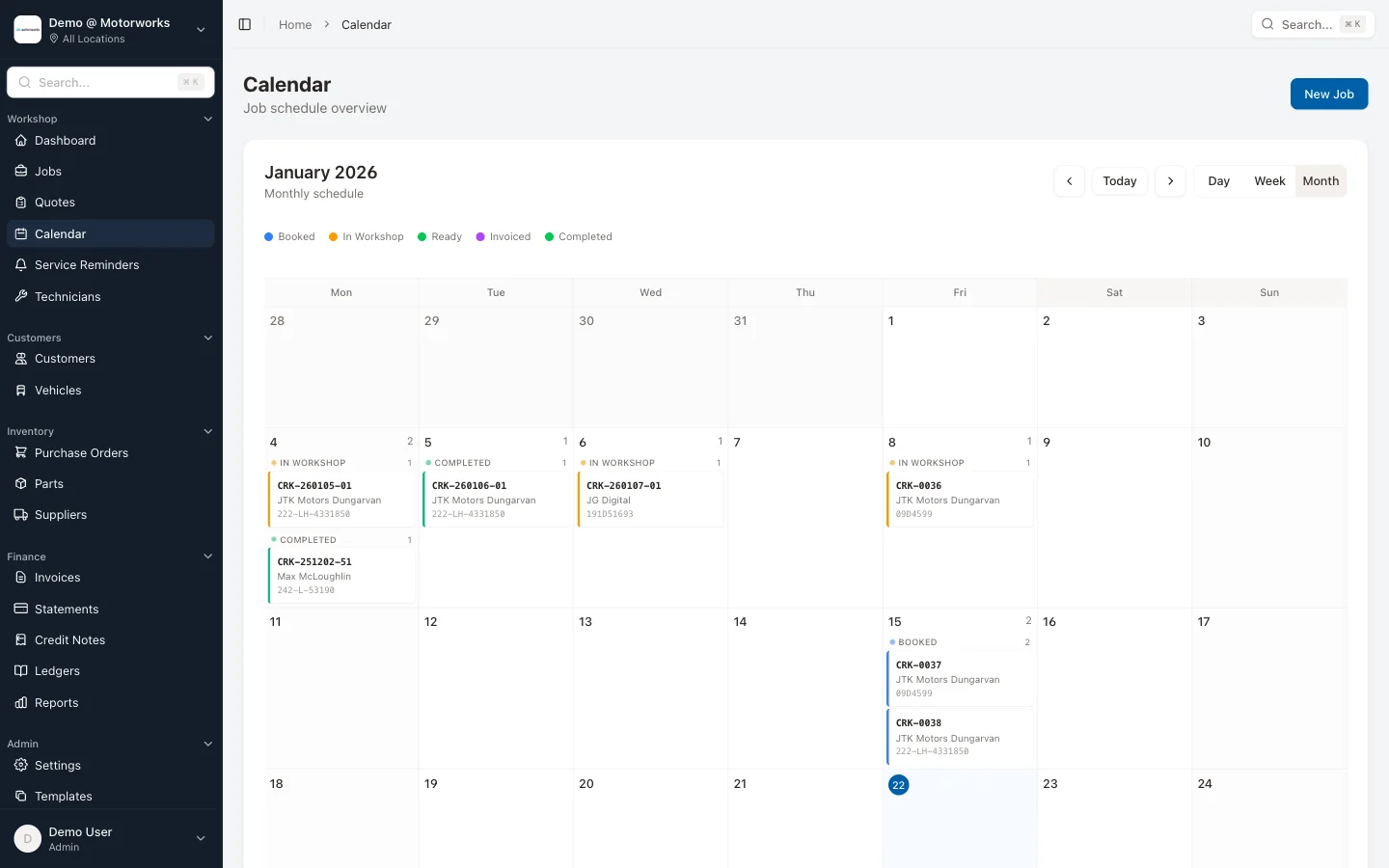
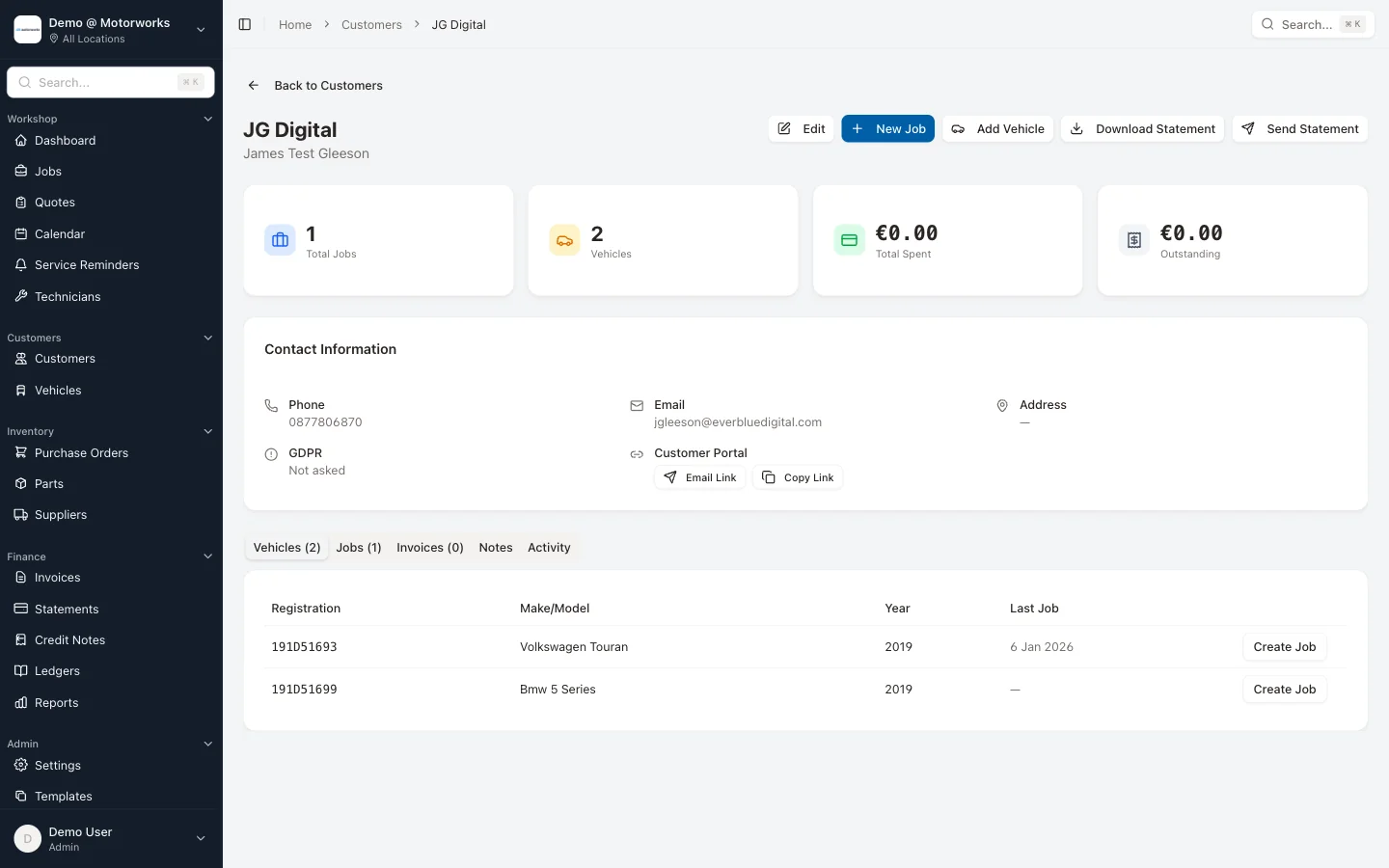
A customer portal isn’t just a convenience feature — it’s a reputation management tool. In MotorWorks, customers log in with a one-time passcode (no passwords to set up or forget), and can see their full service history, outstanding invoices, and job status. Customers who feel well looked after don’t write one-star reviews. And if they have a concern, they’re more likely to raise it with you directly rather than going straight to Google.
Similarly, the kind of customer who no-shows and then posts a one-star review complaining about a “rude receptionist” is often a customer who felt uninformed or ignored at some point. Keeping customers updated with automated reminders and clear communication before and after their appointment removes most of the friction that leads to complaints in the first place.
Clear communication also extends to invoicing. When a customer picks up their car and the invoice is itemised, professional, and easy to understand, they’re far less likely to feel surprised or overcharged — two of the most common triggers for negative reviews. Digital invoicing makes this straightforward.
If you’re still managing all of this manually, it might be worth reading how online booking and automated reminders reduce no-shows and customer frustration — many of the same principles apply to review management. Our post on customer retention and repeat business also covers how keeping customers informed drives long-term loyalty.
Making review management a habit, not a crisis response
The garages that manage their online reputation well don’t do anything complicated. They’ve just built a few habits:
- Check Google reviews at least once a week
- Respond within 24-48 hours, every time
- Ask happy customers for a review when the job is done
- Include a review link in follow-up messages
- Track their average rating over time
None of this is a big lift. But done consistently, it compounds. A garage that asks for reviews regularly and responds to all of them will, over 12 months, look dramatically better online than one that ignores the whole thing and only notices reviews when a bad one arrives.
The bottom line
A one-star review is not the end of the world. Most customers understand that every business gets them occasionally. What matters is what comes next.
Respond quickly. Be professional. Take the conversation offline. And put the same energy into earning positive reviews as you put into responding to negative ones.
Your garage Google reviews are a living part of your reputation — one you can actively shape, not just react to. The garages winning new customers through Google aren’t the ones with zero complaints. They’re the ones who handle complaints well and give happy customers an easy way to say so.
Looking for ways to give customers a better experience before they ever have a reason to complain? MotorWorks includes a customer portal with OTP login, automated service reminders, clear digital invoicing, and job management that keeps customers informed at every stage. Book a demo to see how it works for your garage.