Think about a customer who came in for a full service fourteen months ago. Good customer. Paid promptly. Said they’d be back. You haven’t heard from them since — not because they’ve gone elsewhere, but because nothing reminded them it was time to come back.
Meanwhile, their car is past its service interval. And another garage that sends reminders is about to beat you to the conversation.
That gap — between the customer who drifts and the customer who stays — is almost entirely a function of whether you stay in front of them at the right moment. And staying in front of them consistently, across your entire customer base, is something no garage can do manually at any meaningful scale.
Automated service reminders solve this problem without you having to do anything after the initial setup. This guide covers how they work, what to send, when to send it, and why the ROI is higher than almost anything else you could invest time in.
What automated service reminders actually are
A car service reminder, in the manual world, is a sticky note on the job card saying “call this customer in six months.” In practice, that note gets lost, the call never happens, and the customer moves on.
In an automated system, it works differently. When you close a job, the software records what was done and when. Based on that record, it schedules future outreach automatically — a reminder to the customer when their next service is due, or when follow-up work that was flagged but deferred becomes relevant again.
You do not manually trigger any of this. You set the rules once — “remind customers about their annual service 10 months after their last one” — and the system runs it from there. Every customer, every time, without fail.
The output is a steady flow of inbound bookings from customers who were reminded at the right moment, by a message that came from your garage, and who are primed to say yes because the timing is right.
Why most garages lose customers between visits
Customer retention in the motor trade is worse than most garage owners realise, and the reason is almost always the same: the gap between jobs is too quiet.
A customer finishes a service and leaves satisfied. There is no particular reason for them to think about their car again for months. When their service is eventually due, they might remember you — or they might search online, ask a friend, or use whoever is most convenient that week. If you have not been in contact in the intervening twelve months, there is nothing tying them to you specifically.
This is not disloyalty. It is how people work. We return to the places that stay in front of us. The dentist who sends a six-month checkup reminder. The accountant who emails before the tax deadline. The garage that knows when your service is due and tells you before you had to think about it.
That last one — the garage that reaches out proactively — wins the repeat business almost every time, because the customer does not have to make a decision. They were going to have to sort the service anyway. You just made it easy.
The garages that do this consistently are not necessarily the closest or the cheapest. They are the ones that feel like they are paying attention. And in a business built on trust, that feeling is worth more than any advertising campaign. If you want to go deeper on this, our post on customer retention strategies for garages covers the broader picture.
The four types of reminders worth setting up
Not all reminder types work the same way or carry the same revenue value. These four are the ones that deliver a reliable return for most garages.
Annual service reminders
The most fundamental reminder in any workshop. A customer who had a full service last September should hear from you in July or August — before the anniversary — giving them time to book in before they go over their interval.
The message is simple: their car is coming up on its next service, you have capacity, would they like to get it in? No hard sell. Just a timely prompt from a garage they already trust.
The conversion rate on this type of reminder is consistently high because you are reaching a customer who already knows they need the work done. You are not creating demand — you are capturing it before it goes to someone else.
NCT reminders
If you have an NCT expiry date on file for a customer’s vehicle, a reminder six weeks before that date is a natural touchpoint. Offering a pre-NCT inspection puts you in the conversation at a moment when the customer is already thinking about their car.
NCT reminders often cascade into additional work. The inspection finds worn pads, a failed light, a tyre at the limit. That work gets done before the test. You have handled the prep, the remedial work, and potentially the next service — all because you reached out at the right time.
For more on how to build pre-NCT work into a consistent revenue stream, see our guide on building a profitable pre-NCT service.
Follow-up work reminders
Almost every job turns up advisory items — work that needs doing but that the customer has asked to defer. Borderline pads. A tyre that will need replacing before winter. A bush that is wearing but not yet critical. You log it on the job card, mention it to the customer, and they say they will sort it next time.
Without a reminder, “next time” is indefinite. With a follow-up reminder, you contact the customer two or three months later: “When we had your car in last time, we flagged the front pads as getting close. They’ll need doing before too long — want to get it booked in?”
This converts advisory work into booked jobs without any ongoing effort on your part. The reminder goes out automatically based on what was recorded on the job card. The customer gets a useful message that is clearly about their specific car. And the conversion rate is strong because the work was already identified as needed. This is one reason why thorough job records matter — the better your notes, the more specific and useful the follow-up.
Post-service follow-up
A short message sent two or three days after a service — asking if everything is driving well and if there is anything the customer would like to discuss — serves a different purpose from the revenue-driving reminders above.
It signals that you care about the outcome, not just the transaction. It catches any concerns early, before they become a complaint. And it gives the customer an easy way to get back in touch if something feels off, which is far better than having them mention it to someone else first.
Customers who receive a follow-up message report higher satisfaction and are significantly more likely to leave a positive review when prompted. It costs almost nothing to send and builds the goodwill that keeps customers coming back year after year.
SMS vs email: which one actually gets read
Both have a place in a well-run reminder system, but they are not interchangeable.
SMS gets read. The open rate for text messages is above 95%, and most are read within minutes of arriving. For time-sensitive reminders — an NCT coming up in six weeks, an appointment the day before — SMS is the right channel. Short, direct, personal. It lands in the same inbox as messages from their family and friends, which means it does not get filtered, filed, or forgotten.
The limitation of SMS is length and formatting. You cannot include a lot of detail. The message needs to make its point quickly and include a clear next step — a link to your customer portal where they can book directly, a phone number, or a reply instruction.
Email gives you more room. You can include the vehicle details, the specific work being flagged, the service history, and a booking link. For annual service reminders where you want to give the customer full context, email is appropriate. It also creates a written record the customer can come back to.
The best approach is both, used at different points. Email when the reminder is further out — a month or more — so the customer has the information but is not expected to act immediately. SMS closer to the date, as a more direct prompt to book.
What you want to avoid is relying on email alone. Open rates for business emails are typically 20-30%. That means seven out of every ten reminders you send by email alone are never read. For a message that represents a booking and the revenue that comes with it, that is a significant miss rate.
For appointment-specific reminders — the day-before reminder that cuts no-shows — SMS is non-negotiable. If you want to understand how this fits into the broader booking picture, our guide on reducing no-shows with online booking covers the mechanics in detail.
Timing: when to send each type of reminder
Timing matters as much as the channel. A well-crafted reminder sent at the wrong moment either goes unread or creates the wrong impression.
Annual service reminders: Send 4-6 weeks before the service is due. This gives the customer time to plan around it without being so early that they file it away and forget. A single follow-up two weeks later if there has been no response.
NCT reminders: If you have the date on file, send at six weeks before expiry. Close enough that it feels relevant, far enough that there is time for an inspection and any remedial work. A follow-up at three weeks if there has been no response.
Follow-up work reminders: Send 6-8 weeks after the job, depending on the urgency of the flagged item. Tyres and brakes sooner. More minor items later. If you have good records on what was logged, this timing can be refined per job type.
Post-service follow-up: Two to three days after collection. Soon enough that the service is still fresh. Not so soon that it feels automated and impersonal.
For appointment reminders (day-before, week-before), those are a slightly different category and covered in more detail in the no-shows guide linked above. The principle is the same: right message, right channel, right timing.
What to say in each message
The biggest mistake garages make with reminder messages is writing them like marketing copy. Offers, promotions, bold claims. Customers switch off.
The messages that work are the ones that feel like they came from a person who knows the customer’s car. Direct, specific, useful.
A service reminder that works:
“Hi [Name], just a note that [make and model] is coming up on its annual service. Give us a call or book online at the link below — we’re booking a few weeks ahead so worth getting it in early. [Your garage name]”
An NCT reminder that works:
“Hi [Name], your [make and model] has its NCT due [month]. We can do a pre-NCT check to make sure everything’s sorted beforehand. Let us know if you’d like to book it in. [Your garage name]”
A follow-up reminder that works:
“Hi [Name], when we had your [make and model] in last time, we mentioned the front pads were getting close. Just a reminder that these will need doing soon — happy to book it in whenever suits. [Your garage name]”
Notice what these messages have in common. They name the specific car. They explain exactly why the customer is hearing from you. They make the next step clear. And they do not pressure, upsell, or push a promotion.
Customers who receive messages like this respond positively because the message is actually useful. It tells them something they needed to know, about their car specifically, at a time when they were going to have to deal with it anyway. That is the opposite of spam.
The revenue maths behind consistent reminders
It is worth being concrete about what a well-run reminder system is worth.
Take a garage with 300 active customers. Without reminders, a reasonable estimate is that 50-60% of those customers return in any given year — some through habit, some because they had a problem, some by coincidence. The other 40-50% drift between services.
With automated service reminders, the return rate moves to 70-80% or higher, because customers who would have forgotten or delayed are reached at the right moment. That shift — from 55% to 75%, say — represents 60 additional customers returning in a year who otherwise might not have.
At an average transaction value of €250 across services and any additional work, 60 extra visits is €15,000 in recovered revenue. That is before accounting for the NCT work, the follow-up jobs, and the compounding effect of those customers staying on the books the following year.
The cost of sending those reminders — in time and software — is close to zero once the system is set up. The ROI is not complicated.
More importantly, this is recurring. The system runs the same way next year and the year after. It does not require you to run a campaign, come up with a promotion, or chase anyone. It just runs.
Setting it up: what you actually need to do
The setup for an automated reminder system is a one-time task. Once configured, it runs without ongoing input.
Step 1: Make sure your customer records are complete. Reminders only work if you have a valid mobile number and email address for each customer. If your records have gaps — landlines instead of mobiles, missing emails — spend time cleaning them up. It is worth the effort.
Step 2: Make sure job records include the right information. For service reminders, the system needs to know when the last service was done and what type. For follow-up work, any flagged items need to be recorded on the job card, not just mentioned verbally. If you are using VRM lookup to pull in vehicle data, test dates may already be on file.
Step 3: Configure your reminder templates. Write the messages once. Include the customer name and vehicle details as merge fields so each message feels personal. Keep them short and specific. Avoid anything that sounds like marketing copy.
Step 4: Set your timing rules. Decide when each type of reminder goes out — 6 weeks before NCT, 10 months after last service, 6 weeks after follow-up work was flagged. These rules apply automatically to every customer from that point forward.
Step 5: Check the outputs periodically. Once a month, review how many reminders went out, how many resulted in bookings, and whether any are bouncing or going to wrong numbers. Adjust timing or wording if the conversion rate is lower than expected.
That is genuinely it. The ongoing overhead is minimal. The system does the work.
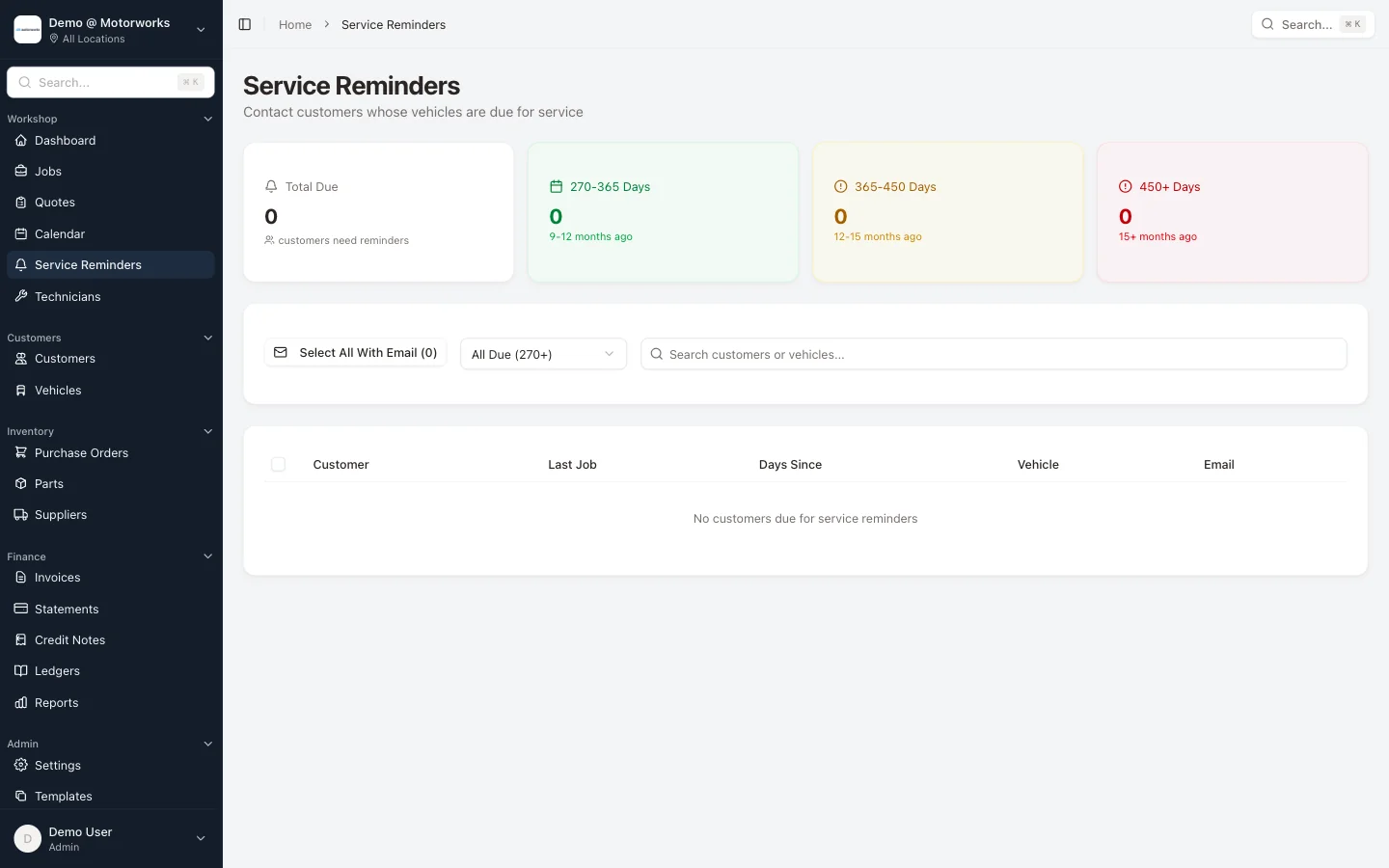
MotorWorks service reminders handle all of this automatically — reminders are triggered by your job history, and customers can book directly through the customer portal using just their phone number (OTP login, no passwords to remember). Their full vehicle history and upcoming appointments are all visible in one place.
The difference between a busy week and a full year
There are garages that have a great week when the weather turns, or when a particular customer sends their fleet in, or when a big job happens to land. And then there are garages that have a full diary, consistently, across the whole year — because they have a system that keeps customers returning on schedule.
The second type of garage is not doing anything extraordinary. They are doing one simple thing that most garages do not: they are reaching out to customers before those customers have to think about it themselves.
A car service reminder sent at the right moment, through the right channel, with a message that is clearly about the customer’s specific car, is not an interruption. It is a service. The customer was going to need the work done. You just made sure they came to you.
Set it up once. Let it run. Watch the diary fill.
Want to see how automated reminders work in practice? MotorWorks includes service reminders, a customer portal with self-service booking and OTP login, full vehicle history, and scheduling — all in one platform built for Irish garages. Book a demo to see the setup and what it could mean for your workshop.