Think about the last ten customers you had in this week. You did good work. They paid, said thanks, and drove away happy.
How many of them will be back in twelve months?
If you are honest with yourself, you probably do not know. And that uncertainty is costing you more than you realise. Customer retention in the automotive aftermarket is not just a nice idea — it is the most direct lever you have on the profitability of your garage. The maths are stark, and most garage owners have never sat down to run them.
This guide does exactly that. We will look at what a loyal customer is actually worth, why garages lose good customers without ever knowing it, and what practical steps you can put in place to stop the drift.
The maths your garage is probably not running
Let’s start with some numbers.
The average car owner in Ireland spends somewhere between €400 and €700 per year on servicing and maintenance. That includes oil and filter changes, NCT preparation, tyres, brakes, and the odd unexpected repair. Call it €500 as a conservative midpoint.
If a customer stays with your garage for ten years, that is €5,000 in revenue from a single vehicle. Multiply that across household — two adults, two cars — and a single loyal household is worth €10,000 over a decade. Add in referrals. A satisfied long-term customer who recommends your garage to two neighbours over ten years has effectively tripled their own lifetime value for you.
Now look at what it costs to replace that customer.
Research consistently shows that acquiring a new customer costs five to seven times more than retaining an existing one. In the garage context, that cost is real even if you are not spending money on advertising. It is the time spent on the initial phone call with someone who does not know you. The risk of them trying you once and not returning. The effort of building trust from scratch. The missed revenue during the months between a lost customer and a replacement.
When you think about customer retention this way — not as a customer service virtue but as a financial priority — it changes how you approach the day-to-day.
Why garages lose customers without doing anything wrong
Here is the uncomfortable truth about customer churn in the automotive aftermarket: most of the time, you do not lose customers because you did bad work. You lose them to drift.
Drift happens when a customer’s life changes in a small way and they end up at a different garage — and then that becomes their garage by default. Their usual service reminder does not come. They move house and the new place is closer to a competitor. Their partner takes the car in one time and the other garage asks if they want to book for next year. Suddenly, they are someone else’s loyal customer.
Drift is invisible. The customer does not call to complain. They do not leave a review. They just stop coming back, and if you do not have a system for noticing, you will not spot it until they have been gone for two or three years.
The garages that retain customers at a high rate are not always the best garages in their area. They are often just the most consistent. They stay in touch. They reach out before the customer has had a chance to drift. They make it easy to keep coming back.
Service reminders: the single highest-value retention tool
If your garage does one thing differently after reading this, make it this: stop waiting for customers to remember you.
Most car owners are not thinking about their next service until they need it. They are busy. The car feels fine. The NCT is months away. And then something nudges them — an article, a friend mentioning their garage, a passing sign — and they think: I should get that sorted. Which garage? Often, whoever comes to mind first.
A timely service reminder puts you at the front of their mind at exactly that moment. Better still, it creates the moment — rather than waiting for them to arrive at it themselves.
The numbers on reminder campaigns are consistently strong. In the automotive aftermarket, a well-timed reminder to an overdue customer converts at rates that make almost every other marketing activity look expensive by comparison. These are warm customers who already trust you. You are not selling them anything — you are offering a service they already know they need.
A good reminder does a few specific things:
- It arrives at the right time (twelve months after their last visit, or a few weeks before their NCT)
- It references their specific vehicle and situation, not a generic message
- It makes booking easy — ideally a direct link or a reply to confirm
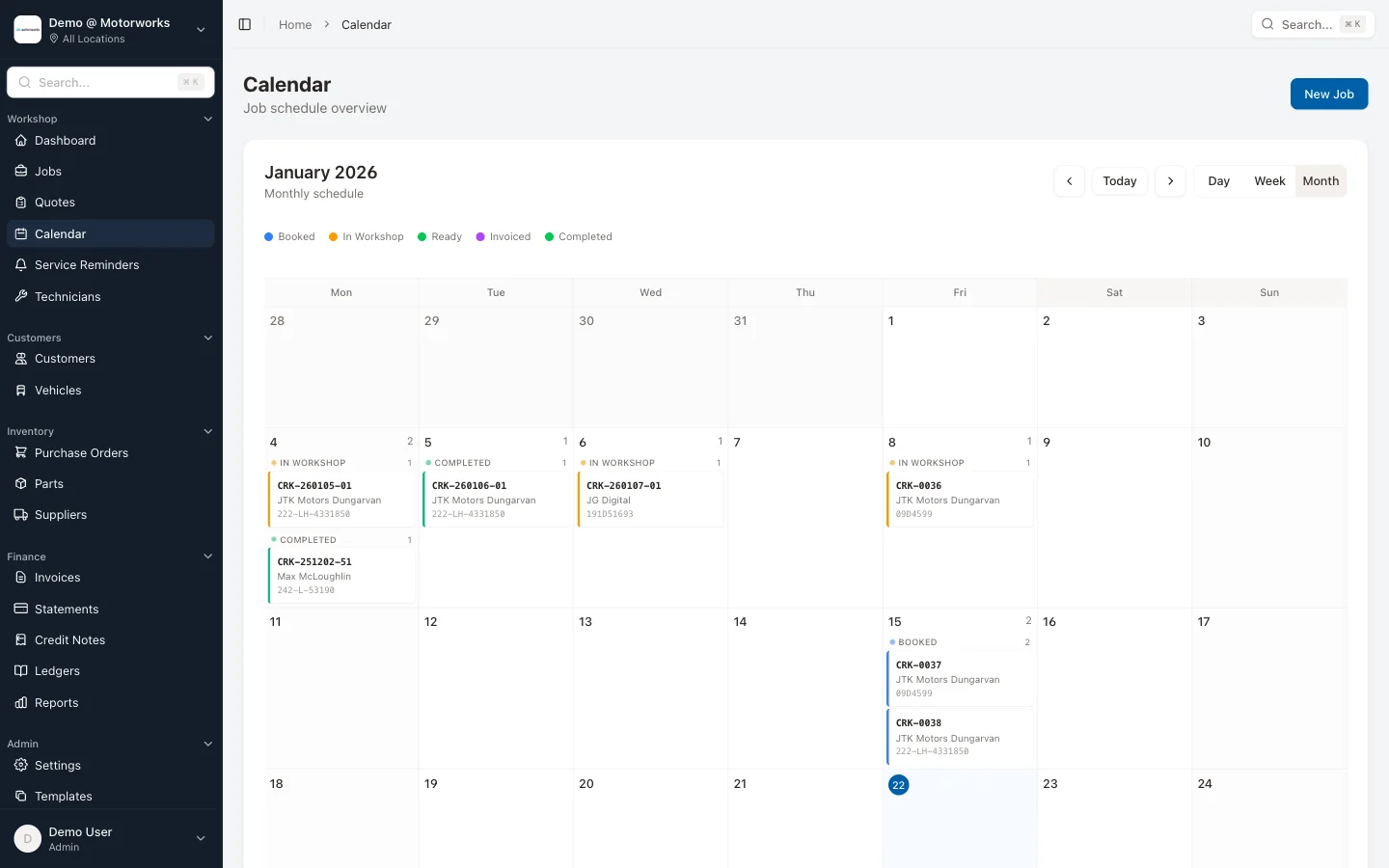
MotorWorks includes a built-in service reminders tool that identifies overdue customers automatically and lets you send targeted messages in bulk. You can sort by last visit date, by vehicle type, or by service history — so the message feels relevant rather than mass-market. For a garage with several hundred past customers, this is the fastest way to recover revenue that is sitting dormant in your existing database.
Using vehicle data to anticipate what customers need
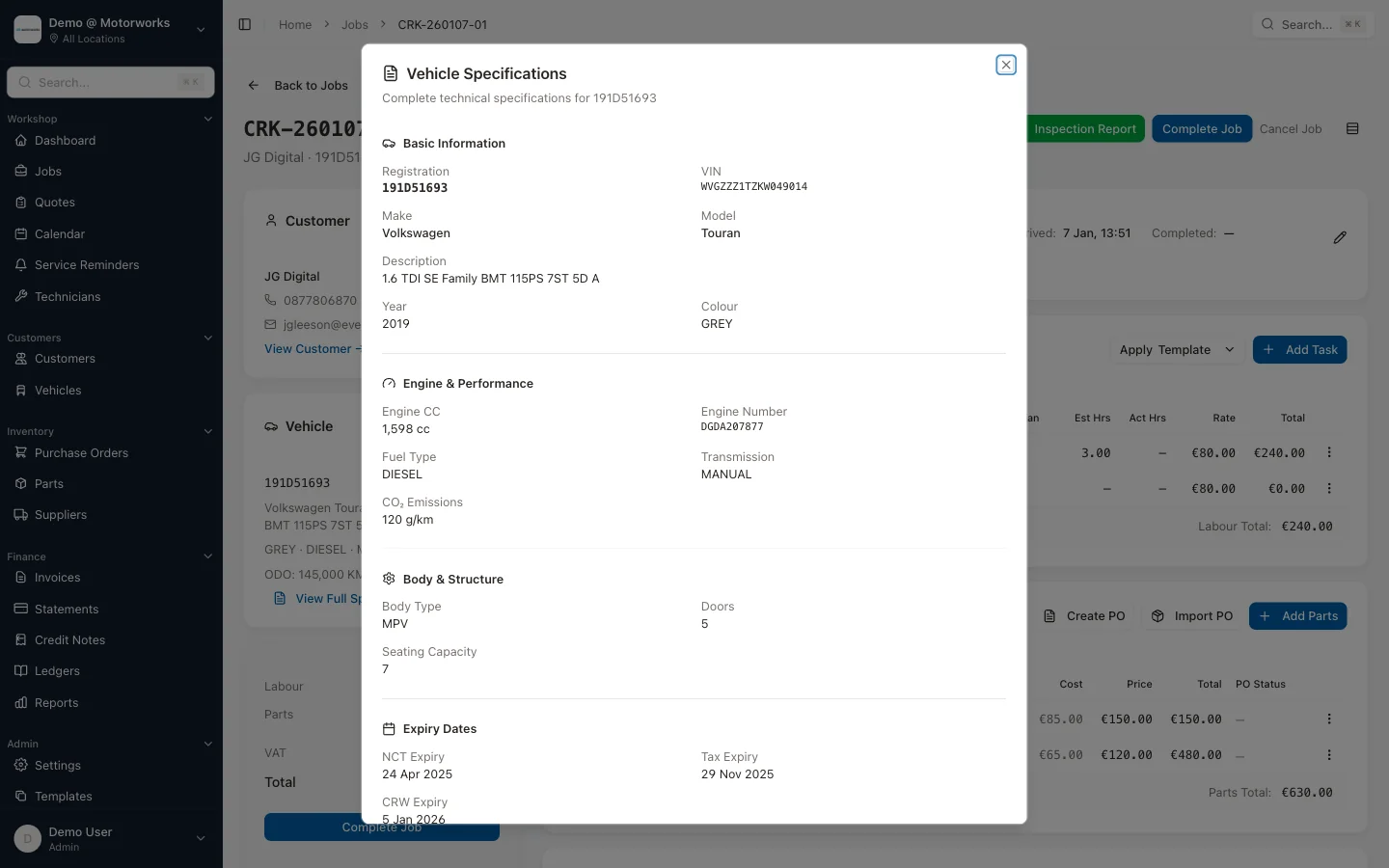
The more you know about a customer’s vehicle, the more proactively you can reach out. When your system holds vehicle details — mileage history, service intervals, and dates like the NCT due date pulled from VRM lookup — you can contact customers before they even realise they need you.
A common example: NCT dates. Every car over four years old in Ireland requires an annual NCT. If you know a customer’s test is due in six weeks, you can reach out and offer a pre-NCT inspection while you still have availability. The customer gets a useful heads-up. You fill a booking that was always going to need doing somewhere. That kind of proactive outreach builds loyalty in a way that good work alone cannot — because the customer remembers that you looked after them before they even asked.
The same principle applies to mileage-based service intervals, tyre age, or any scheduled maintenance item you recorded during the last visit. The more data your system captures per vehicle, the more opportunities you have to reach out with something genuinely useful rather than a generic marketing message.
If you want a deeper look at how to turn NCT preparation specifically into a reliable revenue stream, the post on building a profitable pre-NCT service covers the full approach.
The follow-up call: simple, underused, effective
Most garages do not follow up after a service. The car goes out, the invoice is paid, and that is the end of the interaction until the customer calls again — if they do.
A follow-up call, or even a text, two days after a service does several things at once.
First, it catches any issues early. A customer who has a question or a minor concern after a service is likely to sit on it rather than call you. Left unresolved, that niggly feeling erodes their confidence in you. A simple “is everything running well after your service?” gives them an opening to raise it — and gives you the chance to fix it before it becomes a negative review.
Second, it signals that you care about the outcome, not just the transaction. This sounds soft, but it has a measurable effect on retention. A customer who hears from you unprompted feels valued. That feeling translates into loyalty.
Third, it creates a natural point to mention anything relevant. “We noticed your tyres are getting close to the legal limit — worth keeping an eye on over the next few months.” That is not pushy. It is useful. Customers remember garages that give them genuinely helpful information.
You do not need to call every customer for every job. Focus on new customers (where you are still building the relationship), anyone whose job involved a significant repair, and anyone who seemed uncertain or had questions during the visit. The investment in time is small. The effect on retention is not.
Customer portals: giving customers a reason to stay connected
One of the quieter shifts happening in the automotive aftermarket is that customers are increasingly expecting to access their own records digitally. They want to see what was done on their car last year. They want to know when their next service is due. They want to check the invoice without having to call the garage.
If they cannot get this from you, they might get it from someone else — and that means their attention, and their data, sits with a competitor.
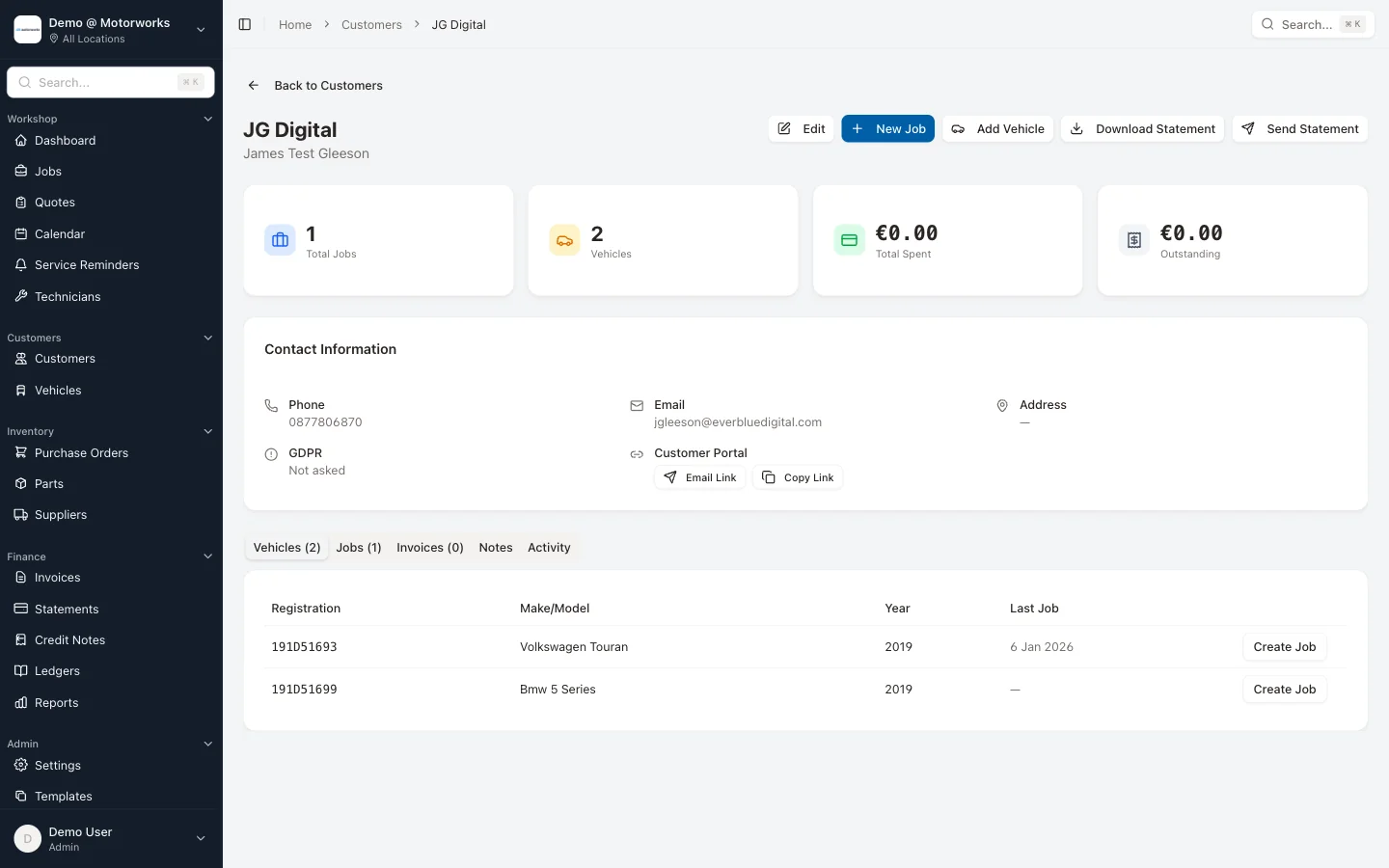
The MotorWorks customer portal gives your customers a place to view their full vehicle history, upcoming service dates, approve quotes, check invoice status, and book their next service — all from their phone or laptop. Customers log in with a one-time passcode sent to their phone (no passwords to remember or reset), which keeps the barrier to entry as low as possible.
For the customer, it is convenient. For you, it is a touchpoint that keeps your garage front of mind between visits — and it removes friction from the booking and approval process. A customer who can approve a quote from their phone while on a tea break is more likely to authorise work promptly than one who needs to answer a phone call.
There is also a practical benefit when it comes to trust. A customer who can see exactly what was done on their car, with dates and mileage records, is a customer who does not have to take your word for it. That transparency builds confidence — and confident customers refer others. For more on what car owners actually want from a portal, see the post on what car owners want from a customer portal.
Building relationships that prevent drift
The strategies above — reminders, vehicle data, follow-up calls, portals — are all tools. But the underlying principle is the same: staying consistently present in your customers’ lives between visits.
Drift happens in the silence. When a garage goes quiet after a service and the customer hears nothing for twelve months, the relationship has no warmth to it. It was transactional. And transactional customers are far more easily lost to a competitor than customers who feel known.
The garages with the strongest retention rates tend to share a few habits:
They personalise where possible. A reminder that references the customer’s name and their specific vehicle feels different from a generic SMS blast. It takes almost no extra effort with the right system, but customers notice.
They give value between visits. A quick note in October about winter tyre pressures. A heads-up about common NCT failure points heading into spring. This is content that costs you nothing but keeps your name associated with being helpful rather than just billing.
They remember the small things. If a customer mentioned last visit that they were worried about a noise in the rear suspension, and you sorted it, following up three months later to check it is still fine shows a level of care that is genuinely rare. Most customers will remember it for years.
They treat complaints as opportunities. A customer who complains and gets a good response is often more loyal than one who never had a problem. The complaint is a chance to demonstrate that you stand behind your work. Handle it well and you likely keep them for life. Handle it badly and you lose them forever — and they will tell people.
What good retention actually looks like in numbers
To bring this back to the financial reality: retention is not just good customer service. It is a direct driver of garage profitability.
Consider two garages, both with the same number of customers and the same average job value. Garage A retains 60% of customers year on year. Garage B retains 80%. Over five years, Garage B will have significantly more returning revenue and will need to spend far less on acquisition to maintain the same turnover.
The difference between 60% and 80% retention might seem small. In practice, it compounds. Retained customers bring in referrals. They are more likely to try new services. They are less price-sensitive because they already trust you. They are cheaper to serve because there is no onboarding friction. Every percentage point of improvement in retention has a multiplier effect on profitability.
Most garage owners focus on getting new customers. That is important. But the fastest path to a more profitable garage is almost always to stop losing the ones you already have.
If you have not already looked at your marketing spend in the context of retention, the guide on garage marketing tactics covers how to think about customer acquisition and retention together — and where your budget is likely to go furthest.
Where to start
If customer retention has not been a deliberate focus in your garage, start with the lowest-effort, highest-return activity available to you: contact your lapsed customers.
Pull a list of everyone who visited you twelve to twenty-four months ago and has not been back. Send them a straightforward message — their name, their car, a reminder that you serviced them, and an invitation to book in. Do not make it a promotion. Make it personal.
A portion of those customers will respond. Some have moved away. Some found a garage closer to home. But some simply drifted — and a reminder from a garage they already trusted is all they need to come back.
That is the simplest possible version of a retention strategy. From there, you can build: automated reminders, post-service follow-ups, a customer portal for self-service booking and vehicle history. Each layer adds more contact points, more relationship, and more reasons for customers to stay.
The work is not dramatic. It is consistent. And in the automotive aftermarket, consistent attention to existing customers is the most reliable way to build a garage that grows without depending on a constant stream of new business to survive.
Want to put this into practice? MotorWorks gives Irish garage owners the tools to automate service reminders, give customers a self-service portal with OTP login, and keep full vehicle histories that power proactive outreach — alongside job management, invoicing, purchase orders, and reporting in one system. Book a demo and see how it works for a workshop your size.