Think about the last time a customer called you looking for a pre-NCT check with their test booked for the following week. Tight schedule, scrambled booking, maybe not enough time to fix everything you found. Now think about how different that conversation would have been if you had called them six weeks earlier.
That gap — between you reacting to a panicked customer and you reaching out before they even thought to worry — is where garages either hold on to their customers or quietly lose them. And it all comes down to one thing: whether or not you know when their NCT is due.
This guide covers how to track NCT due dates across your customer base, what methods actually hold up in practice, and how proactive outreach turns NCT preparation into one of the most reliable revenue streams in your workshop.
Why NCT dates are the most valuable data in your customer records
Every car over four years old in Ireland needs an annual NCT. That test date is fixed, predictable, and tied directly to an opportunity for work. Not speculative work — real, specific work that the customer already knows is coming and is primed to spend money on.
Unlike a general service, which customers often defer, the NCT has a hard deadline. The disc expires. The car cannot legally be driven without a current cert. That urgency is your ally, but only if you’re in the conversation before the panic sets in.
When you know a customer’s NCT date, you know when they are going to need their car looked at. You know what window to contact them in. You know what to say. Every other form of customer outreach requires you to manufacture urgency. NCT dates come with urgency built in.
The garages that understand this treat NCT dates as the core of their customer retention system — not as an afterthought attached to vehicle records, but as the trigger for proactive outreach that keeps their diary full.
The problem with tracking NCT dates manually
Most garage owners know proactive NCT outreach works in theory. The challenge is doing it consistently across an entire customer base.
Here is what manual tracking usually looks like in practice.
You note the NCT date on a job card when a customer comes in. Maybe it goes into a spreadsheet. Maybe you have a folder somewhere. A well-intentioned system exists, but it was built for five or ten regulars and it has not scaled. The spreadsheet has 200 rows and nobody updates it regularly. The job cards from three years ago are in a drawer. Some NCT dates were never recorded at all because nobody thought to ask.
Even when the data is there, acting on it requires someone to check the list each week, work out who is due in the next six weeks, pull contact details, write a message, and send it. Every week. Without fail.
That is not something most garages can sustain alongside everything else. So it does not happen, or it happens inconsistently, which means the customers who hear from you are the ones you happened to think of at the right time — not necessarily the ones with the most urgent need.
The result is that your proactive NCT outreach, if it exists at all, is more accident than system.
The manual approach: what works if you are just starting out
If you are not currently tracking NCT dates at all, starting manually is still better than not starting.
Here is a simple approach that works for workshops of up to 50-100 active customers.
Create a central record. A spreadsheet with columns for customer name, vehicle registration, NCT expiry date, and last contact date is enough to get going. The NCT expiry date is printed on the NCT certificate and disc. When a customer is in for any job, write it down.
Set a weekly calendar reminder. Every Monday morning, open the spreadsheet and identify everyone with an NCT due in the next four to eight weeks. That is your outreach list for the week.
Keep the message simple. A short text or phone call is all it takes:
“Hi [Name], just a note that your [make and model] is due for NCT on [date]. Would you like us to check it over beforehand? We can usually get you in within a week or two.”
That is genuinely it. No promotional language, no hard sell. You are being useful. Most customers will appreciate the reminder — they probably had not thought about it yet.
Track the response. Note who booked, who did not respond, and who said they had already sorted it. This data will tell you a lot about your timing and your message over a few months.
The limitation of this approach is obvious: it does not scale. As your customer base grows, the manual overhead grows with it. And the human element means things get missed — weeks get busy, the spreadsheet gets out of date, and some customers who should have heard from you do not.
For a small operation, it is a reasonable starting point. For any garage that wants to make NCT outreach a genuine revenue driver, you will eventually hit a ceiling.
How to find NCT due dates without asking customers directly
One of the practical barriers to tracking NCT dates is that you often do not have them. Customers do not walk in waving their NCT cert. Unless someone asks, the date does not get recorded.
There are a few ways to capture NCT dates reliably.
Check at every visit. Train your front desk or mechanics to ask for the registration at every job and note the NCT due date from the cert or disc. Most customers have the cert in the glovebox. It takes thirty seconds.
Use a VRM lookup tool. A vehicle registration lookup pulls vehicle data when you enter a registration — make, model, engine size, and the NCT expiry date. If you are already entering the reg for a job, the NCT date comes back automatically without any additional effort.
Ask at booking. When a customer calls or books online, include NCT date as a field on your booking form. Frame it as useful information for your workshop. Most customers will check or know it.
Run a reg lookup on your existing customer base. If you have a record of customer registrations from previous jobs, you can look each one up and pull the current NCT expiry date. This is labour-intensive if done manually but straightforward if you have software that can do it in bulk.
The goal is to get to a position where every vehicle in your system has a current NCT date against it. Once you have that, everything else — the reminders, the outreach, the follow-up — becomes much easier.
When to reach out: the six-week rule
Timing your NCT outreach correctly matters more than most garage owners realise.
Contact a customer too early — three or four months out — and the NCT does not feel real yet. They will say they will think about it and then forget. Contact them too late — one or two weeks before the test — and there may not be enough time to do a proper inspection, fix any issues, and still be comfortable going into the test.
Six weeks is the window that works. It is close enough that the customer is starting to think about it, far enough that there is plenty of time to book an inspection, carry out any remedial work, and still have buffer before the test date.
At six weeks, you are also almost certainly the first person to bring it up. You are not competing with anyone. No other garage has called. The customer has not yet panicked and booked themselves in somewhere at short notice. You are just being helpful before they needed to ask.
If you get no response at six weeks, a follow-up at three or four weeks is reasonable — brief, no pressure, just a reminder that you are there if they need it.
For customers with older vehicles or ones you know have borderline brake pads or worn tyres from a previous service, earlier contact can make sense. More lead time means more time to plan the work.
What consistent outreach actually does for your business
The mechanical impact of proactive NCT outreach is not complicated: you get the booking before someone else does. But the compounding effect is worth understanding.
When you contact a customer six weeks before their NCT, you win the pre-NCT inspection. If the inspection turns up work — and most do, especially on vehicles over five or six years old — you win that work too. Then the customer comes back after their NCT has been done. They are your customer now: not just for NCT prep, but for the next service, the next tyre change, the next thing.
That is the retention mechanism. You stayed in front of them. You were the garage that remembered them. You made it easy. And when they need something next time, they call you first because that is the pattern that has been established.
The customers who drift away from garages do not usually leave after a bad experience. They drift because nothing was keeping them connected. A quiet period with no contact. A moment when they needed something and you were not in front of them. Proactive NCT outreach is the most natural way to stay in contact regularly because the NCT comes around every year, like clockwork, for every car they own.
You can read more about the retention economics behind this in The NCT Revenue You’re Losing Without Knowing It and in our guide to building a profitable pre-NCT service at your garage.
Moving from manual to automated: what changes and what does not
The principle behind automated NCT tracking is exactly the same as the manual approach. You track the dates, identify who is coming up, and reach out at the right time. What changes is how much of that happens without you having to think about it.
When NCT due dates are stored in your garage management software — either entered manually or pulled automatically through a VRM lookup — the system always knows what is on the horizon. You do not have to check a spreadsheet. You do not have to maintain a weekly routine. The data is just there, updated and accurate.
From there, automated NCT reminders handle the outreach. When a vehicle’s NCT date crosses the six-week threshold, the system sends a message to that customer — a text, an email, or both — at the timing you have configured. You set the template once. After that, it runs.
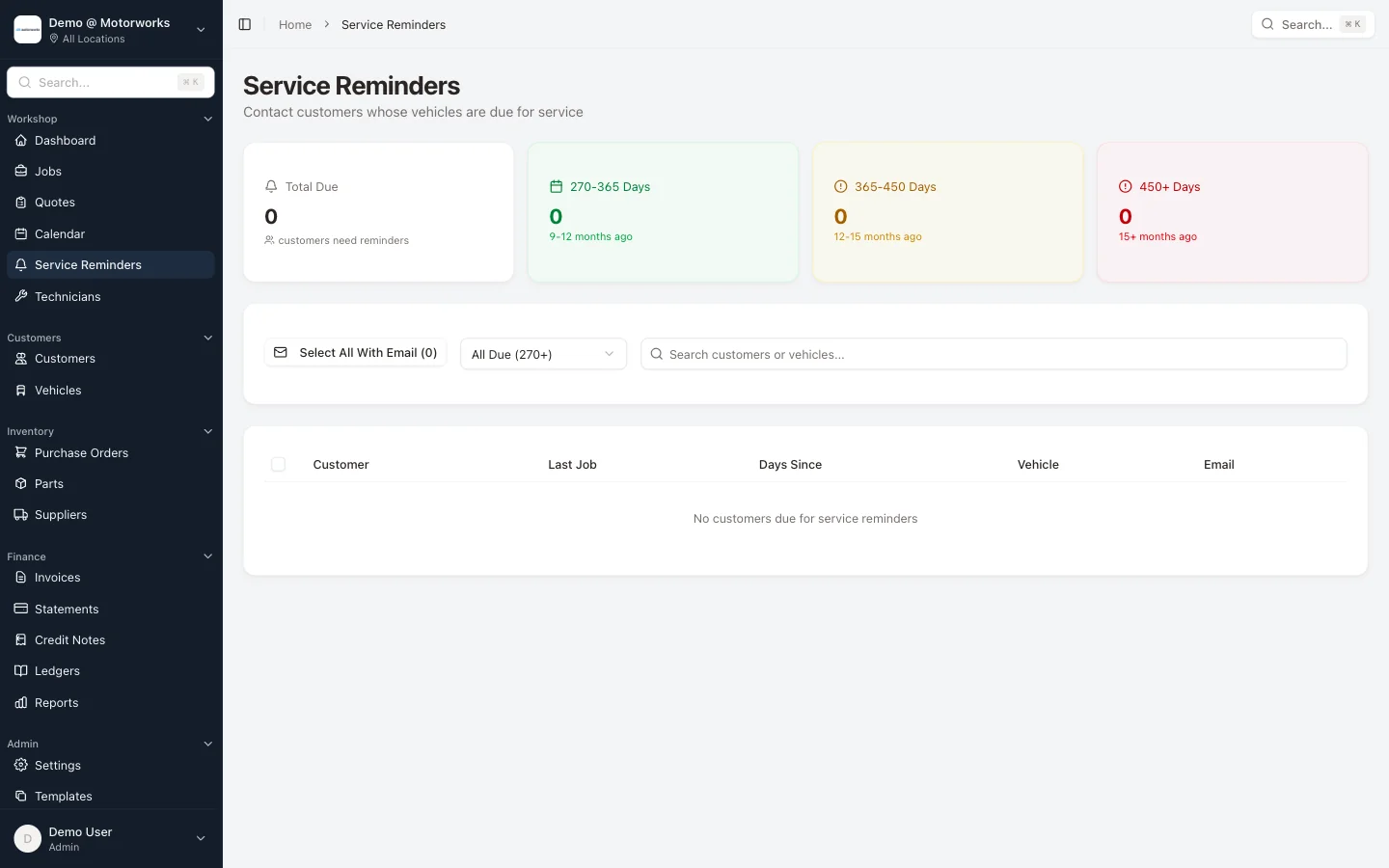
The report you would have generated manually each Monday — everyone with an NCT due in the next 30 days — is always available as an NCT due report without any manual effort. You can see at a glance who is coming up and reach out before they go elsewhere.
This is not about replacing the personal relationship you have with your customers. The message they receive still sounds like it is from your garage. It is your name, your tone, your contact details. What automation removes is the administration burden that prevented you from reaching every customer consistently.
A garage using manual outreach might contact 40-50% of their customers before NCT — the ones who came to mind, the ones who happened to come in recently, the regulars they know well. Automated tracking means you contact 100% of your customers at the right time, every time, without any additional overhead.
That gap — from 40-50% to 100% — is what the revenue difference looks like in practice.
Building the habit: getting started this week
Whether you are starting from scratch or looking to tighten up a system that already exists, here is a practical path forward.
Audit what you have. How many customer registrations do you currently have on file? Of those, how many have an associated NCT due date? That gap tells you the size of the problem.
Capture NCT dates at every touchpoint. From today, every vehicle that comes in gets its NCT date recorded — from the cert, from the disc, or from a VRM lookup. No exceptions. Within a few months, your records will be significantly more complete.
Start the weekly routine. Even if you are doing this manually for now, block 20 minutes each Monday to run through who is due in the next six weeks and send the outreach. Do it consistently for a month and see what comes back.
Track the conversions. Note how many customers you contacted and how many booked. This is the data that will tell you whether the system is working and how to improve it.
Look at the tools available to you. If you are finding the manual approach is already taking more time than it should, or you are missing customers because the system depends on you remembering to check, it is worth looking at what software can do. A VRM lookup that captures NCT dates automatically, a due report that surfaces who is coming up, and automated reminders that send the outreach without you lifting a finger — these are not expensive or complex features. They just need to exist in your workflow.
The difference between a good week and a full diary
Most garages have weeks where the diary fills itself and weeks where it does not. The difference, often, is not the quality of the work — it is whether the right customers were contacted at the right time.
NCT due dates give you a lever that almost no other business has: a predictable, recurring trigger for customer outreach that arrives naturally, carries genuine urgency, and leads directly to work. You do not have to manufacture a reason to get in touch. The reason exists already. You just have to act on it before someone else does — or before the customer leaves it too late and goes to whoever happens to be available.
Tracking NCT dates is not glamorous. It is not complicated. But done consistently, it is one of the most effective things a garage can do to hold on to the customers they already have and keep the diary busy without spending a penny on advertising.
If you want to see how MotorWorks handles NCT date tracking, automated customer outreach, and pre-NCT booking management, book a demo and we will walk you through exactly how it works in practice.