Two cars arrive at two different garages the week before their NCTs.
At the first garage, the customer calls in a panic. The mechanic squeezes them in, does a quick look-over, finds a few issues, patches what he can in the time available, and sends them on their way hoping for the best. The job is logged. The invoice goes out. Nobody thinks much more about it.
At the second garage, the customer was contacted six weeks ago. A pre-NCT inspection was booked as a proper appointment. A technician worked through a structured checklist, documented everything, and produced a written report. The customer approved the recommended work, the car passed first time, and the job generated more than twice what the rushed inspection next door did.
Same service, in theory. Completely different outcomes — in revenue, in customer experience, and in what the garage can build on next year.
That difference comes down to one thing: whether your pre-NCT offering is a structured service or just ad-hoc work you do when someone asks.
This guide walks you through how to turn it into the former.
Why pre-NCT is the best service line most garages undervalue
Every car in Ireland over four years old needs an annual NCT. That’s a fixed, recurring event you can plan around — unlike breakdowns, which are unpredictable, or major repairs, which customers put off.
The NCT creates a natural moment of concern for vehicle owners. They want to know their car is going to pass. They’re open to spending money to make sure. They’re receptive to hearing from their garage.
That’s a very different conversation from cold-calling someone to tell them their car is due a service they don’t feel the urgency of.
And yet most garages treat pre-NCT work as overflow — something you fit in when asked, priced on the fly, documented inconsistently. There’s no named service, no fixed price, no standard checklist, no proactive outreach.
The garages that have formalised it into a proper offering consistently report two things: higher average job values and stronger customer retention. Because when you contact a customer before they’ve panicked, before they’ve gone elsewhere, before they’ve booked the test at short notice — you’re in a different position entirely. You’re the trusted adviser, not the last resort.
You can read more about the revenue dynamics behind this in The NCT Revenue You’re Losing Without Knowing It.
Designing your pre-NCT service
Before you price it or market it, you need to know what you’re actually offering. The most common mistake is defining the service as “a look over before the NCT” — which means something different every time, is priced inconsistently, and is impossible to manage at scale.
A proper pre-NCT inspection service has three characteristics: a defined scope, a documented output, and a consistent time allocation.
Define the scope
Your pre-NCT inspection should cover everything the NCTS inspects, systematically. That means:
- Lighting: all exterior lights, indicators, brake lights, fog lights
- Brakes: pad depth, disc condition, handbrake, brake fluid level and condition
- Tyres: tread depth, sidewall condition, tyre pressure, wheel condition
- Steering and suspension: play in the steering, shock absorber condition, bushings
- Exhaust system: leaks, security, emissions readiness
- Windscreen and wipers: chips, cracks, wiper condition and coverage
- Horn and mirrors
- Undercarriage: visual inspection for rust, fluid leaks, structural concerns
- Engine bay: fluid levels, visible leaks, battery condition
- Interior: seatbelts, warning lights, dashboard indicators
You don’t have to offer the same scope as a full NCT inspection to call this a pre-NCT check. But whatever you do, it should be consistent, written down, and communicated clearly to the customer.
A well-structured pre-NCT inspection is covered in detail in our Pre-NCT Inspection Checklist for Irish Garages, which you can use as a starting point for your own internal checklist.
Document the output
Every pre-NCT inspection should produce a written report the customer receives. This does several things at once.
It justifies the price — you’re not just looking at the car, you’re producing a professional assessment they can take away. It creates upsell opportunities — you can list advisory items alongside pass/fail items, turning the report into a natural conversation about what else needs attention. And it builds trust — a customer who receives a detailed written report is far more likely to authorise the recommended work than one who gets a verbal summary.
The common NCT failure points you should be checking systematically are worth reviewing when building your checklist. Lights, tyres, and brakes account for a disproportionate share of NCT failures in Ireland — make sure your inspection gives these adequate time.
Allocate the time correctly
A pre-NCT inspection done properly takes 45 to 90 minutes depending on the vehicle’s age and condition. Block the appointment accordingly. If you’re fitting it into a 20-minute gap between services, you’re not doing the job, you’re going through the motions — and that will show up in customer results and your reputation.
Treat it like any other skilled job: allocate a bay, assign a technician, and protect the time.
Staffing the service
You don’t need a dedicated NCT technician. You do need a clear process so that whoever picks up the job knows exactly what to do and how long they have.
A printed or digital inspection checklist is the simplest way to manage this. Technicians work through the list in sequence, record their findings, and flag items as pass, advisory, or fail. The report practically writes itself.
Over time, you’ll identify which technicians are most efficient with inspection work. Some mechanics are faster and more thorough on inspections than others — it’s worth recognising that and allocating accordingly.
Pricing your pre-NCT service
This is where most garages either leave money on the table or overcomplicate things.
The flat-rate model
A single flat rate for the inspection is the easiest to market and the easiest for customers to say yes to. In Ireland, most garages charge between €50 and €90 for a pre-NCT inspection, depending on location and the scope of the check.
The flat rate should cover the inspection itself and the written report. Any remedial work — replacing bulbs, adjusting brakes, changing wiper blades — is quoted and invoiced separately.
The advantage of flat-rate is simplicity. It’s a clear number, easy to put on your website, easy to communicate over the phone, and easy for customers to budget for.
The tiered model
Some garages offer two tiers: a basic visual inspection (covering lights, tyres, and a quick undercarriage check) at a lower price point of around €40-50, and a comprehensive inspection covering the full NCTS checklist at a higher price of €70-90.
The tiered model works well if you want to compete on price with a lower entry point while still capturing higher value from customers with older vehicles or specific concerns. It does add some marketing complexity — you need to communicate the difference clearly — but it gives customers a choice.
What about including minor fixes?
Some garages offer a “pre-NCT service” that bundles the inspection with common quick fixes — replacing any bulbs found faulty, adjusting tyre pressure, topping up fluids — for a fixed price of around €100-120.
This can be a strong offer because the customer knows exactly what they’re getting and the total bill feels contained. The trade-off is that it caps your revenue on jobs where there’s more work to be done. Use it as an introductory offer if you want, but make sure your checklist and reporting process still surfaces the bigger issues that need to be quoted separately.
Don’t undervalue the work
The inspection itself generates revenue. But the real opportunity is in the follow-on work. A comprehensive pre-NCT inspection that surfaces worn brake pads, borderline tyres, and a dodgy wiper motor has just created €300-500 in additional jobs — none of which the customer would have known about or authorised without the inspection.
Price the inspection at a level that respects the technician time it takes. A properly-done 60-minute inspection priced at €30 is doing everyone a disservice.
Marketing your pre-NCT service to existing customers
You do not need to spend money on advertising to fill your pre-NCT inspection calendar. Your existing customer base is enough — if you reach out to them at the right time.
The timing window
The optimal window to contact a customer about a pre-NCT check is four to six weeks before their test. Early enough that there’s time to book in, do the inspection, carry out any remedial work, and still have a buffer before the NCT date. Late enough that the test feels real and the customer is thinking about it.
Contact them too early and it doesn’t feel urgent. Contact them too late and they either don’t have time or they’ve already made other arrangements.
Six weeks is the sweet spot. At six weeks out, you’re the first person to mention it. You’re not competing with anyone. You’re being helpful.
What to say
Keep it simple and personal. The message doesn’t need to be elaborate:
“Hi [Name], just to let you know [car make and model] is due for NCT on [date]. Would you like us to check it over beforehand? We have availability the week of [date] — just reply or call us to book.”
That’s it. No hard sell, no promotional language, no urgency tricks. Just a useful piece of information and an easy next step.
Most customers appreciate this. They weren’t going to remember on their own. You’ve made their life easier and positioned yourself as the obvious choice for the work.
How to identify who to contact
This is where the process breaks down for most garages. You know proactive outreach works. You know the timing matters. But who, exactly, do you contact this week? And how do you make sure you don’t miss anyone?
If you’re working from memory or a spreadsheet, the honest answer is that you’ll contact the customers you happen to think of, at the time you happen to think of them, which may or may not be six weeks before their NCT. Some will slip through entirely.
If you want to do this consistently — and consistency is what turns it from a nice idea into a reliable revenue stream — you need a system that tracks NCT dates for every vehicle and surfaces the right customers at the right time.
Automating your pre-NCT lead generation
This is where the gap between garages that do this well and those that don’t becomes very clear.
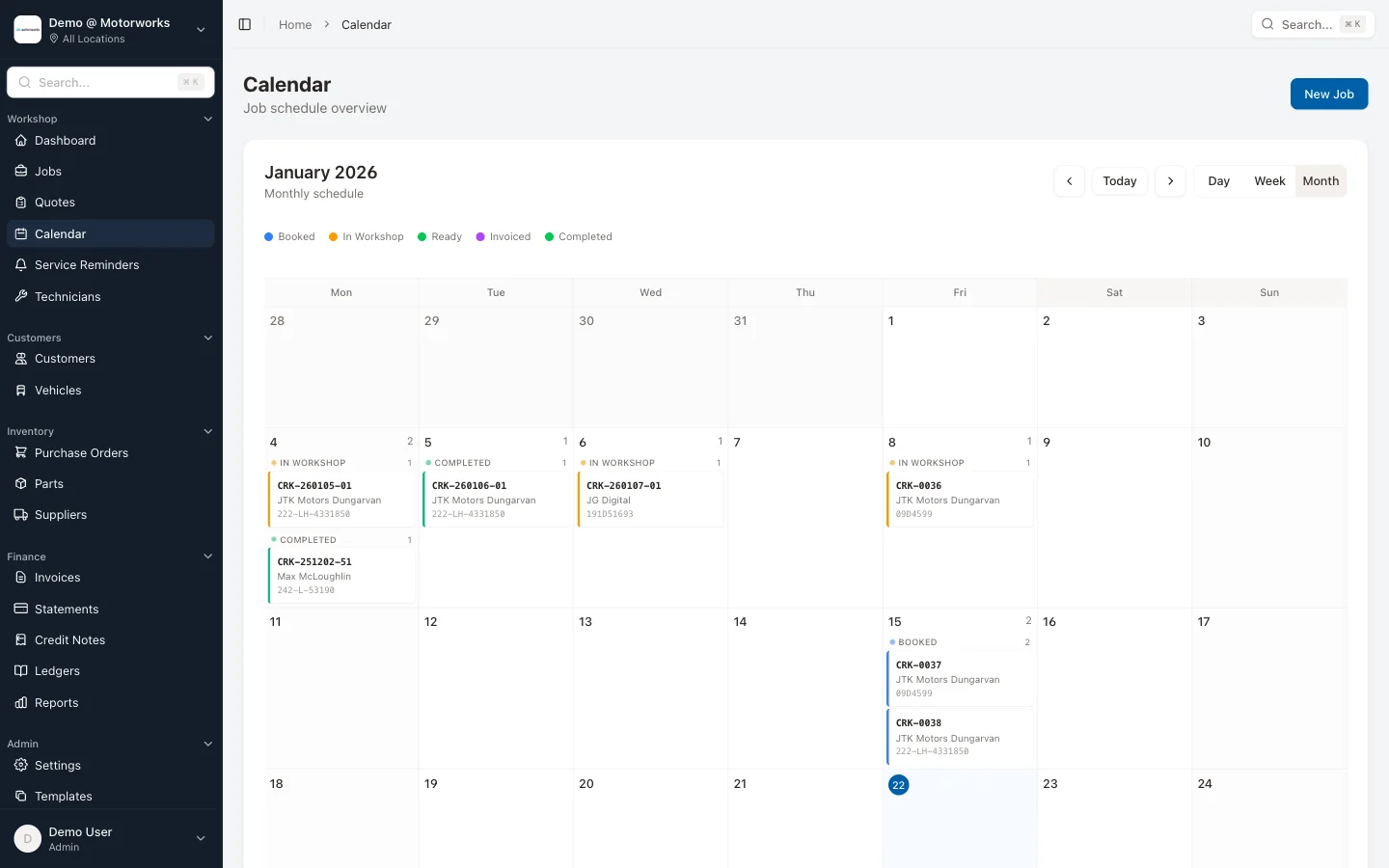
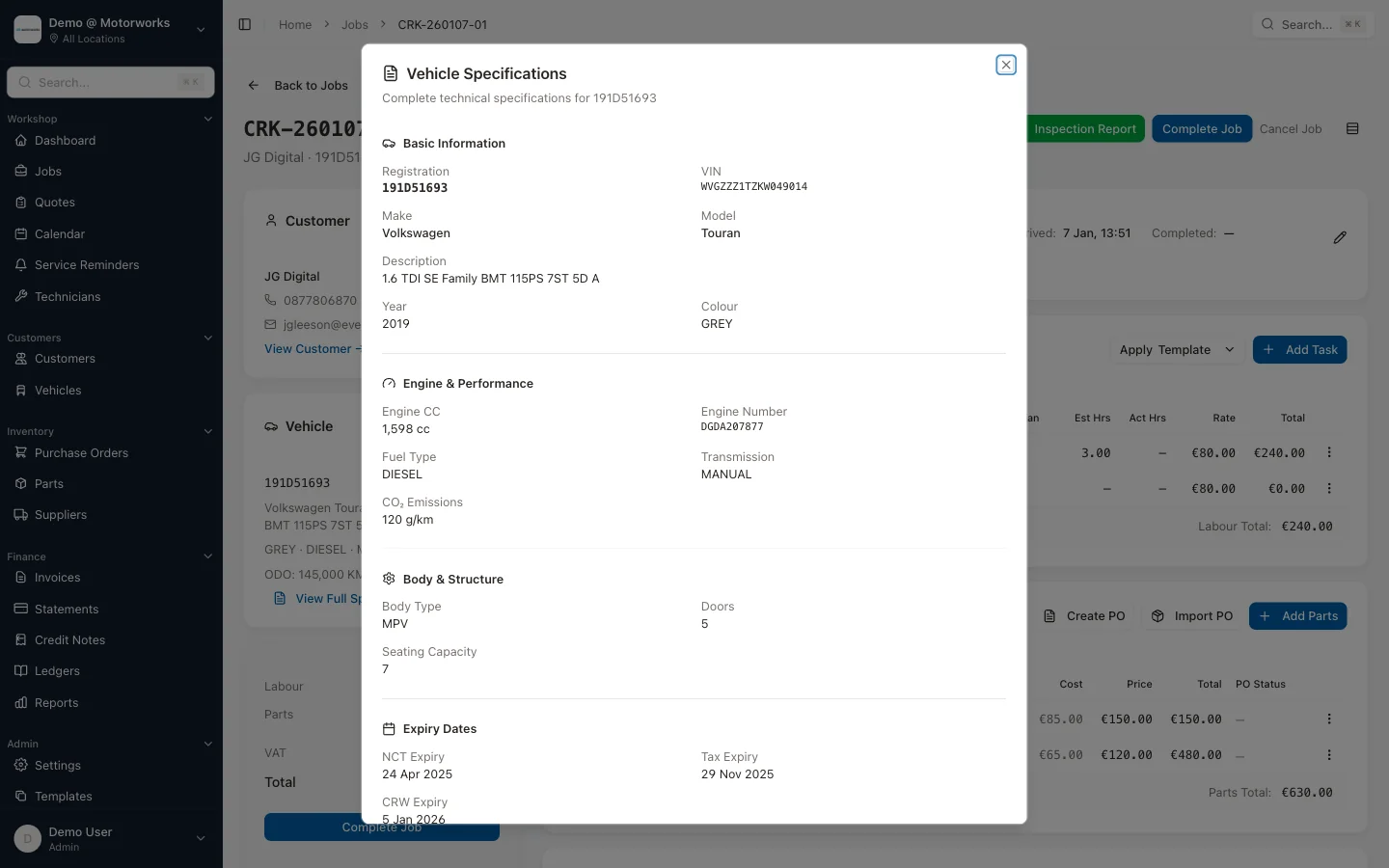
When you look up a vehicle registration through VRM lookup, MotorWorks captures the NCT due date automatically and stores it against the vehicle record. You don’t have to enter it manually. From there, filtering vehicles by upcoming NCT date takes seconds — that’s your outreach list for the week.
Automated service reminders take this further. The system sends the outreach message automatically, at the right time, to the right customers, without you checking a list each week. Customers are contacted at six weeks, given an easy path to booking, and scheduled into your diary.
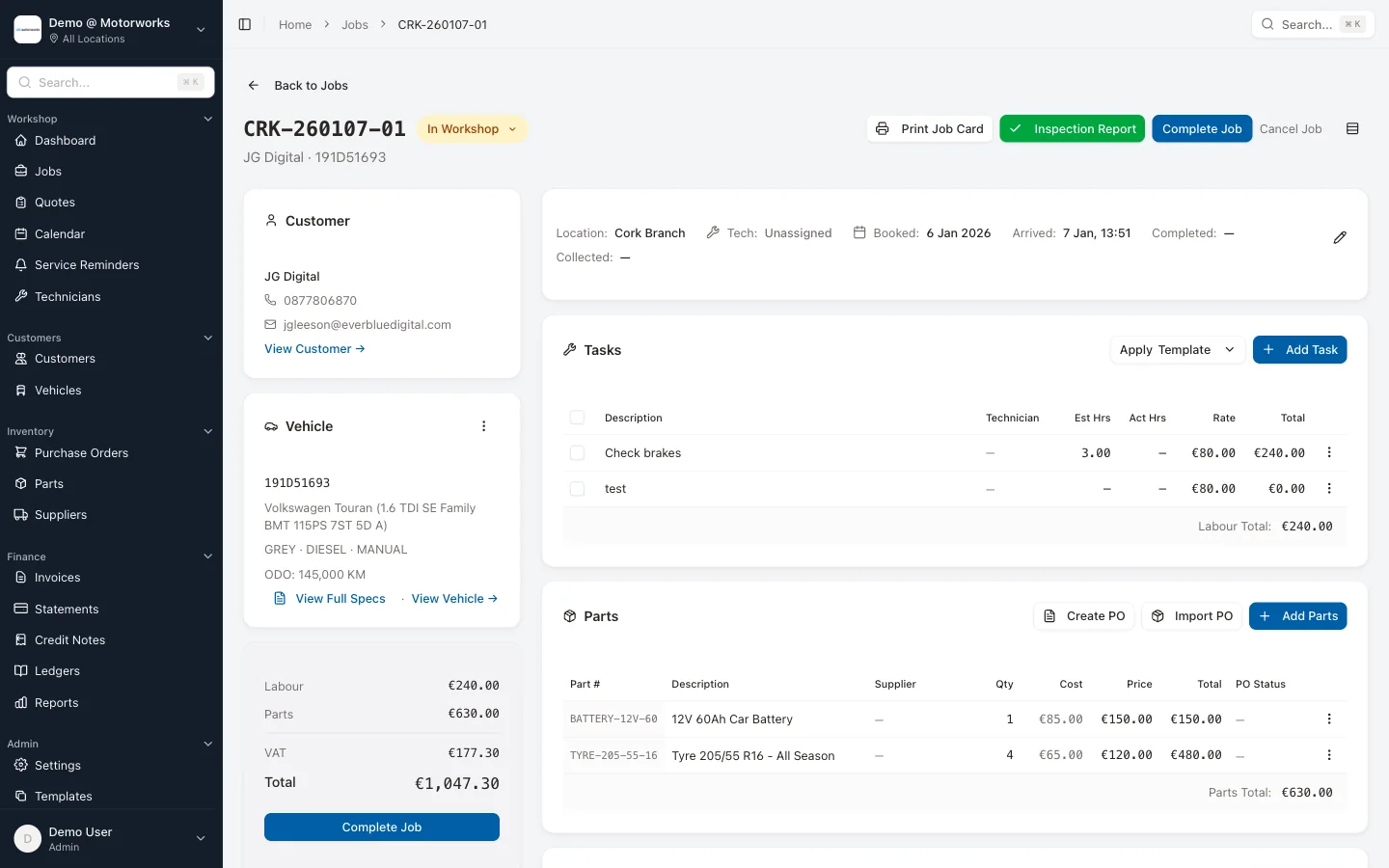
When the job is booked, job management tracks the full lifecycle. You can use a job template for your standard pre-NCT checklist so every technician follows the same process. The inspection findings are logged against the vehicle. If follow-on work is needed, you quote it from the same job — and the customer can approve the quote through the customer portal on their phone. Parts for the repair get ordered through purchase orders linked to the job, so you can see the true margin. When the work is done, the job card converts to an invoice in one click.
This is not a complex system to set up. But it requires having your NCT dates stored and your workflow digital. A paper-based garage cannot do this reliably.
Measuring whether your pre-NCT service is working
Once you’ve launched a structured pre-NCT offering, track these numbers monthly.
Outreach volume. How many customers are you contacting about upcoming NCTs each month? This tells you whether your tracking and reminder system is working.
Conversion rate. Of the customers you contact, how many book a pre-NCT inspection? A healthy conversion rate from proactive outreach is 30-50%. If you’re significantly below this, review your message or your timing.
Average inspection revenue. What does the average pre-NCT inspection job generate, including follow-on work? Track this separately from the inspection fee. MotorWorks reports can break this down by job type and technician, so you can see which inspections are generating follow-on work and which aren’t. If your average is consistently below €100 including follow-on work, your checklist may not be surfacing issues effectively or your reporting process isn’t prompting conversations about the advisory items.
First-pass NCT rate. Track what percentage of customers who did a pre-NCT inspection with you pass their NCT first time. This is your quality metric — and it’s a powerful marketing claim when you can say it honestly.
Repeat bookings. Are the customers who used your pre-NCT service coming back for their annual service and their next NCT prep? High repeat rates confirm that the service is building the kind of relationship that drives long-term revenue.
Review these numbers monthly for the first six months after you formalise the service. You’ll quickly see where the gaps are.
Putting it all together
A profitable pre-NCT service is not complicated. It is methodical.
You define what the service includes, price it properly, allocate time for it like a real appointment, produce a written output the customer values, and contact customers at the right time before they go looking elsewhere.
The garage that does this well wins not just the pre-NCT inspection, but the follow-on repair work, the next annual service, and the customer’s loyalty over the years that follow. Because you were the one who reached out. You were the one who remembered. You were the one who made it easy.
That’s what turns a one-off transaction into a relationship — and a relationship is worth significantly more than any single job.
If you want to see how MotorWorks handles automated customer outreach, job templates, purchase orders, and the full job-to-invoice workflow for pre-NCT inspections, book a demo and we’ll walk you through it.