You’ve been running the ramps solo for two or three years. The bookings are full. You’re turning down work. You’re finishing at seven every evening and starting again before eight. And you’ve finally said the words out loud: it’s time to take someone on.
Hiring your first mechanic is one of the most significant decisions you’ll make as a garage owner. Get it right and you double your capacity, reduce your own hours, and start building a business that doesn’t depend entirely on you. Get it wrong and you’re dealing with a costly mistake — one that’s harder to unwind in Ireland than many owners expect.
This guide covers every step of the process: where to find candidates, what to pay, how to structure the contract, what you’re legally required to do as a new employer, and how to set a new hire up for success from day one.
Before you advertise: getting clear on what you actually need
The mistake most solo garage owners make when they decide to hire is jumping straight to the job ad. Before you write a single word, you need to be clear on a few things.
What type of role are you actually hiring for?
There’s a meaningful difference between:
- A fully qualified motor technician who can work independently on a full range of jobs
- A junior technician (one to two years post-qualification) who needs some direction but can handle routine work
- A SOLAS apprentice who is at the start of their training and requires significant supervision
- A general assistant or trainee who handles tyres, exhausts, oil changes, and takes work off your bench
Each of these carries different pay expectations, different supervision demands, and different value to the business. Be honest about what you need — and what you can actually support.
Do you have the work to justify the hire?
A full-time technician needs to generate enough billable hours to cover their wages, your employer PRSI, and your own time managing them — and still leave margin for the business. At a typical labour rate of €80 to €100 per hour, a technician working a five-day week needs to produce somewhere between six and seven billable hours per day to be clearly profitable. If you’re not sure whether you have the workflow to support that consistently, it’s worth tracking your job management data first to see what your actual throughput looks like before committing to a hire.
Where to post a mechanic job ad in Ireland
The market for qualified mechanics in Ireland is tight. Demand consistently outstrips supply, particularly outside Dublin. This means you need to advertise in the right places and make your ad compelling enough to stand out.
Job boards
- Indeed Ireland — the highest-volume platform for trade jobs in Ireland. A sponsored listing (€5 to €20 per day) significantly increases visibility.
- IrishJobs.ie — well-established and widely used in the Irish market. Good for attracting candidates who are actively looking.
- Recruit Ireland — smaller but focused on Irish roles, often less competitive for niche trade positions.
- LinkedIn — increasingly useful for attracting experienced technicians, particularly those with specialist skills or who may not be actively job-hunting.
Trade-specific channels
- SIMI (Society of the Irish Motor Industry) — SIMI’s job board reaches industry-specific candidates. If you’re a SIMI member, use it.
- Apprenticeship.ie — if you’re open to taking on a SOLAS apprentice, the national apprenticeship network connects employers with candidates.
- Local automotive Facebook groups — there are active local and regional groups where mechanics look for work. A direct post often reaches people not actively browsing job boards.
Word of mouth and your own network
For a first hire, your own contacts are often your best source. Let your trade suppliers know you’re looking. Talk to your parts reps — they call into garages all day and hear who’s looking for a move. Tell other garage owners (non-competing ones). Many of the best hires in the motor trade happen through a quiet conversation rather than a formal application process.
Writing a job ad that gets responses
A poorly written job ad is one of the most common reasons garages struggle to hire. Many ads are vague, jargon-heavy, and focused on what the employer wants — with very little about what the candidate gets out of it.
A good mechanic job ad in Ireland should include:
A clear job title. “Motor Technician — Full Time, Galway” works. “Automotive Professional Required” does not.
A brief description of the garage. How many bays, what type of work, what vehicle types, what kind of customers. Candidates want to know what their working day will actually look like.
The specific role and responsibilities. Don’t just list generic duties. Be specific: is this mostly servicing and NCT prep? Is there diagnostic work? Specialist vehicles? The more specific you are, the better matched your applicants will be.
Pay range. Ads without salary information get significantly fewer applications. You don’t have to give an exact figure — a range works fine. Hiding it signals that the pay isn’t competitive, even if it is.
What you’re offering beyond pay. Decent hours, a clean and well-equipped workshop, ongoing training, a chance to build skills — these matter to technicians. If you have them, say so.
How to apply. A direct email address or a phone number. Keep it simple.
What do mechanics earn in Ireland in 2026?
Pay is the biggest factor in whether candidates apply to your ad and whether you retain them once hired. The Irish motor trade is experiencing real wage pressure, and garages that are paying below-market rates are struggling to attract or keep staff.
Here are realistic 2026 figures for qualified motor technicians in Ireland:
| Level | Annual salary range |
|---|---|
| Newly qualified (Year 1) | €28,000 to €33,000 |
| Junior technician (1–3 years) | €32,000 to €38,000 |
| Mid-level technician (3–7 years) | €38,000 to €46,000 |
| Senior / specialist technician | €46,000 to €55,000+ |
| SOLAS apprentice (Year 1) | €14,000 to €18,000 |
| SOLAS apprentice (Year 2–4) | €18,000 to €26,000 |
Regional variation applies. Dublin and large urban centres are at the top of these ranges. Rural garages often sit towards the lower end, though a loyal local workforce and lower cost of living can offset this.
A few things worth knowing about pay in the current market:
Demand for qualified technicians, particularly those with EV or advanced diagnostics skills, is high. If you find a strong candidate, being slow to make an offer is a risk. Someone with options will not wait two weeks for you to decide.
Pay alone is not always the deciding factor. Hours, conditions, workshop quality, and the culture of the place matter — particularly for experienced technicians who have choices. A well-run garage with good equipment and a reasonable working environment can attract and retain staff at or slightly below the top of the salary range. A disorganised one with poor tools will struggle even at a premium. For a broader look at what labour costs actually mean for your business, see our post on setting labour rates for an Irish garage.
The minimum wage in Ireland from January 2025 is €13.50 per hour (increasing to €14.00 in January 2026). Any role you offer must meet or exceed this. For a full-time role (39 hours per week), the national minimum wage equates to approximately €27,300 per year.
SOLAS apprenticeships: taking on a trainee mechanic
If you’re not in a position to pay full technician rates, or if you want to develop someone from scratch, a SOLAS motor mechanic apprenticeship is worth serious consideration.
The Motor Mechanic apprenticeship in Ireland is managed by SOLAS (the Further Education and Training Authority) and leads to a QQI Level 6 Advanced Certificate — Craft qualification. It typically runs over four years and combines on-the-job training with off-the-job phases at an Education and Training Board (ETB) or approved college.
How the apprenticeship works
Apprentices alternate between your workshop and off-the-job training at their allocated ETB. During off-the-job phases, the apprentice is attending college — you are still their employer of record, but they are not physically in your workshop. SOLAS pays an allowance directly to the apprentice during these off-the-job periods, so your wage cost reduces significantly during that time.
During on-the-job phases, the apprentice is working in your workshop and you pay their wages. Apprentice wages are typically significantly lower than qualified technician rates — this reflects the supervised training they’re receiving.
Your responsibilities as an approved employer
To take on a SOLAS apprentice, you need to be an approved employer. The process involves registering with SOLAS and demonstrating that your workshop can provide the required range of training activities. You also need a designated workplace mentor — usually yourself or your most experienced technician — who will be responsible for the apprentice’s on-the-job training and assessment.
The key obligations are:
- Pay the apprentice for all on-the-job time
- Provide a structured, safe training environment
- Complete training records and assessments as required by SOLAS
- Allow the apprentice to attend all off-the-job phases without penalty
- Support the apprentice through their competency assessments
Taking on an apprentice is a genuine commitment. It’s not cheap labour — the first year in particular involves significant supervision time, and the apprentice will make mistakes. But a four-year investment in an apprentice produces a fully qualified technician who knows your workshop, your systems, and your standards. Many of the best long-term employer-employee relationships in the Irish motor trade started this way.
For more on the SOLAS apprenticeship programme, visit apprenticeship.ie or contact your local ETB.
Interview questions worth asking
Once you have applications, the interview stage is where most garage owners feel least confident. A few practical guidelines:
Call them first. A five-minute phone call before a formal interview saves time. You’ll quickly get a sense of how they communicate and whether the basics match up.
Ask about their recent work, not their career history. “Tell me about the last complicated job you worked on” is more useful than a review of their CV. You’re looking for how they think through a problem.
Ask about tools and equipment. A genuine technician can talk about the kit they use. What diagnostic software are they familiar with? What vehicles have they worked on most? What’s the most complex fault they’ve diagnosed recently?
Find out why they’re moving. This is important. “I want more variety” is different from “I don’t get on with my boss” and very different from “I’ve had issues at a few places.” None of these are automatically disqualifying, but you need to understand the context.
Be honest about what your workshop is like. A candidate who expects a main dealer environment and arrives at a busy independent workshop will not stay. Describe your typical day accurately. Show them around. Let them see what they’re actually taking on.
Check qualifications. Ask to see their QQI certificate or apprenticeship completion record. It is entirely reasonable to request this before making an offer.
Check references. Always. Ring the previous employer, not just the reference listed on the CV. A brief phone conversation with a previous garage owner will tell you significantly more than a written reference.
Employment law basics for new employers in Ireland
Employing someone in Ireland for the first time involves legal obligations that many solo traders underestimate. This is not an area where you can figure it out as you go — getting it wrong can be expensive. Here are the key things you need to have in order from day one.
Employment contract
Under the Terms of Employment (Information) Acts, you are required to provide every employee with a written statement of their core terms of employment within five days of starting work. The full written contract must be provided within one month.
The statement must include:
- Full name of employer and employee
- Address of the employer
- Place of work
- Job title or nature of the work
- Date of commencement
- Expected duration of contract (if temporary or fixed-term)
- Rate of pay or method of calculating pay
- Pay frequency
- Hours of work and rest periods
- Annual leave entitlement
- Details of collective agreements if applicable
- Notice periods
Failing to provide a contract is a breach of employment law and gives the employee grounds to bring a claim to the Workplace Relations Commission (WRC). A template contract from a solicitor or HR advisor costs a few hundred euro and removes a significant compliance risk. It is money well spent.
Employer registration with Revenue
Before your new employee starts, you need to register as an employer with Revenue. This is done through ROS (Revenue Online Service). You will then need to operate PAYE (Pay As You Earn) payroll — deducting income tax, USC, and employee PRSI from every payslip and remitting them to Revenue.
You will also owe employer PRSI on top of gross wages. The current employer PRSI rate is 11.15% on most earnings above the weekly threshold. On a €38,000 annual wage, that is approximately €4,240 per year in employer PRSI alone. This is a real cost that needs to be in your budget before you make an offer. For a full breakdown of what staffing actually costs, see our post on the true cost of running a garage in Ireland.
Annual leave
Full-time employees in Ireland are entitled to four working weeks of paid annual leave per year, plus nine public holidays (or equivalent time off in lieu). Annual leave entitlement is calculated based on hours worked, not just the contract. Part-time and casual workers also have annual leave entitlements — prorated to hours worked.
Sick leave
The Sick Leave Act 2022 introduced statutory sick pay in Ireland for the first time. Employers are required to pay sick leave to employees who are unable to work due to illness, up to a defined number of days per year. The entitlement has been increasing each year since 2023 — check the current obligation at citizensinformation.ie, as it will continue to increase through 2026 and beyond.
Statutory sick pay is paid at 70% of normal weekly pay, up to a daily cap. You will need to have a sick leave policy and process in place.
Probationary period
You can include a probationary period in the contract — typically three to six months. During probation, employment can generally be ended with shorter notice, and the employee does not yet have the same unfair dismissal protections that apply after 12 months of continuous employment.
However, probation is not a free pass. Dismissing someone during probation still needs to be on legitimate grounds and handled fairly. If in doubt, document everything — performance conversations, training provided, any issues raised. If a dismissal goes to the WRC, your records matter.
Unfair dismissal protections
After 12 months of continuous employment, your employee has full unfair dismissal protections under the Unfair Dismissals Act. This means you cannot end their employment without a fair reason and a fair process. Valid grounds for dismissal include capability, competence, conduct, and redundancy — but each requires the correct procedure.
The consequence of getting this wrong is a WRC hearing and potentially a significant financial award to the employee. If you ever need to performance-manage or dismiss an employee, take advice from an HR professional or solicitor before you act. It is almost always cheaper than the alternative.
Auto-enrolment pension
Ireland’s auto-enrolment pension scheme is being phased in from 2024. By 2026, employer contribution obligations are coming into effect. Under auto-enrolment, employers will be required to make pension contributions for eligible employees who are not already enrolled in an occupational pension scheme. Contributions will increase incrementally over several years. Your payroll provider or accountant can advise on your specific obligations.
For the most up-to-date information on all of the above, the Workplace Relations Commission (workplacerelations.ie) and Citizens Information (citizensinformation.ie) are the definitive Irish sources.
Onboarding: the first four weeks
The first month of a new hire’s employment is the most important. How you handle it determines whether they stay, whether they become productive quickly, and whether the relationship starts on a sound footing.
Day one: don’t throw them in the deep end
Walk them around the workshop. Show them where everything is — tools, consumables, parts storage, the job management system, the kettle. Introduce them to anyone else on site. Explain how jobs flow through the workshop, how you track time, how parts get ordered.
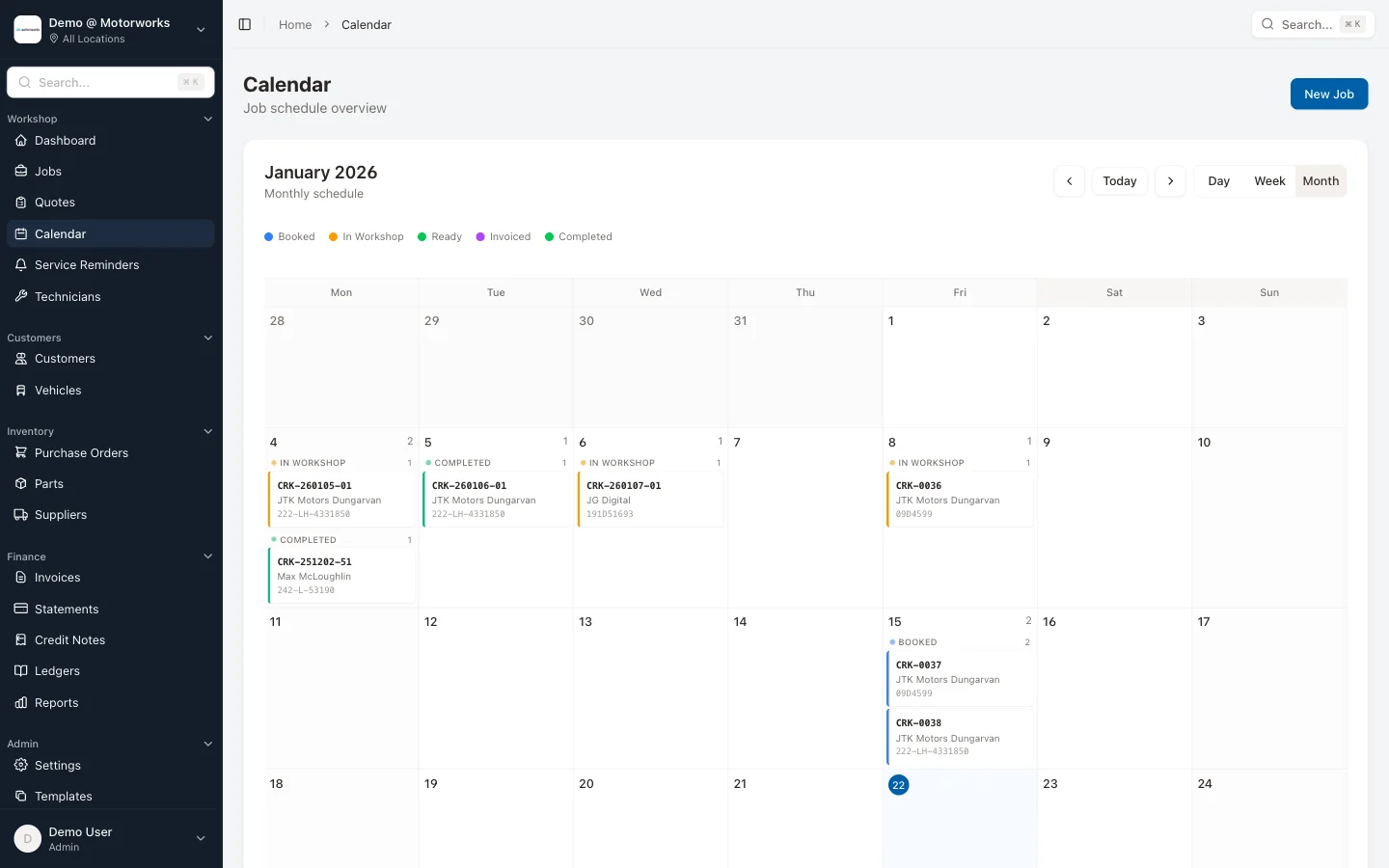
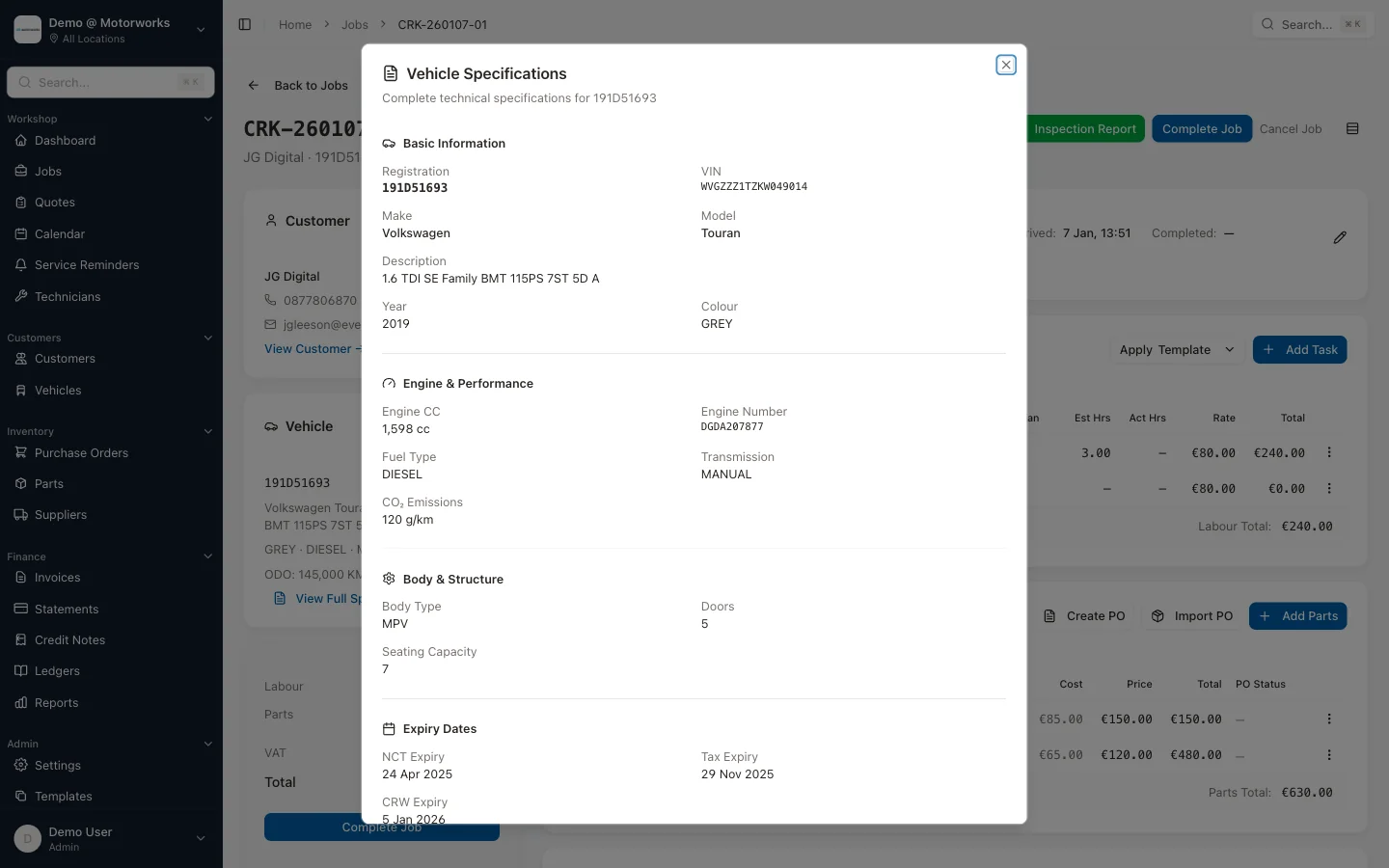
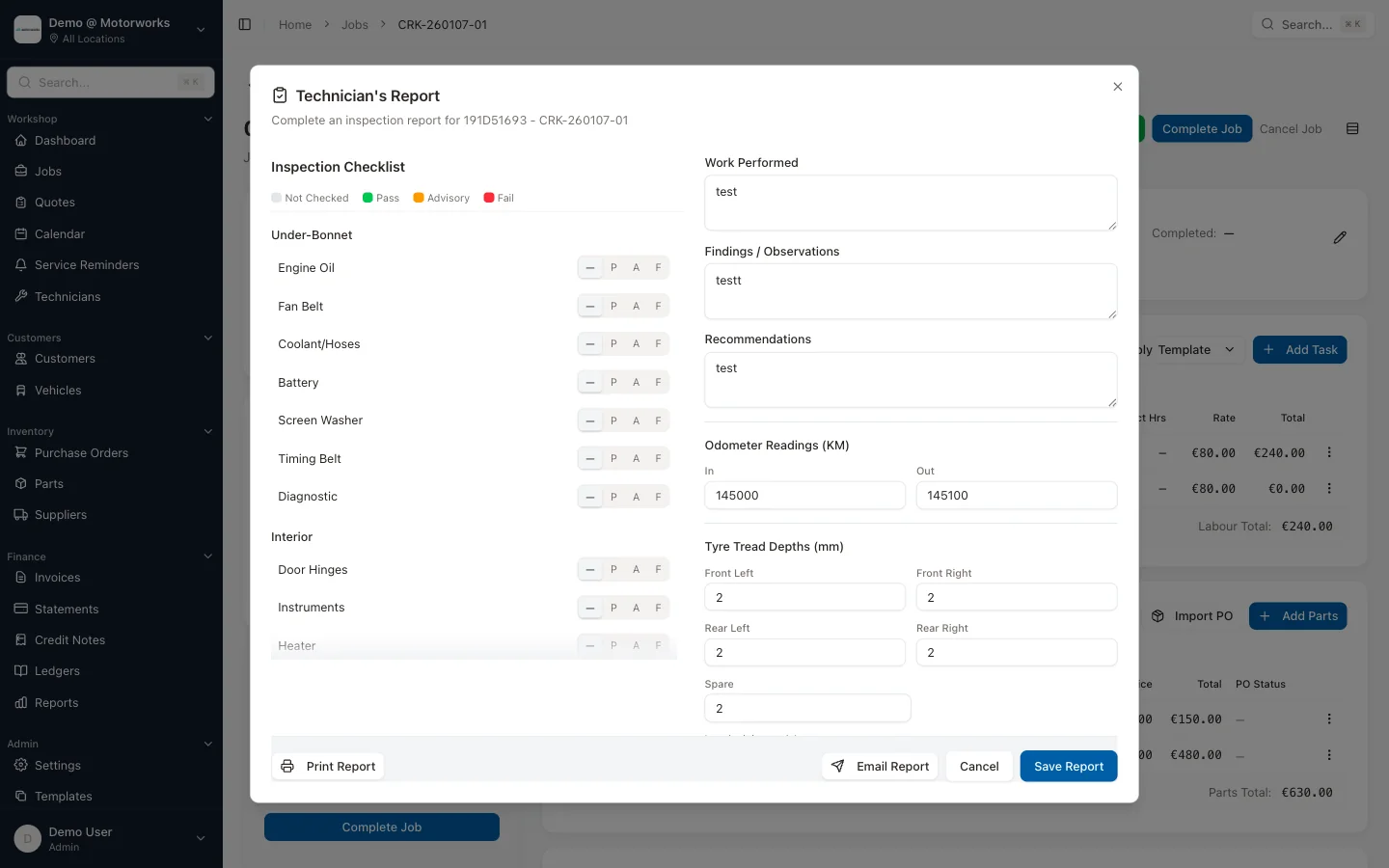
If you’re using a job management system like MotorWorks, give them a walkthrough on day one. Show them how jobs move through statuses, how to log time, how to raise purchase orders for parts against a job, and how to record advisory items. Understanding the system early prevents the bad habits — paper notes, lost times, unrecorded parts — that cause headaches later.
Make sure they have what they need: protective equipment, any required workwear, access to the systems they’ll be using. Starting someone on day one without the basics sorted is a poor first impression.
Week one: watch, then let them work
Resist the urge to just hand them jobs and disappear. The first week is your chance to see how they actually work — not just what they claimed in the interview. Observe how they approach a job, how they handle a fault they haven’t seen before, whether they ask the right questions.
Most experienced technicians will want some autonomy. But the first week is also about establishing your standard. How you want jobs documented, how time gets recorded, how parts get ordered, what happens when a job goes over estimate. These habits are easier to set now than to fix six months in. If you want a broader view of how to tighten up workshop processes, our guide on workshop efficiency covers the operational side in detail.
First four weeks: build the routine
By the end of the first month, a good hire should be running independently on routine work — servicing, NCT prep, standard mechanical jobs — and coming to you with questions on anything outside their experience. That’s a healthy dynamic.
Be explicit about what you expect. If you have a particular way of doing things — how vehicles are received, how job cards are completed, how customers are updated — spell it out rather than assuming it’s obvious. What’s obvious to you after ten years in your workshop is not obvious to someone who has just arrived.
Scheduled check-ins
Have a brief one-to-one conversation at the end of week one, the end of week two, and at the four-week mark. These don’t need to be formal. Five minutes at the end of a shift: how’s it going, any questions, anything you need. This habit normalises open communication and means problems surface early rather than festering.
It also gives you the information you need to make a probation decision with confidence.
The paperwork checklist before you make an offer
When you’re ready to hire, work through this list before the candidate’s first day:
- Written contract or statement of core terms prepared
- Revenue employer registration completed (via ROS)
- Payroll process in place (you or a payroll bureau)
- Employer’s liability insurance added or updated
- Motor trade road risks policy updated to include the new driver
- Safety statement reviewed and updated to reflect new headcount
- Health and safety induction planned for day one
- Any required equipment, PPE, or workwear ordered
Most of these are straightforward if you plan ahead. The ones that cause problems are the ones left until the last minute — particularly insurance (lead time required) and payroll setup (you cannot pay someone properly without this in place).
Getting the numbers to work
Before you make any hire, you should be able to answer a simple question: how much billable revenue does this person need to generate per week to justify their cost?
Take the annual wage you’re offering. Add 15 to 20% for employer PRSI, sick leave, holiday pay, and ancillary costs. That is your real annual employment cost. Divide it by your workshop’s annual working weeks (roughly 48, accounting for holidays and downtime). Divide that by your labour rate. That gives you the minimum billable hours per week that person needs to generate to break even.
At €38,000 salary with a 17% employer cost loading, your real annual cost is approximately €44,500. At 48 working weeks and an €85 labour rate, break-even is approximately 10.9 billable hours per week. That is comfortably achievable for a full-time technician producing six-plus chargeable hours per day.
The exercise is worth doing before you hire, not after. And once the person is in the door, tracking their actual billable output via your job reports tells you quickly whether the numbers are working or whether there is a problem to address.
A final word
Hiring your first employee is a genuine milestone for any garage. It’s also a commitment with real legal, financial, and human weight to it. The garages that handle it well are the ones that prepare properly — not just with a job ad, but with a clear understanding of what they need, what they can afford, what the law requires, and how they’re going to set the new hire up to succeed.
If you are at the point where your workshop is busy enough to need another pair of hands, that is a good problem to have. The question is whether your systems are ready to support a team as well as a solo operator.
MotorWorks is built for garages that are growing. Job management with technician assignment and time logging, purchase orders linked to jobs for real margin visibility, technician-level reporting showing productivity and billable hours, and role-based permissions so your new hire sees only what they need to. If you’d like to see how it works before your first hire arrives, book a short demo.
For further reading on the financial side of running a garage, see our full breakdown of the true cost of running a garage in Ireland.