A customer drops off their car for a full service and walks out looking pleased with the bill. You think: fair enough, that’s what we charge. But then you sit down at the end of the week and look at what actually came in versus what went out — wages, employer PRSI, the insurance renewal, the equipment lease, the rent — and the picture is less comfortable.
You charged €75 an hour. But what did it actually cost you to deliver that hour?
This is the question most Irish garage owners have never sat down to answer properly. Not because they’re not smart, but because the number is harder to calculate than it looks, and because setting rates by looking at what the garage down the road charges feels easier and safer. The problem is that the garage down the road might be making the same mistake.
This post gives you a framework for calculating a garage labour rate in Ireland that covers your real costs, accounts for how people actually work, and builds in the profit margin your business needs to be sustainable.
Why “what does the competition charge?” is the wrong question
Most garages in Ireland set their labour rate by looking at what’s typical for their area, adding or subtracting a few euros based on how they want to be positioned, and leaving it at that. This is understandable. It’s also a structural problem.
Your competitor’s rate reflects their cost base, not yours. Their rent might be half what you pay. They might have fewer staff, older equipment that’s fully paid off, or a lower insurance premium because of their claims history. Their rate might be profitable for them and loss-making for you — or the other way around. You have no way of knowing.
The only meaningful way to set a garage labour rate is to start from your own costs and work outward.
What goes into the real cost of an hour’s labour?
Before you can calculate what you need to charge, you need to know what it costs you to have a technician producing a billable hour of work. This is more than just their hourly wage.
Here’s how to break it down.
Step 1: True technician cost per hour
Take your technician’s annual gross wage. Add employer PRSI at 11.15%. Add the cost of their annual leave entitlement — four weeks plus public holidays, which is roughly 28 days a year. Add statutory sick pay obligations (currently five days per year at full pay under the Sick Leave Act). Add workwear, PPE, and any training costs attributable to that person.
For a technician on a gross wage of €40,000 per year, the full employer cost looks something like this:
| Cost item | Annual cost |
|---|---|
| Gross wage | €40,000 |
| Employer PRSI (11.15%) | €4,460 |
| Holiday cover (28 days) | €4,310 |
| Statutory sick pay (5 days) | €770 |
| Workwear and PPE | €750 |
| Technical training | €1,500 |
| Total employer cost | €51,790 |
So before a single customer is invoiced, that technician is costing you approximately €52,000 a year.
Step 2: Productive hours — the number most garages get wrong
Now divide that cost by the hours that technician is actually available for billable work.
There are 52 weeks in a year. Subtract four weeks annual leave. Subtract public holidays — Ireland has ten of them. Subtract an allowance for sick days and any closures. Your technician is available for work for roughly 44 to 46 weeks of the year, which at 40 hours a week gives you 1,760 to 1,840 hours of attendance time.
But not all of that is billable. Technicians spend time on non-billable activities: workshop tidying, moving vehicles, waiting for parts, attending team briefings, doing warranty work and comebacks. In a well-run garage, a realistic billable utilisation rate is 75 to 85% of attendance time. That brings your billable hours per year down to around 1,320 to 1,564.
Use 1,400 as a working figure for a competent, busy technician in an independent garage. Some garages will be slightly above this; many will be slightly below.
So the technician cost per billable hour is:
€51,790 / 1,400 hours = €37.00 per billable hour
That’s what that hour of technician time costs you — before a single euro of overhead has been included.
Step 3: Add your overhead cost per hour
Your overheads are all the fixed costs that run regardless of how many jobs you do: rent, rates, insurance, utilities, equipment finance, software, accountancy. These costs need to be recovered through your labour rate (and your parts margin — but let’s focus on labour here).
For a typical independent Irish garage with two technicians, realistic annual overheads look like this:
| Overhead category | Annual cost |
|---|---|
| Rent (provincial location) | €42,000 |
| Commercial rates | €7,500 |
| Insurance (liability, road risks, buildings) | €15,000 |
| Utilities (electricity, heating, waste) | €20,000 |
| Equipment finance and maintenance | €12,000 |
| Software and technology | €10,000 |
| Accountancy and professional fees | €6,000 |
| Other (consumables, miscellaneous) | €5,000 |
| Total annual overheads | €117,500 |
With two technicians each producing around 1,400 billable hours, you have 2,800 total billable hours across the year to recover these overheads.
€117,500 / 2,800 hours = €42.00 overhead per billable hour
Step 4: Add a profit margin
You now know what it costs to deliver a billable hour. But cost recovery is not the goal — profit is.
If you want to generate a 15% net profit margin on your labour revenue, you need to factor that in as well. If your floor price is cost + overhead, your charge-out rate at 15% margin would be calculated as:
(cost per billable hour + overhead per hour) / (1 - target margin)
(€37 + €42) / (1 - 0.15) = €79 / 0.85 = €93 per hour
At €93 per hour, you’re covering your true technician costs, recovering your full overhead, and generating a 15% net margin on labour. That is your minimum viable labour rate for this cost structure.
What does €75 per hour actually cost you to deliver?
Let’s run the numbers the other way. Many independent garages in Ireland are still charging in the €70 to €80 per hour range. Some have been at those rates for two or three years without reviewing them. So what does a €75 rate actually look like against the cost base above?
At €75 per hour with 2,800 billable hours per year, your total labour revenue is:
2,800 hours x €75 = €210,000
Your total labour cost (technician costs for two technicians) is roughly €103,580.
Your overheads are €117,500.
Total costs: €221,080
Labour revenue at €75: €210,000
Result: a shortfall of €11,080 before parts margin is factored in.
This is why garages that are busy but not profitable exist. At €75 per hour against this cost base, your parts margin has to make up the labour shortfall before it can contribute to profit. You are not breaking even on labour — you’re subsidising labour out of parts revenue.
At €90 per hour, the same 2,800 hours generates €252,000 in labour revenue — a surplus of approximately €30,920 over total costs before parts. That’s the difference between struggling and building a healthy business.
Regional rates: Dublin vs. the rest of Ireland
The market context matters, even if it shouldn’t be the only input. Here’s a realistic picture of where garage labour rates sit across Ireland in 2026.
| Region | Typical independent garage rate |
|---|---|
| Dublin city and inner suburbs | €90–€115 per hour |
| Dublin outer suburbs and commuter belt | €80–€100 per hour |
| Cork, Galway, Limerick city | €75–€95 per hour |
| Provincial towns and rural areas | €65–€85 per hour |
Dublin rates are higher partly because Dublin costs are higher. Rent in a Dublin suburb can be €70,000 to €90,000 per year — nearly double what the same footprint costs in a provincial town. Insurance is higher because there are more vehicles on the road and more repair activity. Technician wages in Dublin are generally higher because the cost of living is higher and competition for staff is more intense.
If you are running a garage in County Roscommon with annual rent of €22,000 and two technicians on €36,000 each, your floor rate will be lower than a Dublin garage with comparable headcount paying double the rent. That’s as it should be. But the principle — calculate from your costs — is exactly the same.
The important question is not “what does a garage in my area charge?” but “what do I need to charge to run a profitable business at my cost base?”
If the market rate in your area is below your minimum viable rate, that’s a signal — either your costs are above what that market can support, or there’s a gap between what the market charges and what well-run garages in that market actually need to charge.
Factors that shift your rate up or down
Once you have your floor rate from the calculation above, there are legitimate reasons to position above or below it.
Reasons to charge above your calculated floor:
- Specialist expertise (EV and hybrid work, ADAS calibration, diagnostics on complex vehicles) commands a premium because the investment in training and equipment is higher and the skill is rarer
- Strong local reputation with a loyal customer base willing to pay for quality and trust
- Lower labour supply in your area — if getting work done anywhere requires waiting three weeks, your rate can reflect that scarcity
- Premium positioning (well-presented premises, clear communication, strong online reviews)
Reasons your effective rate may need to be higher than you think:
- Significant equipment finance on recently purchased lifts, diagnostics systems, or alignment equipment increases your overhead cost per hour
- High insurance premiums due to claims history or premium location
- A younger technician team where non-billable time is higher as they develop speed and efficiency
Things that are not good reasons to charge less:
- “I don’t want to lose customers” — you will lose customers at any price point; the question is whether the customers you retain are profitable
- “The garage down the road charges less” — their cost base may be fundamentally different from yours
- A rate you set four years ago that you haven’t reviewed since
How to review your rate without losing sleep
If your current rate is below your calculated floor, you don’t have to jump to the right number overnight. But you should have a plan.
A common approach is to increase by €5 to €10 per hour per year until you reach a sustainable level. Most customers — particularly loyal, established ones — accept reasonable annual increases if they’re communicated straightforwardly. A short message when they book, or a note on the invoice, is usually enough: “Our hourly labour rate from March is €82, reflecting increases in wages and operating costs.”
Some garages find it easier to adjust rates for new customers first, then bring existing customers up over the following twelve months. This limits disruption while still moving the rate in the right direction.
The customers you lose when you raise your rate to a sustainable level are, almost by definition, customers who were not generating profit at the old rate. Losing them is not always a bad outcome.
The other side of the rate: labour recovery
Setting the right rate is half the picture. The other half is recovering that rate consistently across every job.
If your rate is €90 per hour but your technician spends 30 minutes on a diagnostic that doesn’t make it onto the job card, or a job runs 90 minutes over the quoted time and the invoice isn’t updated, you’re charging a lower effective rate without knowing it.
In practical terms, a technician losing 45 minutes of chargeable time per day — through unrecorded diagnostics, warranty work that isn’t tracked, or jobs that run over without re-quoting — costs the business roughly €16,000 to €20,000 in lost revenue per year at a rate of €90 per hour.
The rate you set matters. The rate you actually collect matters just as much.
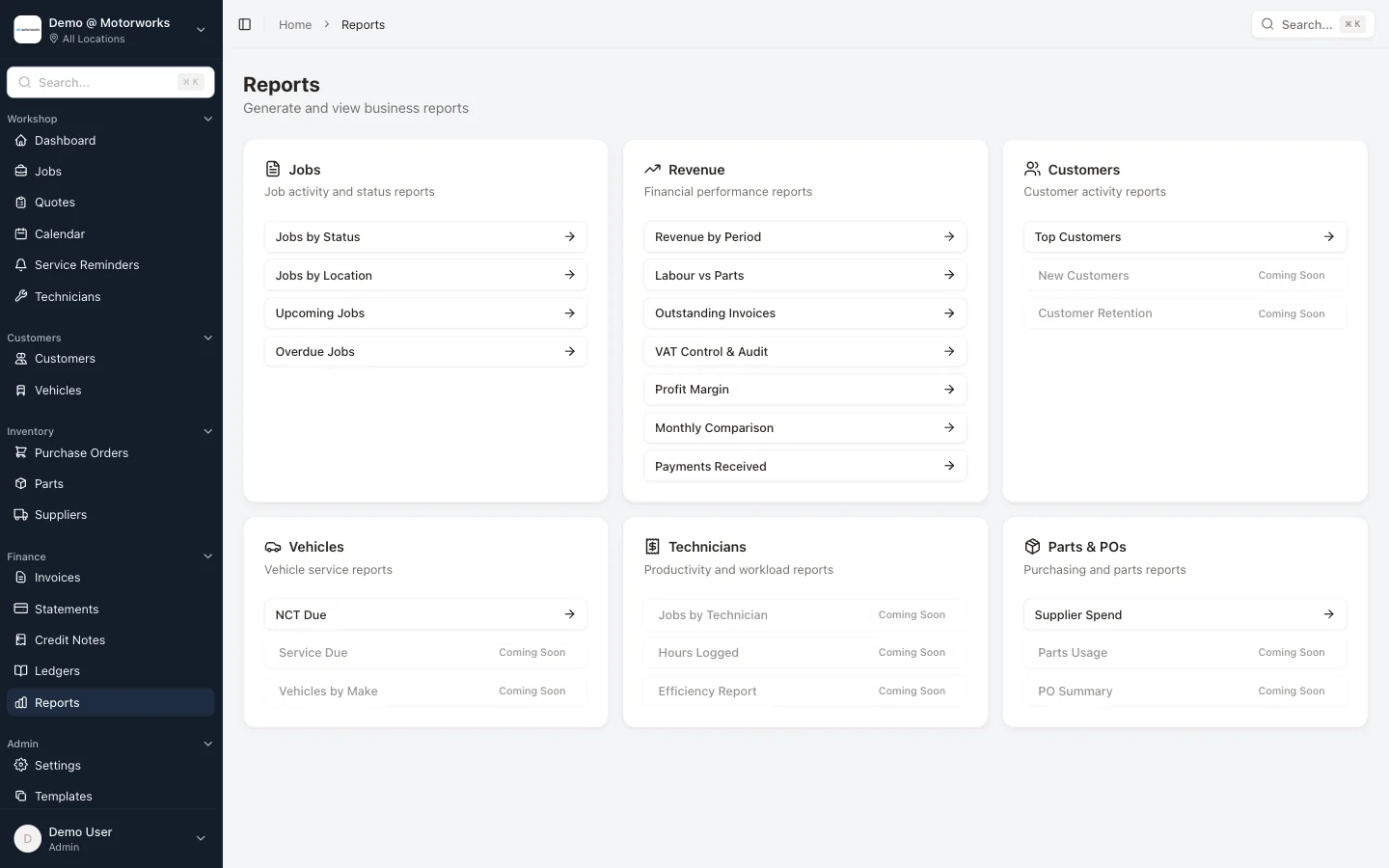
This is where job-level financial tracking earns its keep. When every hour worked is logged against a job, when diagnostic time is captured as a line item rather than absorbed, when jobs that run over get flagged for re-quoting — the effective rate you collect gets much closer to the rate you set. Profitability reports that show you labour revenue per job, per technician, and per service type make this visible. MotorWorks includes 15+ reports covering profit per job, per technician, per service type, revenue trends, and technician productivity — so you can see exactly where your labour recovery is strong and where it’s leaking. Without that visibility, you’re guessing.
It’s also worth noting that MotorWorks supports separate labour rates per location for garages operating across more than one site — so if your Dublin workshop charges €95 and your Midlands site charges €78, each location applies the correct rate automatically.
Putting it all together: a simple rate-setting process
If you want to calculate your own minimum viable labour rate, here’s the process in summary:
Step 1. Add up the true annual employer cost for each technician — wage, PRSI, holidays, sick pay, training, workwear.
Step 2. Estimate realistic billable hours per technician per year. Be honest. Use 1,300 to 1,500 depending on how efficiently your workshop runs.
Step 3. Divide total technician costs by total billable hours to get technician cost per billable hour.
Step 4. Add up your total annual overheads — rent, rates, insurance, utilities, equipment, software, accountancy.
Step 5. Divide total overheads by total billable hours to get overhead cost per billable hour.
Step 6. Add technician cost per hour and overhead cost per hour to get your total cost per billable hour.
Step 7. Divide by (1 minus your target net profit margin) to get your minimum charge-out rate.
If that rate is above market, investigate your cost structure. If it’s at or below market, you have room — make sure you’re using it.
For a detailed breakdown of where these costs sit relative to industry benchmarks, the post on the cost of running a garage in Ireland covers rent, insurance, wages, and other overheads in more detail.
Using your invoicing data to check the maths
Once you have a target rate, your invoicing history is the fastest way to check whether you’re hitting it.
Take the last three months of invoices. Total up all labour charges. Total up the hours that went to customer invoices. Divide. That’s your actual effective labour rate over that period.
If your target rate is €90 and your effective rate is €78, you have a recovery problem — jobs are running over, diagnostic time is being absorbed, or invoices aren’t being updated when scope changes.
Clean, searchable invoicing records make this calculation quick. If you’re still reconstructing invoices from memory or paper job cards, calculating your real effective rate takes much longer — and you’re less likely to do it, which means the gap persists.
For a broader look at where Irish garages sit on profitability benchmarks — and what the healthy ranges for parts margin and net profit actually look like — the post on garage profit margins and benchmarks for Irish workshops covers the full picture.
Key takeaways
- Set your labour rate based on your own cost structure, not what your competitors charge.
- The true cost of a technician is 25 to 30% above their gross wage once PRSI, holidays, sick pay, and training are included.
- Not all attendance time is billable. A realistic billable utilisation rate is 75 to 85% of hours worked.
- Overhead costs — rent, insurance, utilities, equipment, software — need to be recovered through your rate. Divide your total overheads by your total billable hours to find the overhead cost per hour.
- Add your target profit margin on top. At a 15% margin target, divide total cost per hour by 0.85.
- Setting the right rate solves only half the problem. Consistently recovering that rate on every job — capturing diagnostic time, updating jobs that run over, tracking labour to the invoice — is the other half. A proper job management system with time logging makes this measurable rather than guesswork.
- If your rate hasn’t been reviewed in two or more years, it almost certainly needs to go up. Wages, insurance, and operating costs have all increased meaningfully since 2023.
If you want to see what job-level profitability tracking looks like in practice, book a demo. We’ll show you how MotorWorks captures labour hours against jobs, links parts costs through purchase orders for real margin visibility, and gives you the reporting to see what your effective rate actually is — versus what you think it is.
Frequently asked questions
What is the average garage labour rate in Ireland? In 2026, independent garages in Ireland typically charge €65 to €115 per hour for labour depending on location. Dublin and larger urban areas tend to sit at €85 to €115. Provincial towns and rural garages more commonly charge €65 to €85. The right rate for your workshop depends on your specific cost base, not the regional average.
How do I calculate my minimum labour rate? Add up the true annual employer cost for each technician (wage, PRSI, holidays, sick pay, training). Divide by realistic billable hours (typically 1,300 to 1,500 per technician per year). Add your overhead cost per hour (total annual overheads divided by total billable hours). Then divide by one minus your target profit margin. The result is your minimum charge-out rate.
Should I charge the same rate as other garages in my area? No. Your competitors’ rates reflect their cost structures, which may be very different from yours. Their rate might be profitable for them and a loss-maker for you. Use their rates as context, not as your starting point. Start from your costs.
How often should I review my labour rate? At minimum, annually. If your technician wages have increased, if your rent or insurance has gone up, or if your equipment costs have changed, your rate should be reviewed immediately. Many garages that are financially stretched have not reviewed their rate in two or three years despite significant cost increases over that period.
What if raising my rate means losing customers? Some customers will be price-sensitive and may look elsewhere. But customers lost when you raise to a sustainable rate were, by definition, customers you were serving at a loss or at break-even. A smaller number of profitable customers is a better position than a large number of customers at a rate that doesn’t cover your costs. Most loyal, established customers accept a clearly communicated annual increase without leaving.
What is employer PRSI and how does it affect my labour rate? Employer PRSI is a payroll tax paid by Irish employers on top of employee wages. The main rate is 11.15% on most earnings above the weekly threshold. On a €40,000 gross wage, employer PRSI adds approximately €4,460 to your annual staffing cost. This needs to be factored into your technician cost per hour when setting your rate.