It’s Wednesday at half two. You’ve got three cars waiting, two jobs overrunning, a parts delivery that hasn’t arrived, and someone on the phone asking when their Audi will be ready. Your best technician is standing in the yard waiting on a decision about what to do next.
You’re not understaffed. You’re disorganised — and the difference matters enormously.
Most busy garages don’t need more people. They need better systems. The jobs are there. The skills are there. The problem is all the friction in between: the waiting, the searching, the miscommunication, the decisions that take five minutes instead of thirty seconds.
This guide covers the practical improvements that actually move the needle on workshop efficiency — a clearer way of running the jobs you’re already doing.
What “maxed out” usually means
When a garage owner says they’re at capacity, what they usually mean is that they feel at capacity. The ramps are full. The diary is full. The team is busy. But full ramps and high throughput aren’t the same thing.
If you’re doing 15-25 jobs a day and it feels like you’re constantly firefighting, the issue almost certainly isn’t how many staff you have. It’s how much time those staff spend on the actual work versus everything that surrounds it.
Think about how many times a day a technician stops work to:
- Wait for someone to tell them what job is next
- Track down a part that was ordered but nobody knows where it is
- Call the front desk to get a customer’s phone number
- Ask about the diagnosis before they can start
- Wait for approval to order a part they know they need
None of these are major events on their own. But they add up across a workshop of four or five people over an eight-hour day. An hour of combined dead time across your team, five days a week, is a significant amount of work that isn’t getting done.
Improving workshop efficiency starts with identifying where that time actually goes.
Fix your scheduling first
Poor scheduling is the root cause of most workshop inefficiency. Not because garages don’t use diaries — they all do — but because most scheduling is done without enough information.
When you book a job over the phone, you’re making decisions about time allocation without knowing which technician is best suited, what parts you’ll need, or how long a similar job actually took last time. So you guess. And when enough guesses are slightly wrong in the same direction, your whole day slips.
Book by technician, not just by time
Every technician in your workshop has different strengths. One is faster on diagnostics. Another is your go-to for electrical work. If you’re scheduling jobs to ramps rather than people, you’re leaving efficiency on the table.
Good workshop scheduling matches jobs to the technician best suited for them, and accounts for how long that specific technician typically takes on that type of work. That’s not something you can do effectively with a paper diary or a shared Google calendar.
Build in realistic job time
Most garages underestimate job durations when they book, then spend the rest of the day compensating. The diagnostic that always runs long. The service that turns into a brake job once the car is on the ramp. Booking too tight creates a cascade effect where everything from midday onwards is delayed.
Review your actual job times. If a full service reliably takes two and a half hours in your workshop, stop booking it as two. Padding your schedule with reality instead of optimism is one of the simplest things you can do for throughput.
Stop overbooking Monday morning
Many garages load Monday heavily because the diary looks empty over the weekend. By 11am, everything’s backed up, the team is stressed, and customers who booked first thing are already waiting longer than expected.
Spreading bookings more evenly through the week — and keeping a few flex slots for diagnostics and unexpected work — makes the whole operation run more smoothly than any amount of hustle can compensate for.
Get jobs moving faster through the workshop
Once a car arrives, the clock starts. Every minute it sits waiting is a minute of capacity you’re not recovering. The biggest drains on job flow tend to be the same across most workshops.
The car that arrives without a proper job brief
A technician who walks up to a car and doesn’t know what’s been agreed with the customer, what’s been checked, or what parts are expected — that technician is starting from scratch. They’ll ask around. They’ll recheck things the service advisor already confirmed. They’ll wait before starting.
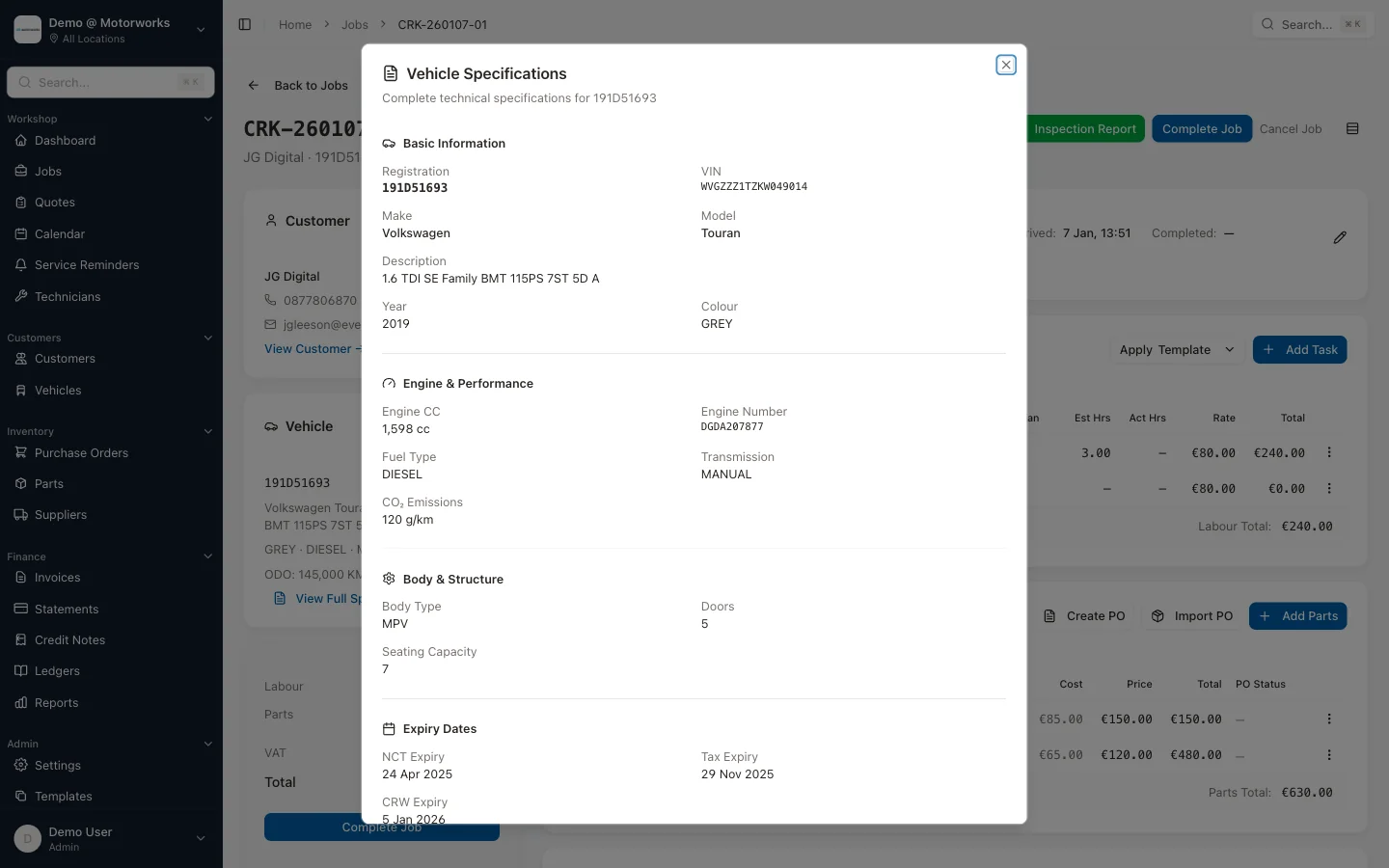
A proper job card or digital job sheet travels with every car from booking to completion. It carries everything the technician needs to start work without asking anyone: what the customer reported, what was observed at check-in, what parts are on order, what the target completion time is.
This sounds obvious. Most workshops still don’t do it consistently.
The waiting game between stages
Jobs don’t stall at the start — they stall in the middle. The diagnostic is done, but nobody has told the service advisor to approve the additional work. The parts have arrived, but the technician is on a different car and nobody flagged that their job can restart. The car is ready, but the invoice isn’t prepared, so it’s sitting on a ramp waiting to move.
These handoff moments are where workshop time disappears. In a well-run workshop, every job status change triggers the next step automatically. In a typical workshop, someone has to notice, walk over, and tell someone else.
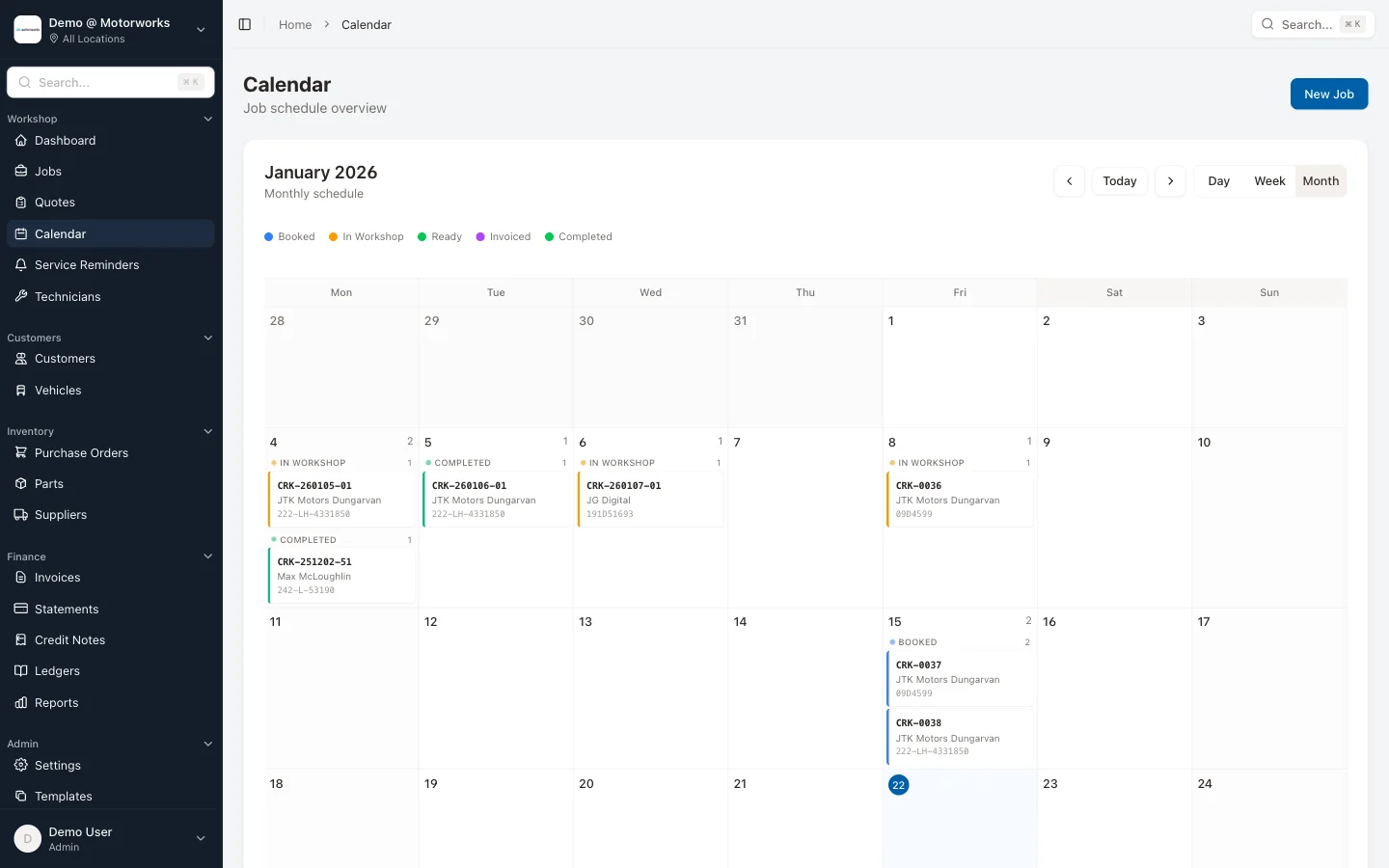
Software that manages job flow — showing job status in real time, alerting staff when a job is ready for the next stage — removes the reliance on everyone mentally tracking half a dozen jobs at once.
The technician waiting for a decision
This one costs more than most owners realise. A technician on a diagnostic finds an additional issue and needs approval to proceed. They tell the service advisor. The service advisor tries to reach the customer. The customer calls back twenty minutes later. The technician has moved to another job and now needs to context-switch back.
The MotorWorks customer portal handles this. Send the customer a quote for the additional work, and they approve it on their phone — no phone calls, no voicemail, no waiting. The approval is logged against the job, which also gives you a record of exactly what was agreed if the customer later questions the invoice.
Parts management: the hidden efficiency killer
Parts are where workshop efficiency breaks down more often than anywhere else. The car is ready to go. The technician is available. The ramp is clear. And you’re waiting on a part that was supposed to arrive this morning.
Order early, track properly
The best-run workshops order parts the moment a job is confirmed, not when the car arrives. For routine services and common repairs, the parts should be sitting ready before the technician walks up to the car.
This requires knowing, at booking time, what the job involves. It also requires a parts ordering system that doesn’t rely on memory or sticky notes.
In MotorWorks, purchase orders are linked directly to jobs. Every part has a job attached to it, every order is traceable, and when the delivery arrives it can be matched instantly to the work it belongs to. This also means you can see true margin on every job — parts cost from the PO, labour from the time log, revenue from the invoice. No more parts shelf with unlabelled boxes and no idea which job they’re for.
Stop losing parts on the shelf
Walk into most busy workshops and you’ll find a shelf — or a corner, or a windowsill — with parts that arrived for jobs. Some are labelled. Many aren’t. Occasionally a part gets used on the wrong job, or ordered twice, or forgotten entirely when the customer’s car comes in.
Every part should have a job reference from the moment it’s ordered. When it arrives, it goes into a specific place for that specific job. When the car comes in, there’s no searching, no confusion, no delay.
This sounds like admin. It is — but it’s admin that pays for itself immediately in reduced waiting time.
Build supplier relationships around speed
For common parts, get to know which suppliers can turn things around in two to three hours. Have an account with at least two for each part category so you’re not waiting on a single supplier during a backlog.
The best garages aren’t necessarily working with the cheapest suppliers. They’re working with the most reliable ones, because every hour a job waits on a part is an hour that ramp is occupied without earning.
How software removes the bottlenecks
A lot of the friction described above is a communication and information problem. People in the workshop don’t have the information they need, when they need it, in a format they can act on.
Everyone sees the same picture
When your job management lives on paper or across a few different systems, everyone has a slightly different view of what’s happening. The service advisor thinks the Passat is nearly done. The technician is waiting on a part. The customer has just called expecting to pick it up.
With MotorWorks, everyone — from front desk to workshop floor — is looking at the same job status, in real time. Jobs move through defined stages (booked, in workshop, waiting on parts, ready, invoiced, completed), and each status change is visible instantly. The technician marks a job as waiting on parts. The service advisor sees that immediately and calls the customer. No crossed wires, no embarrassing phone calls, no cars sitting unremarked for two hours.
The mobile advantage on the workshop floor
Getting your team to update a job status shouldn’t require them to walk to the office computer. With a mobile app on a phone or tablet, technicians can update job progress, flag issues, and receive new job assignments from wherever they are on the floor.
This is particularly valuable for larger workshops where the distance between the ramp and the front desk is a genuine friction point. When updating a job takes ten seconds on a phone instead of a three-minute walk and a conversation, it actually happens.
Visibility into where time goes
You can’t improve what you can’t measure. One of the biggest benefits of moving to workshop management software is that you start to have data on your own operation.
How long do your full services actually take? Which technician completes pre-NCT inspections fastest? Which job type reliably overruns its allocated time? Which supplier delivers fastest when you’re in a bind?
Most garage owners operate on gut instinct and memory for these questions. MotorWorks reports give you actual numbers — profit per job, technician productivity, revenue by service type, and more across 15+ report types. Actual data lets you make better decisions about scheduling, pricing, and resource allocation.
If you’re considering making this shift, our guide to going digital as a garage owner covers how to manage the transition without disrupting your day-to-day.
Practical quick wins you can implement now
If a full software implementation feels like a big step, start with the habits that don’t require any technology:
Standardise your job card. Whether paper or digital, every job that enters your workshop should have the same fields completed: customer contact, vehicle reg, work agreed, estimated time, parts expected. Inconsistency in how jobs are started creates inconsistency in how they run. If you’re still on paper, our guide to digital job cards vs paper covers the practical differences.
Set a daily job board. A whiteboard with current jobs, assigned technicians, and target completion times gives the whole team a shared view of the day. It’s not as powerful as software, but it’s infinitely better than everyone working from their own mental model.
Do a morning walk-around. Before the day starts, spend ten minutes with the whole team going through what’s in the diary, who’s doing what, and where the pressure points are. This five-minute stand-up prevents hours of mid-day confusion.
Track your no-movement time. For one week, note every time a technician is idle or waiting. Not on a break — genuinely stalled. At the end of the week, look at the list. You’ll see the patterns, and the patterns will tell you where to focus.
Pre-call the customer before complex jobs. For anything beyond a routine service, call the customer the day before to confirm what’s agreed and whether they have any other concerns about the car. This prevents scope creep surprises and reduces mid-job authorisation delays.
The efficiency ceiling
Here’s the honest version: there is a ceiling to what you can achieve without proper tools. Manual processes, even good ones, break down as volume increases. A whiteboard that works for fifteen jobs a day becomes unmanageable at twenty-five.
If you’re already doing the basics well and still feeling the squeeze, the next step is almost certainly software. Not because software is magic, but because the coordination and communication problems that limit growth can’t be solved with more paper.
The garages that handle high volume without high stress aren’t better garages. They’re more systematic garages. They’ve got fewer decisions being made in the moment, fewer things relying on one person’s memory, and fewer handoffs that happen by accident instead of by design.
Workshop efficiency isn’t about working harder. It’s about reducing the time between one job ending and the next one starting — the gaps where no value is being created but costs keep running.
Most workshops have more gap than they realise. Not sure where to start? Take our free Workshop Health Check to see where your biggest efficiency gains are.
If you want to see how MotorWorks handles scheduling, job flow with defined stages, purchase orders linked to jobs, customer approvals via the portal, and reporting across 15+ metrics, book a demo and we will walk you through how it works for a workshop your size. No obligation, no hard sell — just an honest look at whether it fits.