You take on a new member of staff and wonder if the books will hold. You renew your insurance and the premium has gone up again. You get a quote to repair the lift and wonder where that’s coming from. And somewhere underneath all of it, you know you should understand your numbers better than you do — but between running the workshop and keeping customers happy, when exactly is that supposed to happen?
If you’re an existing garage owner trying to get a grip on your costs, or someone thinking about buying or starting a garage in Ireland, this breakdown is for you. We’ve pulled together realistic 2026 figures across every major cost category — no spin, no rounding things down to make it look more attractive. Just the numbers as they are.
Running an independent garage in Ireland is a viable, often very profitable business. But the margins only work if you know what you’re carrying.
What kind of garage are we talking about?
The numbers below are based on a typical independent garage in a provincial Irish town or city suburb. Call it three to four ramps, two to three technicians, one front-of-house person or working owner. Turnover somewhere between €400,000 and €800,000 a year. General mechanical work — servicing, NCT prep, brakes, tyres, exhausts, diagnostics.
A city-centre garage or a main dealer will see different numbers. But for the bread-and-butter independent workshop, this is the territory.
We’ve structured it by cost category and given annual figures with a monthly equivalent where that’s more useful.
Premises costs
Rent
This is the single biggest fixed cost for most garages, and it varies enormously by location.
- Rural or small town: €18,000 to €30,000 per year
- Provincial city (Limerick, Galway, Waterford, Cork suburbs): €30,000 to €55,000 per year
- Dublin suburbs: €50,000 to €90,000 per year
- Dublin city or major commercial areas: €90,000+ per year
If you own your premises outright, you don’t pay rent — but you’re still carrying an opportunity cost (the return you could earn if you leased the space to someone else). Don’t ignore it when you’re thinking about whether the business is genuinely profitable.
Typical annual rent for this model: €35,000 to €55,000
Commercial rates
Commercial rates are a local authority charge on business premises, calculated based on the rateable valuation of the property. For a garage of typical workshop size, rates generally run between €4,000 and €12,000 per year depending on location and the size of the premises.
Rates have increased steadily since the post-Covid revaluation cycle and many garages saw their bills jump meaningfully in 2024-2025.
Typical annual rates: €5,000 to €10,000
Insurance
Insurance for an independent garage is not cheap, and it has not been getting cheaper.
A typical independent garage in Ireland needs:
- Garage liability (public liability + product liability): This covers you if a customer’s car is damaged on your premises, or if a repair you carried out causes damage later. Expect €3,500 to €7,000 per year depending on turnover and claims history.
- Employer’s liability: Required as soon as you employ anyone. Usually bundled with garage liability — if priced separately, budget €1,500 to €3,000 on top.
- Motor trade road risks: Covers your staff driving customer vehicles. This has increased significantly in recent years. For a small to medium garage, budget €4,000 to €9,000 depending on the number of drivers and their records.
- Buildings and contents: If you’re renting, your landlord covers the structure — but you cover equipment, tools, stock, and the fit-out. Budget €1,500 to €3,500.
Total typical annual insurance cost: €10,000 to €20,000
If you’ve had a claim, or if your staff have driving convictions, you’ll be at the higher end or beyond it. If your insurer knows you have proper systems and security (CCTV, access control, a clean claims history), you may get closer to the lower end.
Equipment and tools
Equipment is partly a capital cost and partly an ongoing cost. Here’s how it splits out.
Capital equipment (one-off or replacement cycle)
- 2-post lift: €4,000 to €10,000 new. Well-maintained lifts last 15 to 20 years. Budget for one replacement per decade.
- 4-post or scissor lift: €8,000 to €18,000.
- Wheel alignment system: €8,000 to €25,000 depending on specification.
- Tyre changer: €3,500 to €8,000.
- Wheel balancer: €3,000 to €7,000.
- Brake tester: €6,000 to €15,000.
- Multi-brand diagnostics system: €3,000 to €8,000, with ongoing subscription costs on top.
- Exhaust emissions analyser: €2,000 to €5,000.
- Air compressor and pneumatic tooling: €2,000 to €5,000.
For a reasonably equipped independent garage, the capital investment in equipment is typically in the range of €60,000 to €130,000 by the time you’re properly set up. This is usually spread over several years rather than paid upfront.
Ongoing equipment costs
- Maintenance contracts and servicing: Lifts, diagnostics systems, and specialist equipment all need regular servicing. Budget €2,000 to €5,000 per year for maintenance across the shop.
- Consumables: Oils, fluids, gases, cleaning materials, disposal costs. Roughly €4,000 to €8,000 per year for a garage of this size.
- Tool replacement and small equipment: Good hand tools don’t last forever, especially in a busy workshop. Budget €1,500 to €3,000 per year.
- Diagnostics software subscriptions: Multi-brand diagnostic software is increasingly subscription-based. Budget €1,200 to €3,600 per year depending on coverage levels.
Total ongoing equipment and consumable costs per year: €9,000 to €20,000
Staffing costs
This is the area where the numbers are most often underestimated, because people look at wages and forget the employer costs on top.
Wages
In 2026, qualified motor technicians in Ireland expect:
- Junior technician (1-3 years qualified): €28,000 to €36,000 per year
- Mid-level technician (3-7 years): €36,000 to €45,000 per year
- Senior technician or specialist: €45,000 to €55,000 per year
- Service advisor or front-of-house: €28,000 to €38,000 per year
For a three-person workshop (two technicians, one working owner or one front-of-house person), wages alone run from approximately €80,000 to €130,000 per year before any employer costs.
Finding and keeping good technicians is one of the most significant pressures on Irish garages right now. Demand for qualified mechanics outstrips supply significantly, particularly outside Dublin. Some garages are paying meaningfully above these figures to hold on to experienced staff.
Employer PRSI
Employer PRSI in Ireland is currently charged at 11.15% on most earnings above the weekly threshold. On an annual wage of €40,000, the employer pays approximately €4,460 in PRSI on top of the gross wage.
Across a team of three, employer PRSI typically adds €10,000 to €18,000 to your annual payroll cost.
Other payroll obligations
- Holiday pay: Annual leave entitlement for full-time staff is four working weeks plus public holidays. For a €40,000 salary that’s approximately €3,100 in holiday cost.
- Sick leave: The Sick Leave Act 2022 introduced statutory sick pay, now at five days per year covered by the employer in 2025 and increasing. Budget for this.
- Pension: From 2024, auto-enrolment is being phased in. By 2026, employer contribution obligations are coming into effect — the specifics are still bedding in, but budget an additional 1.5% to 3% of payroll.
- Protective equipment and workwear: Overalls, boots, gloves. Budget €500 to €1,000 per person per year.
Total employer cost per employee beyond gross salary: typically 15-20% on top
On a two-technician, one-front-of-house model, the true total staffing cost including wages, PRSI, holidays, and ancillary costs is likely in the range of €110,000 to €160,000 per year.
Parts stock and purchasing
Most garages carry some level of parts stock — consumables, common filters, bulbs, wiper blades, oils, and fast-moving items for their typical vehicle parc. The level of stock varies considerably.
Holding stock
A well-stocked independent garage typically holds €8,000 to €20,000 of parts at any given time. This ties up cash, requires storage, and carries a risk of obsolescence if you hold branded parts for vehicles that age out of your typical customer base.
The shift toward same-day or next-morning delivery from trade suppliers (EuroCarParts, Tetrosyl, Autofirst, local factors) means many garages have reduced their held stock significantly and rely more on fast ordering. This is sensible cash management.
Parts purchasing spend
For a garage turning over €400,000 to €800,000, parts and consumables purchased for jobs typically represent 35% to 50% of revenue — though this depends heavily on your job mix. A bodywork or tyre-focused garage has a different ratio than a diagnostics and electrical specialist.
At €600,000 turnover, this means parts spend in the region of €210,000 to €300,000 per year — though the majority flows directly through to customer invoices and is recovered in markup. The net margin on parts (after markup) is typically 20% to 40% above cost.
The risk area is parts that are ordered but not billed, or where markup isn’t applied consistently. This is where purchase orders linked to jobs make a significant difference — every part ordered is tracked against the job it’s for, so nothing gets forgotten.
Utilities
Electricity
Garages are heavy electricity users. Lifts, compressors, lighting, heating, diagnostics equipment, welding equipment — it adds up. Average electricity costs for a workshop of this size in Ireland in 2026:
- Annual electricity cost: €8,000 to €18,000
Unit prices have stabilised somewhat from the 2022-2023 spike but remain well above pre-2021 levels. A solar PV installation (typically €15,000 to €25,000 for a commercial roof-mounted system) can make a meaningful dent in this — many garages have invested in solar in the last two years and are seeing payback periods of five to eight years.
Heating and gas
Most workshops use oil or gas heating for the workshop space and office. Annual cost:
- Annual heating: €3,000 to €8,000 depending on size and insulation.
Waste disposal
You are legally required to dispose of used oil, tyres, brake fluid, batteries, and other automotive waste through licensed waste contractors. This is not optional, and Revenue has increased enforcement activity in this area.
- Annual waste disposal: €2,000 to €5,000
Total typical annual utilities: €14,000 to €31,000
Software and technology
Technology costs have increased for garages over the last five years as the industry has digitised. Here’s what a well-run independent garage is typically spending in 2026.
Garage management software
A proper garage management system — job cards, invoicing, purchase orders, customer records, scheduling, service reminders — typically costs between €150 and €400 per month, depending on the system and the level of features.
That’s €1,800 to €4,800 per year. Not nothing. But a garage running on pen, paper, and spreadsheets is losing more than that in uncharged labour, forgotten parts, and missed follow-up jobs. The software pays for itself.
Accounting software or accountant integration
If you use standalone accounting software (Xero, Sage, or similar), budget €600 to €1,800 per year depending on the plan. Many garages rely on their garage management system for day-to-day financial tracking and use a simpler setup for accountant handoff.
Phone and broadband
A reliable broadband connection is essential for cloud-based systems, diagnostics software, and day-to-day communication. Budget €1,200 to €2,400 per year for business broadband and a basic phone system.
Card payment processing
Card terminals cost €20 to €50 per month to rent or are provided free by payment providers. Transaction fees typically run 0.5% to 1.5% depending on your volumes and the processor. On €600,000 revenue (most of which flows through card or bank transfer), payment processing costs can be in the range of €2,000 to €5,000 per year.
CCTV and security monitoring
Required for insurance purposes in many cases, and good practice in all cases. Budget €500 to €1,500 per year for monitoring contracts plus any equipment upkeep.
Total typical annual software and technology costs: €7,000 to €16,000
Accountancy and professional fees
You need a good accountant. Full stop.
An accountant who understands the motor trade — who knows the Revenue rules on VAT in the garage sector, who keeps you right on employer obligations, who plans your tax position — is worth significantly more than their fee.
For an independent garage at this scale, annual accountancy fees typically run:
- Annual accounts, tax return, basic advisory: €3,000 to €6,000 per year
- Payroll bureau (if outsourced): €500 to €2,000 per year depending on payroll frequency and headcount
- Bookkeeping support: €1,500 to €4,000 per year if you outsource any portion of it
The cleaner your records going in, the lower your accountancy fee coming out. If your garage management software produces clean, categorised transaction data — with invoicing, credit notes, and partial payments all tracked — your accountant spends less time on archaeology and more time on advice. That’s covered in more detail in our guide to accounting software for Irish workshops.
Total typical annual professional fees: €4,000 to €10,000
Regulatory and compliance costs
Running a garage in Ireland comes with a number of ongoing compliance obligations that carry real costs.
Motor trade licensing
The motor trade does not require a formal licensing regime in the same way some other trades do, but there are obligations:
- SIMI membership: Optional but widely held. Approximately €600 to €1,200 per year depending on membership level.
- Authorised Treatment Facility (ATF) registration: If you handle end-of-life vehicles, you need EPA registration and must meet specific storage and disposal requirements. This is a significant compliance burden if applicable.
- NCTS-authorised garage: Some garages hold NCTS authorisation for particular services. There are associated fees and inspection requirements.
Health and safety
Under Irish health and safety law (Safety, Health and Welfare at Work Act 2005 and associated regulations), garages must:
- Maintain a current safety statement
- Conduct and document risk assessments
- Provide appropriate training
- Maintain lifting equipment inspection records (LOLER-equivalent requirements)
Compliance costs include:
- Safety statement preparation and annual review: €500 to €1,500 (external consultancy) or internal time
- Lifting equipment inspections: €500 to €1,500 per year across multiple lifts
- Health and safety training: See training section below
Data protection
GDPR compliance is relevant — you hold customer vehicle and personal data. If you haven’t done a GDPR review since 2018, it’s overdue. A one-off review costs €500 to €1,500. Ongoing obligations are largely internal process.
Total typical annual compliance costs: €2,000 to €5,000
Training and development
Ongoing technical training is not optional in 2026. Vehicle technology changes quickly — EVs, ADAS, hybrid systems, advanced diagnostics — and a garage that isn’t training its technicians will find itself unable to service an increasing proportion of the vehicle parc within a few years.
Technical training
- OEM or system-specific training courses: €300 to €1,000 per course, per person. A technician doing two to three courses per year costs €600 to €3,000 in training fees, plus time out of the workshop.
- IMI or SOLAS qualifications: Apprenticeship contributions if you’re training an apprentice. First-year apprentice wages are subsidised, but there are still costs associated with their time and training support.
- EV and hybrid training: Increasingly important. Recognised EV qualifications from providers like the IMI run €500 to €1,500 per person.
First aid and safety training
Mandatory first-aid training (one qualified first aider per shift) costs approximately €150 to €250 per person for a two-day course, renewed every two years.
Total typical annual training budget: €2,000 to €8,000
The garages that treat training as a cost to be avoided are the ones that lose staff to better employers and find themselves unable to take on newer vehicles. The ones that invest in it use it as a retention and marketing tool — “our technicians are trained to Level 3 EV” is a differentiator that will matter more with every passing year.
Putting it all together
Here is a consolidated annual cost summary for a typical three- to four-bay independent garage in Ireland in 2026.
| Cost category | Typical annual range |
|---|---|
| Rent | €35,000 to €55,000 |
| Commercial rates | €5,000 to €10,000 |
| Insurance | €10,000 to €20,000 |
| Equipment (ongoing) | €9,000 to €20,000 |
| Staffing (total employer cost) | €110,000 to €160,000 |
| Utilities | €14,000 to €31,000 |
| Software and technology | €7,000 to €16,000 |
| Accountancy and professional fees | €4,000 to €10,000 |
| Compliance | €2,000 to €5,000 |
| Training | €2,000 to €8,000 |
| Total fixed and semi-fixed overheads | €198,000 to €335,000 |
Parts purchasing sits outside this table because the bulk of it is directly recoverable from customers through job invoices. But your effective overhead — the money you spend before you’ve charged for a single job — is in the range of €200,000 to €335,000 per year for this type of operation.
At €600,000 annual revenue, that means your overhead-to-revenue ratio is roughly 33% to 56%. After parts costs (which might be 40% of revenue), you’re looking at a gross margin of 60% and a net margin — before the owner’s own drawings — of perhaps 10% to 25%. The variance depends almost entirely on how well labour is charged and how tightly parts costs are managed.
Where the money actually goes missing
Talking to garage owners, the cost leaks are rarely in the obvious places. They’re in the edges.
Uncharged labour. A technician spends 45 minutes on a diagnostic that wasn’t quoted and doesn’t make it onto the job card. Multiply that across a week. Across a year, a single technician losing 45 minutes of chargeable time per day costs the business approximately €15,000 to €22,000 in lost revenue at typical labour rates.
Parts not billed. A part arrives, gets fitted, and doesn’t make it onto the invoice because the job was finished in a rush. In a busy workshop, this happens more often than anyone wants to admit. Tracking purchase orders against jobs closes this gap entirely.
Underpriced labour rates. Many garages haven’t reviewed their labour rate in two or three years despite wages rising significantly. If your rate hasn’t kept pace with your employer costs, you’re working harder for the same money.
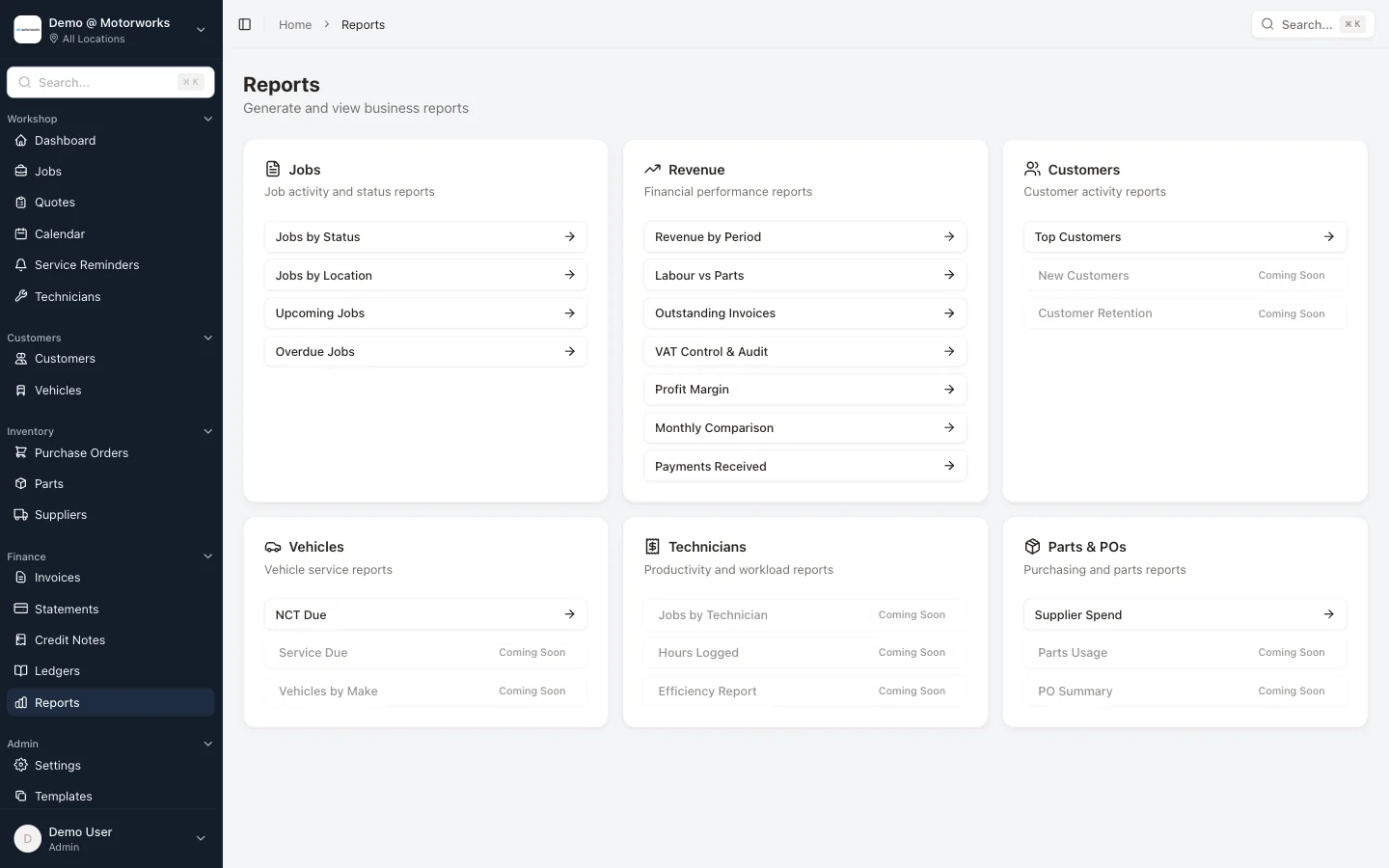
Not tracking job profitability. You might know your total monthly revenue and your approximate costs. But do you know which jobs made money and which didn’t? Which service types have healthy margins and which are break-even or worse? Profitability reporting by job, by job type, and by technician makes this visible — and once you can see it, you can change it. Our post on five numbers every garage owner should track covers what to look at first.
Late payment and aged debt. Cash in the door matters as much as revenue earned. A garage carrying €15,000 in aged debtors is effectively lending that money to customers interest-free while paying its own bills monthly. Statements, credit notes, and a consistent follow-up process close this gap. We’ve written a detailed post on how to stop chasing payments if this is a recurring problem.
What this means if you’re thinking about buying a garage
If you’re evaluating a garage acquisition in Ireland, these numbers are your starting point for due diligence. When you see a garage with a published turnover of €700,000 and an asking price, you need to understand:
- What are the actual lease terms and how long do they run?
- What is the insurance renewal history and current premium?
- What equipment is included and what is the condition and age of each item?
- What are the real employer costs on the current team?
- Is the owner’s wage included in the P&L, or are they drawing profit informally?
- Are parts being properly tracked and billed, or is there chronic undercharging?
- What does the customer database look like and what is the repeat rate?
A garage with €700,000 revenue and strong processes can be genuinely profitable. The same revenue with poor cost discipline can leave the owner working sixty hours a week for wages a technician would earn with less responsibility.
The numbers in this breakdown give you a framework for asking the right questions.
Getting your own numbers in order
The garages that understand their costs are the ones that can manage them. And the ones that manage them are the ones that can make confident decisions — on pricing, on headcount, on investment, on whether the business is actually growing or just getting busier.
If your current setup makes it hard to see your cost per job, your margin per service type, or your parts spend versus your parts revenue, that’s the first thing worth fixing. Clean financial data flows from a system that captures the right information at the right time — on the job card, at the point of ordering, at invoicing.
If you’re also thinking about what a garage owner can realistically earn at these cost levels, our breakdown of what a garage owner earns in Ireland pairs well with this post.
If you’d like to see how MotorWorks helps you track job costs, manage parts purchasing, and report on profitability across your workshop, book a short demo. No commitment, no hard sell — just a look at what the numbers could look like when everything is in one place.