You’ve been wrenching for fifteen years, you know the trade inside out, and at some point the thought crosses your mind: what would it actually be like to run my own place?
Or maybe you’re already running one — and you’re wondering whether what you’re drawing out of it is what you should be drawing, or whether you’re leaving money on the table every month without knowing it.
Either way, the question is the same: what does a garage owner in Ireland actually earn?
The honest answer is: it varies enormously. And most of what you’ll read online either inflates the number to make self-employment sound glamorous, or it’s US data dressed up as something relevant to Ireland. This post tries to give you a more grounded picture — the numbers, the variables, and what actually drives the difference between a comfortable living and a stressful one.
The range is wider than you’d expect
There is no single figure for a garage owner’s salary in Ireland, because the business model itself varies so much. A one-person mobile mechanic operation is structurally different from a four-bay independent workshop with two technicians and an office manager. Both are “garage owners.” Their earnings look nothing alike.
That said, here are realistic ranges based on industry data and what we hear from independent garages around the country:
Solo operator (owner-mechanic, 1–2 ramps): €35,000–€55,000 net per year. This assumes the owner is doing most of the technical work themselves, has reasonable parts margins, and is reasonably busy. It’s not a bad income, but it’s also not far ahead of what a senior employed mechanic earns — and it comes with significantly more responsibility and risk.
Small workshop (2–4 bays, 1–3 staff): €50,000–€90,000 net. This is where the range starts to open up. A well-run garage at this size, with good margins on parts and labour, a reliable customer base, and tight control of costs, can generate a solid owner income. But so can a busy but poorly-managed one that’s generating revenue without generating profit.
Larger independent operation (4+ bays, 4+ staff): €80,000–€150,000+ net. At this scale, the owner is typically less hands-on technically and more focused on managing the business. Profitability depends heavily on how well the operation is structured — labour recovery rates, parts margins, utilisation across the bays, and how tightly costs are tracked.
These figures represent what the owner actually draws — not gross revenue, not turnover. Gross revenue at a small-to-medium independent garage might be anywhere from €300,000 to over €1 million annually. What ends up in the owner’s pocket after wages, parts, rent, insurance, VAT, and tax is a different matter entirely.
What “salary” actually means for a garage owner
This is worth pausing on, because garage owners are almost never drawing a conventional salary.
Most run as sole traders or through a limited company. What they “earn” is the profit left after all business expenses are paid — including the wages of their staff, but not their own labour, which is often implicit rather than formally paid. Some owners pay themselves a director’s salary through a company structure; others take drawings as they go.
This matters because a garage showing €600,000 in annual turnover might deliver €60,000 to the owner’s pocket after everything is paid — or it might deliver €120,000. The difference is almost entirely down to how well the business is managed, not how busy it is.
Revenue and profit are not the same thing. A garage can be flat out all year and still not be making the money it should.
The factors that actually move the needle
Location
A garage in a Dublin suburb with 50,000 cars within a ten-minute drive is in a structurally different position from a rural workshop in Roscommon or Donegal. That’s not a value judgement — rural garages often have loyal customer bases, lower overheads, and less competition. But population density and local demand set a ceiling on how much revenue you can generate.
Urban garages face higher rent and more competition. Rural ones face lower throughput but potentially higher loyalty. Neither is automatically better, but location shapes what’s achievable.
Labour rate and how well it’s applied
The gap between what garages charge per hour and what they could charge is often wider than owners realise. A lot of Irish garages have not raised their labour rate in proportion to cost increases over the last few years, absorbing inflation rather than passing it on.
But the labour rate isn’t the only issue. The bigger leak is often in labour recovery — the difference between hours worked and hours charged. If your technician is in the workshop for eight hours but only four of those hours end up on a customer invoice, your effective rate has been halved. Diagnostic time, warranty work, quoting time, and jobs that run over without being re-quoted all eat into this.
Parts margins
Parts are where a significant portion of garage profit comes from — or should come from. Industry benchmarks suggest a gross margin of 25–40% on parts is reasonable for an independent workshop. Many garages are running below this without realising it, either because they’re not applying a consistent markup policy or because they’re not tracking parts costs against invoices properly.
The garages that manage this well treat parts as a profit centre, not just a pass-through cost. They know their average parts margin per job. The ones that struggle treat parts as an afterthought.
Size of team and how efficiently they’re working
Adding staff increases capacity but also increases fixed costs. An extra technician generating €5,000 a month in labour revenue on a salary of €38,000 a year is roughly breaking even before you account for employer PRSI, tools, and insurance. The margin on that hire depends entirely on whether they’re consistently generating more than their cost.
This is why utilisation matters. Empty ramp time is lost revenue. A technician who is productive for six of their eight hours is contributing meaningfully. One who is productive for four is a cost burden.
Business structure and overheads
Rent is the biggest variable cost after wages. A garage paying €3,000 a month in rent needs to generate significantly more revenue to reach the same owner income as one that owns its premises or has a lower-cost lease. This is one reason why long-established garages often outperform newer ones at similar revenue levels — they inherited a cost structure from a cheaper era.
Insurance, heating, equipment leasing, and consumables all add up. The garages that track these carefully tend to spot problems early. The ones that don’t often find themselves wondering where the money went at year end.
After tax: what actually comes home
Ireland’s income tax system applies fully to self-employed garage owners. As a sole trader, you’ll pay Income Tax, PRSI (currently 4.2% from October 2025), and USC on your net profit. There’s an additional 3% USC surcharge on self-employed income above €100,000.
At an income of €70,000 net profit, an Irish sole trader is looking at an effective tax rate in the region of 35–42% depending on their personal circumstances, credits, and allowable deductions. That brings a €70,000 profit down to somewhere between €40,000 and €45,000 in take-home.
At €100,000 net profit, you’re in the higher tax bracket throughout, and your effective rate climbs. After tax, PRSI, and USC, you might see €55,000–€62,000 depending on deductions.
These aren’t reasons not to run a garage. They’re context. The self-employed take additional risk and carry additional stress in exchange for the potential for higher income. Whether the exchange is worth it depends enormously on how well the business is managed.
Operating through a limited company changes the calculation somewhat — you can retain profits in the company, pay yourself a salary, and plan more efficiently around tax. Many garage owners move to a company structure once they’re consistently profitable. That’s an accountant conversation worth having early rather than late.
Why two garages at the same size can earn very different incomes
This is the bit that matters most, and it’s the bit that’s hardest to see without data.
Two garages in the same town, similar size, similar number of staff, doing broadly similar work. One owner earns €65,000 a year. The other earns €40,000. What’s the difference?
Usually it comes down to a handful of things:
- Parts margins. One tracks every part ordered against the job it’s for — using purchase orders linked to jobs — and applies a consistent markup. The other orders parts by phone, fits them, and hopes the numbers work out.
- Labour recovery. One charges for diagnostic time and ensures job cards are updated when work takes longer than quoted. The other absorbs overruns.
- Debtor management. One has a clear process for following up on outstanding invoices using statements and credit notes. The other has a few customers who have owed money for months and nobody has pushed for it.
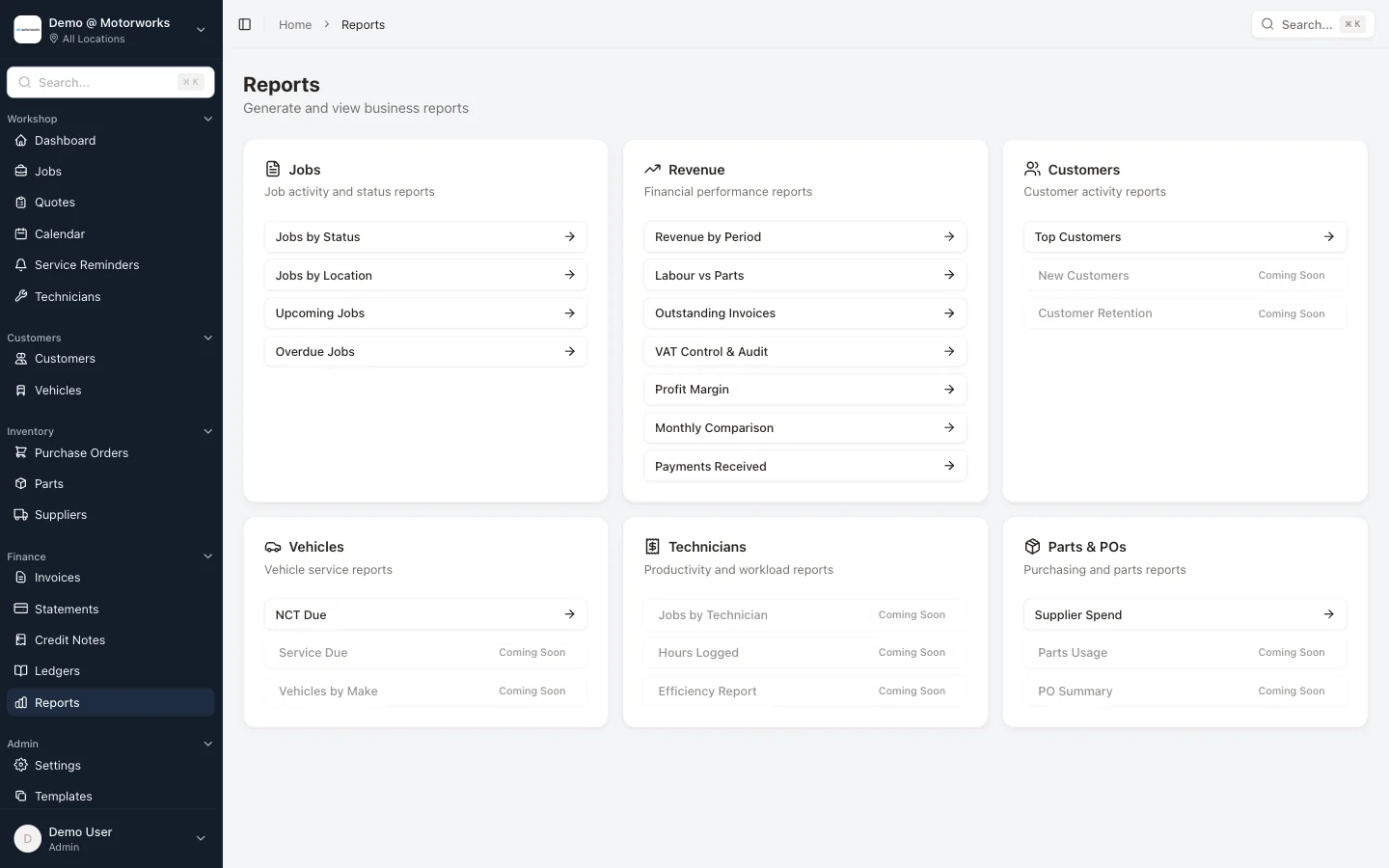
- Visibility. One owner reviews a monthly report that shows profit per job, outstanding debt, and which service lines are making money. The other does a spreadsheet at year end and hopes it matches what the accountant produces.
None of this requires being a business genius. It requires having the right tools and actually using them. The garages that can see their profitability data in real time — at the job level, not just the annual level — consistently make better decisions than those working blind.
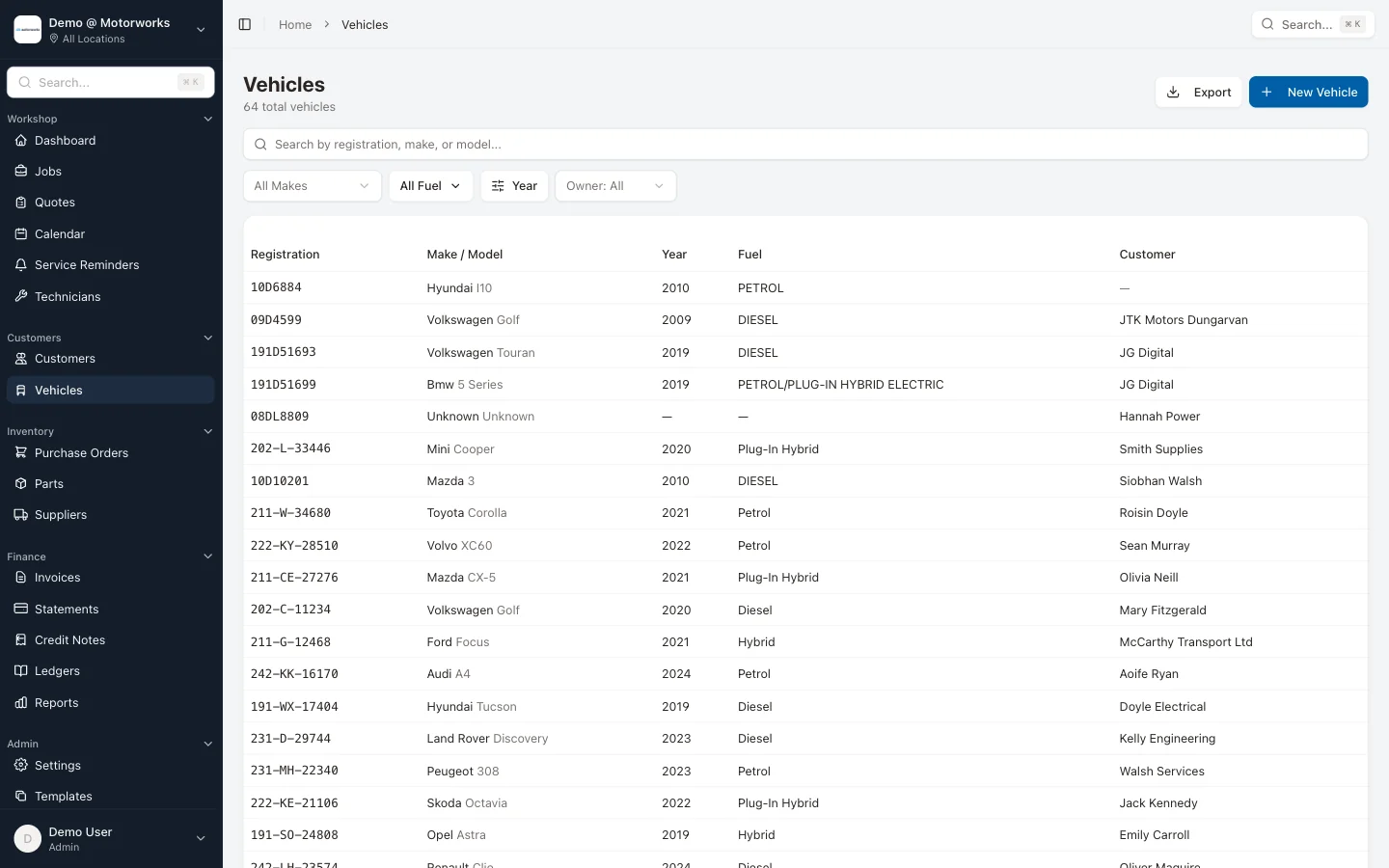
MotorWorks profitability reports are built specifically for this. Every job, every service type, every technician — with purchase order costs feeding directly into job-level margin calculations. You can see which work is making margin and which isn’t. That visibility is what changes the numbers over time.
What’s a reasonable expectation for a new garage owner?
If you’re starting out or have been running a garage for a few years and wondering whether you’re on track, here’s a realistic framing:
In the first one to three years, most garage owners are rebuilding a customer base, learning the business side, and managing startup costs. Net income in this period might be €35,000–€50,000 if things go reasonably well — comparable to or slightly below what you’d earn as an employed senior mechanic, with a lot more stress and uncertainty.
By years four to seven, a well-run operation should be generating meaningfully better returns. €60,000–€85,000 net is achievable for a focused owner of a mid-sized independent workshop who is managing their margins well.
Beyond that, the ceiling depends on ambition and capacity. Some garage owners cap out at a comfortable income from a business they enjoy running. Others grow to multiple locations or specialist operations and earn substantially more. There is no single right answer.
The honest summary
Running a garage in Ireland can be a very good living. It can also be a hard, underpaid slog if the business isn’t managed well. The difference between the two is rarely about technical skill — most garage owners are excellent mechanics. It’s about business fundamentals: pricing, margin tracking, debtor management, and understanding what’s actually making and losing money.
The garages that earn well tend to know their numbers. They review their financial reports regularly, not just at tax time. They price their labour honestly and review it annually. They track parts costs per job. They follow up on outstanding invoices.
If you want to know more about getting the financial side of your garage under control, our post on garage accounting software for Irish workshops covers the practical steps in detail.
If you want to see what better visibility over your garage’s profitability looks like, book a demo and we’ll walk you through how MotorWorks tracks margin at the job level — and what that typically reveals for garages switching from spreadsheets.