You’ve found a premises. You know the trade. You’ve done the sums on a napkin and they seem to add up. But now your bank manager, your Local Enterprise Office advisor, or your accountant is asking for a business plan — and you’re staring at a blank page wondering where to start.
Or maybe you’re at an earlier stage: you want to open a garage in Ireland and you know you need a plan, but nobody has ever shown you what one actually looks like for a workshop.
This guide walks you through a garage business plan structure that works in the Irish context — whether you’re applying for a bank loan, a LEO grant, or simply trying to organise your own thinking before you commit to a lease. Each section explains what lenders and advisors are looking for, what to include, and how to present it. There’s an example structure you can follow throughout.
It is not a generic business plan template with the word “garage” inserted. It is written for independent Irish workshops — general repair, servicing, NCT preparation, the kind of business that serves a local community of car owners.
Why your business plan matters more than you think
Most people writing a garage business plan are doing it because someone asked them to. The bank wants it before they’ll discuss lending. LEO wants it before they’ll approve a feasibility grant. The landlord wants it to assess you as a tenant.
That’s all fine. But the most useful thing a business plan does is force you to think clearly before you spend money.
A well-written garage plan will tell you whether the business is viable at the location you’re considering, at the revenue you’re projecting, with the cost structure you’re planning to carry. It will reveal assumptions you haven’t examined. It will identify risks you haven’t planned for.
If the numbers don’t work on paper, they almost certainly won’t work in practice. The plan is the test.
The structure of a garage business plan
A complete garage business plan for an Irish workshop should cover:
- Executive summary
- Business overview
- Market analysis
- Services and pricing
- Operations plan
- Premises and equipment
- Staffing plan
- Financial projections
- Funding requirements
- Compliance and regulatory overview
- Appendices
You don’t need to write them in that order — most people find it easier to start with the middle sections (services, operations) and write the executive summary last once they know what they’re summarising. But the final document should follow this flow, because that’s the order a reader will move through it.
Let’s go through each section.
Section 1: Executive summary
What it is: A one-to-two page summary of the entire plan. It covers the business concept, the opportunity, the key financials, and what you’re asking for.
What lenders look for: Clarity, credibility, and confidence. They want to know you understand your business, your market, and your numbers. An executive summary that is vague or padded tells them everything they need to know before they’ve read the rest.
What to include:
- The name and legal structure of the business (sole trader, limited company, partnership)
- Your location and the type of garage you’re opening
- The services you’ll offer
- Your target customer and geographic catchment
- A headline revenue projection for year one, two, and three
- How much funding you’re seeking and what it will be used for
- A one-line statement of your competitive advantage
Example:
AutoCare Rathmines Limited will operate an independent motor workshop from a four-bay premises on [address], serving private car owners in the Rathmines, Rathgar, and Terenure areas of Dublin. The business will offer general mechanical repair, vehicle servicing, pre-NCT inspections, and car diagnostics. Year one projected turnover is €380,000, growing to €510,000 in year two and €640,000 in year three as the customer base matures. We are seeking €85,000 in term lending from AIB to fund fit-out, equipment, and working capital. The owner has fourteen years of experience as a motor technician, including six years as workshop manager at an established Dublin independent.
Write this last. Keep it tight. Two pages maximum.
Section 2: Business overview
What it is: Background on the business — who’s behind it, what form it takes, where it operates.
What to include:
Legal structure
Decide early whether you’re opening as a sole trader or through a limited company. Most new garages start as sole traders for simplicity, but a limited company offers liability protection and can be more tax-efficient once profits reach a certain level. Your accountant should advise you on this before you register.
If you’re registering as a company, you’ll need to file with the Companies Registration Office (CRO) and get a company number. If you’re a sole trader, you register with Revenue and will file a Form 11 each year.
Either way, you’ll need to register for VAT if your turnover exceeds or is likely to exceed €40,000 per year — and most garages will exceed this in their first few months of trading.
Owner background
Include a brief biography of yourself (and any business partners). This section carries significant weight with lenders. They are assessing you as much as the business. Include:
- Your qualifications (City and Guilds, FETAC/QQI, IMI accreditation, or equivalent)
- Years of experience in the trade
- Any prior management or business experience
- Whether you are SIMI-registered or intend to be
If you have a co-founder or business partner, include their background separately.
Business history (if applicable)
If you’re buying an existing garage rather than starting from scratch, include a brief history of the business, how long it has been operating, and the reason for the current owner’s exit. A going concern with an established customer base is a different proposition from a greenfield startup, and the plan should reflect that.
Section 3: Market analysis
What it is: Evidence that there is sufficient demand in your catchment area to support the business you’re describing.
What lenders look for: Realism and rigour. Anyone can say “there are lots of cars in Ireland.” What a lender wants to see is that you’ve thought specifically about your local market and why customers will choose you.
The Irish automotive landscape
There are approximately 2.1 million licensed private vehicles in Ireland as of 2025. NCT testing is compulsory for all vehicles over four years old, and the failure rate nationally hovers around 50%, generating significant repair demand. The private car remains the dominant form of transport outside Dublin, and car ownership rates are high relative to European averages.
The independent garage sector is large and fragmented. There is no dominant national chain — the market is made up of thousands of owner-operated workshops, many of which serve a loyal local customer base built over years. This fragmentation is both the market’s strength and its weakness: there is genuine demand for well-run local garages, but competition is local and often based on established relationships.
Your catchment area
Define your catchment realistically. For most independent garages, the majority of customers come from within five to ten kilometres of the premises. People want a garage they can drop a car to in the morning and collect on the way home. Long journeys to a garage are the exception, not the norm.
Research your specific area:
- Population and vehicle ownership: Check CSO data for the census district around your premises. A town of 12,000 people with high car ownership will have meaningfully different demand from an urban area of the same size where public transport is stronger.
- Existing competition: Map the garages within your catchment. How many are there? What do they specialise in? Are there obvious gaps — no garage offering NCT prep in the immediate area, no diagnostic specialist, a cluster of older operations that aren’t investing in newer vehicle technology?
- Demand signals: Are there long wait times at local garages? Do customers complain online about not being able to get appointments? Are neighbouring garages turning away work?
Your competitive advantage
This section is not the place for marketing language. It’s the place for honest self-assessment.
Are you the only garage within five kilometres? Are you opening in an area with high car ownership and underserved demand? Do you have a specific specialisation that isn’t available locally — EV servicing, wheel alignment, particular brand expertise? Are you offering something operationally different — online booking, evening appointments, a customer vehicle collection service?
Be specific. “We will provide excellent customer service” is not a competitive advantage. “We are the only garage offering ADAS calibration within fifteen kilometres, serving a catchment where 40% of vehicles are less than four years old” is.
Section 4: Services and pricing
What it is: A clear breakdown of what you’ll offer and what you’ll charge.
What lenders look for: A coherent service mix, pricing that’s realistic for your market, and an understanding of where your revenue will actually come from.
Service categories
Most independent garages in Ireland offer some or all of the following:
- Vehicle servicing: Oil and filter service, interim service, full service. This is the backbone of most workshop revenue and the anchor for customer relationships.
- NCT preparation and re-tests: High demand, relatively predictable, good introduction to new customers.
- Mechanical repair: Brakes, clutches, exhausts, suspension, steering, timing belts and chains. Variable revenue but often high margin on labour.
- Diagnostics: Increasingly important as vehicle technology advances. Requires investment in equipment and training but can command premium rates.
- Tyres: High volume, lower margin per job. Often used to drive footfall and upsell to other services.
- Wheel alignment: Specialist equipment required but good margin and growing demand as ADAS systems become more common.
- Air conditioning: Seasonal but consistent demand. Requires specific equipment and certification (F-gas).
- EV and hybrid servicing: Growing category. Requires investment in training and specific tooling. Increasingly, a competitive differentiator.
Choose a service mix that matches your equipment, your qualifications, and the demand in your market. Don’t list services you’re not equipped or qualified to deliver.
Pricing
Set out your pricing clearly. Use a table if it helps.
| Service | Price (inc. VAT) |
|---|---|
| Oil and filter service | €75 to €95 |
| Interim service | €120 to €150 |
| Full service | €180 to €230 |
| Pre-NCT inspection | €60 to €80 |
| Brake pad replacement (per axle, labour) | €60 to €80 |
| Wheel alignment (4-wheel) | €65 to €90 |
| Diagnostic inspection | €60 to €90 |
Your labour rate is the single most important pricing decision you’ll make. The market rate for independent garages in Ireland in 2026 is broadly €75 to €110 per hour, with higher rates in Dublin and lower rates in rural areas. Your rate needs to cover your employer costs, your overheads, and leave a meaningful margin. If you haven’t calculated your minimum viable labour rate, do that before you finalise your pricing.
For detailed guidance on what margins to target, our post on garage profit margins and benchmarks for Irish workshops covers the numbers in detail.
Section 5: Operations plan
What it is: How the business will actually work day to day.
What lenders look for: Evidence that you’ve thought through the operational reality, not just the headline concept.
Opening hours
Typical independent garage hours in Ireland:
- Monday to Friday, 8am to 6pm
- Saturday, 8am to 1pm or 2pm
- Closed Sunday
If you intend to operate outside these hours, explain why and how you’ll staff it.
Job flow and throughput
Describe how a job moves through your workshop, from booking to completion to invoicing and payment. A clear process reduces errors, prevents uncharged work, and improves the customer experience.
A sensible job flow for a well-run garage:
- Customer books online or by phone
- Vehicle arrives — registration checked against booking
- Job card opened, vehicle inspection completed
- Technician assigned to job
- Any additional work identified is quoted to the customer before proceeding
- Parts ordered against the job card (never informally)
- Work completed, job card signed off
- Invoice raised from completed job card
- Customer notified — vehicle ready for collection
- Payment taken at collection
Lenders who understand the trade know that uncharged labour and unbilled parts are the two biggest profit leaks in a garage. A documented job flow that prevents these leaks is a meaningful signal that you’re running the operation professionally.
Booking and scheduling
How will customers book? Phone-only is increasingly a competitive disadvantage — customers expect to be able to book at any hour, not only when you’re at the front desk. Online booking, even a simple system, captures enquiries outside hours and reduces the interruption to workshop time. For more on this, see our post on setting up online booking for your garage.
Describe your approach to scheduling capacity. How many ramp hours per day are you targeting? What is your target utilisation rate? For a garage with four ramps, aiming to fill 75% to 80% of available hours is a realistic and healthy target. (If you’re not sure how your current operations measure up, our free Workshop Health Check can help you identify gaps before you formalise the plan.)
Customer records and history
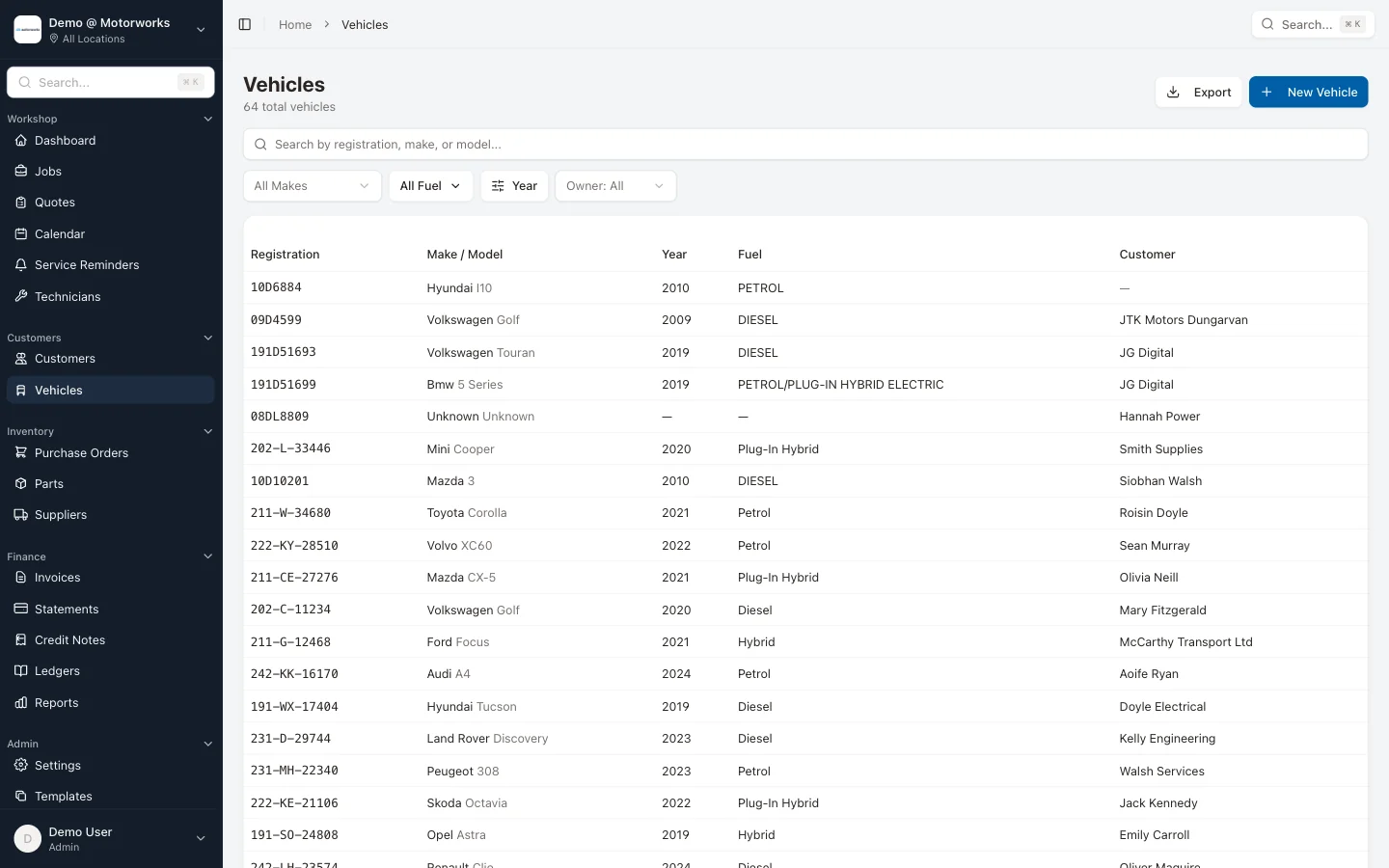
Every vehicle that visits your garage should have a documented history on file — what was done, what was found, what was declined, and when the vehicle is due for its next service, NCT, or other milestone. This is not just good practice; it’s the foundation of your repeat customer business.
Tracking service intervals and test due dates allows you to reach out to customers proactively with automated reminders rather than waiting for them to call. This single habit — reminder-based outreach — is one of the most consistent differences between garages that grow and garages that plateau. Our post on automated service reminders covers how to set this up in detail.
Section 6: Premises and equipment
What it is: A description of where you’ll operate, on what terms, and what equipment you’ll have.
What lenders look for: Security of tenure, appropriateness of the premises, and a realistic equipment budget.
Premises
Include:
- Address and a brief description of the building (size, number of bays, inspection pit if applicable, office space, customer waiting area)
- Lease terms — length, rent, break clauses, rent review schedule
- Landlord’s permission for the use as a garage (if the premises has previously been used for other purposes)
- Planning permission status — does the premises have the required planning consent for use as a motor workshop?
Planning is a point of failure for many new garages. A premises that has not been used as a garage before may require a change-of-use application. This can take months. Check with your local planning authority before you commit to a lease.
If you’re buying the freehold, include the purchase price, valuation, and your solicitor’s details.
Equipment
List the major equipment you’ll have at opening, whether purchased, leased, or included with the premises. Include the value and condition of each item.
| Equipment | Status | Value / Cost |
|---|---|---|
| 2-post ramps (x2) | New, purchased | €14,000 |
| 4-post ramp (x1) | Second-hand, inspected | €6,500 |
| Wheel alignment system | Leased | €220/month |
| Tyre changer | New, purchased | €5,500 |
| Wheel balancer | New, purchased | €4,500 |
| Multi-brand diagnostics unit | Leased | €180/month |
| Air compressor | New, purchased | €2,800 |
| Emissions analyser | Second-hand | €2,200 |
| Hand tools and general workshop equipment | Existing (owner’s) | €8,000 |
Lifts in Ireland must be inspected and certified before use and at regular intervals thereafter. If you are purchasing second-hand lifting equipment, ensure the seller can provide a current inspection certificate and that the equipment complies with PSSR (Pressure Systems Safety Regulations) requirements. Your insurer will require this.
Capital expenditure summary
Consolidate your equipment spend into a single figure for the business plan. Break it into:
- Purchased outright: Total capital cost
- Leased or financed: Monthly obligation and duration
- Existing (owner-provided): Estimated value
This figure feeds directly into your funding requirements in Section 9.
Section 7: Staffing plan
What it is: Who you’ll employ, when, and at what cost.
What lenders look for: A realistic staffing model that supports your projected revenue without overcooking your cost base.
Structure
Describe your intended team at launch and how it will evolve as the business grows.
Example — Year 1:
- Working owner (motor technician): No separate salary in year one; owner draws from profit
- One qualified technician (full-time): €38,000 gross
- One apprentice (year 2 of 4): €18,000 gross
Example — Year 2:
- Working owner: Begins drawing a salary of €35,000
- One qualified technician: €40,000 gross (pay review)
- One apprentice: €20,000 gross
- Part-time service advisor (20 hours/week): €15,000 gross
Employer costs
The plan must account for employer PRSI (11.15% on most earnings above the weekly threshold), holiday pay, sick leave obligations under the Sick Leave Act 2022, and auto-enrolment pension contributions which are being phased in from 2024. In practice, the total employer cost for each employee is approximately 15 to 20% above the gross salary.
For a detailed breakdown of what staffing actually costs in an Irish garage, see our post on the true cost of running a garage in Ireland.
Recruitment
Note any planned use of recruitment agencies, apprenticeship programmes (SOLAS/IMI), or trade associations like SIMI for sourcing candidates. Qualified technician shortage in Ireland is real — building a pipeline through apprenticeships is increasingly the most reliable route to growing a team. For a detailed walkthrough of the hiring process, see our guide on hiring your first mechanic in Ireland.
Owner roles and responsibilities
Be clear about what role you’re playing in the business. Are you on the tools full-time? Are you splitting your time between workshop and management? Are you primarily a business manager who will not do technical work?
This matters for your revenue projections — a working owner on the ramp adds billable hours to the business. A management-only owner does not, but should free up time for business development and customer relationships.
Section 8: Financial projections
This is the section lenders scrutinise most carefully. It needs to be credible, internally consistent, and clearly linked to your assumptions.
You need three documents:
- Projected profit and loss (three years)
- Cash flow forecast (twelve months, month by month)
- Projected balance sheet (at year one, year two, and year three)
Revenue assumptions
Build your revenue projection from the ground up, not as a top-down guess.
Start with your capacity:
- How many ramps do you have?
- How many productive hours per day per ramp?
- What is your target utilisation rate? (Aim for 70% in year one, 80% in year two as the customer base grows)
- What is your average job value?
Example calculation — Year 1:
| Ramps | 3 |
| Productive hours per ramp per day | 7 hours |
| Working days per year | 240 |
| Total available ramp hours | 5,040 |
| Target utilisation (70%) | 3,528 hours |
| Average charge-out rate | €85/hour |
| Labour revenue | €299,880 |
| Parts revenue (approx. 35% of total revenue) | €161,000 |
| Total projected revenue | €460,000 |
Adjust the inputs to match your specific situation. The key variables are utilisation rate (how quickly you fill your diary) and average charge-out rate. Be honest: most new garages do not hit 70% utilisation in month one. Build in a ramp-up period — months one to three at 40%, months four to six at 55%, months seven to twelve at 70%.
Cost assumptions
Map your costs against the categories described in Section 6 (premises), Section 7 (staffing), and the operational costs outlined in this guide. Use realistic figures rather than optimistic ones.
Key cost lines for a three- to four-bay independent garage:
| Cost category | Year 1 estimate |
|---|---|
| Rent | €42,000 |
| Commercial rates | €7,000 |
| Insurance | €15,000 |
| Staffing (total employer cost) | €75,000 |
| Equipment leases and maintenance | €12,000 |
| Utilities (electricity, heating, waste) | €18,000 |
| Parts and consumables (non-job) | €6,000 |
| Garage management software | €3,000 |
| Accountancy and professional fees | €5,000 |
| Marketing | €4,000 |
| Compliance and training | €5,000 |
| Miscellaneous | €3,000 |
| Total overhead | €195,000 |
Your gross profit (revenue minus direct parts and direct labour costs) minus your overheads gives you your operating profit. This needs to be sufficient to service any debt repayments and provide a reasonable return to you as the owner.
Breakeven analysis
Calculate the monthly revenue you need to cover all your costs. If your total annual overheads are €195,000 and your gross margin is 55%, your breakeven revenue is approximately €354,000 per year, or €29,500 per month.
If your capacity model suggests you can hit €350,000 in year one and grow from there, you are above breakeven. If the numbers are tight, stress-test them: what happens if utilisation is 10% lower than projected? What if your labour rate needs to come down slightly to win work early on?
Show this analysis in the plan. Lenders respect founders who have stress-tested their own numbers.
Cash flow forecast
Revenue projections are not the same as cash in the bank. Your cash flow forecast shows when money actually arrives and when bills are due.
Key cash flow considerations for a new garage:
- VAT: You collect VAT on sales and pay it to Revenue quarterly (or bi-monthly). Don’t treat VAT receipts as income — they’re a liability.
- Parts float: You’ll need cash to pay trade suppliers before customer invoices are fully collected.
- Opening costs: Fit-out, equipment, initial stock, and deposits eat cash before revenue starts.
- Seasonal variation: New garages often find the first January is quiet. Factor this in.
A month-by-month cash flow for the first twelve months is the right format. It should show opening balance, receipts, payments, and closing balance for each month.
If the closing balance goes negative in any month, that’s a funding gap. Either your funding request needs to cover it, or your plan needs to adjust.
Section 9: Funding requirements
What it is: A clear, specific request for the money you need, what it will be used for, and how you intend to repay it.
What lenders look for: Specificity, credibility, and a clear exit path.
Sources of funding for new Irish garages
Bank lending: AIB, Bank of Ireland, and Permanent TSB all lend to SMEs. For a new garage without trading history, you will typically need to demonstrate a personal equity contribution (your own money going in), provide security (often a personal guarantee), and show a credible business plan. Term loans for equipment and fit-out are the most common structure.
Local Enterprise Office (LEO): LEOs in each county offer feasibility study grants, business priming grants, and trading online vouchers to new businesses. The priming grant can provide up to 50% of eligible project costs, up to €150,000 in some cases. You’ll need a business plan meeting their specific requirements. Visit your county LEO early in the process.
SBCI (Strategic Banking Corporation of Ireland): The SBCI offers a range of working capital and investment loan schemes, often at preferential rates, distributed through partner banks. The Future Growth Loan Scheme has been a useful tool for SME investment. Check what schemes are currently active at sbci.gov.ie.
Microfinance Ireland: For amounts up to €25,000, Microfinance Ireland provides loans to new businesses that may not qualify through conventional bank lending. Interest rates are higher, but the eligibility criteria are more flexible.
Personal equity: Almost all lenders will expect you to contribute a meaningful proportion of the required capital yourself. A 25% to 33% personal contribution alongside 67% to 75% external lending is a common structure.
How to present the funding request
Be specific:
| Use of funds | Amount |
|---|---|
| Premises fit-out and signage | €22,000 |
| Equipment purchase (see schedule) | €35,000 |
| Initial parts stock | €8,000 |
| Working capital (three months overhead) | €15,000 |
| Professional fees (solicitor, accountant) | €5,000 |
| Total | €85,000 |
| Source | Amount | Notes |
|---|---|---|
| Owner equity | €25,000 | Savings |
| Bank term loan (5-year) | €60,000 | Applied to AIB |
| Total | €85,000 |
Show the repayment calculations for any loan. If you’re borrowing €60,000 over five years at approximately 6.5% interest, the monthly repayment is roughly €1,170. Does your cash flow forecast accommodate that? Confirm that it does.
Section 10: Compliance and regulatory overview
What it is: Evidence that you understand the legal and regulatory environment you’re entering.
This section matters both to lenders (who don’t want to back a business that closes due to a compliance failure) and to your own planning.
Key compliance obligations for Irish garages
Revenue registration: Register as a business entity with Revenue. If operating as a limited company, register with the CRO first, then Revenue. VAT registration is required when turnover exceeds €40,000 (services). Most garages will exceed this threshold quickly and should register voluntarily from the outset.
Employer obligations: As soon as you employ anyone, you have PAYE/PRSI obligations. You must register as an employer with Revenue, run payroll through a PAYE-compliant system (or payroll bureau), and file employer returns on time. Late payroll filing attracts penalties.
Health and safety: Under the Safety, Health and Welfare at Work Act 2005, you must:
- Prepare a written Safety Statement
- Conduct and document risk assessments for all activities in the workshop
- Provide health and safety training to all employees
- Maintain plant and equipment safely
- Have a qualified first aider on every shift
Lifting equipment must be inspected by a competent person at intervals specified by PSSR regulations. Your insurer will require evidence of current inspection certificates.
Environmental compliance: Garages generate regulated waste — used oil, coolant, brake fluid, tyres, batteries, and packaging. You must use a licensed waste contractor and maintain transfer notes. Revenue Environmental Levy applies to certain waste streams. Unauthorised dumping carries significant penalties and reputational risk.
Data protection: You hold customer personal data and vehicle history records. You must comply with GDPR — privacy notice on your website, data retention policies, and a process for handling subject access requests. Register with the Data Protection Commission if required.
Motor trade insurance: Public liability, employer’s liability, and motor trade road risks are non-negotiable. Without current certificates, you cannot legally operate.
SIMI membership: Not legally required, but widely held and recognised. SIMI membership provides access to technical support, trade data, industry representation, and the SIMI dispute resolution service (which customers can use if they have a complaint about your work). It adds credibility, particularly for new businesses.
Section 11: Appendices
The appendices support your plan with documentation. Include:
- CV(s) of the owner and key personnel
- Copies of relevant qualifications (your own and any staff you’ve committed)
- Three years of personal bank statements or, if an existing business, three years of management accounts
- Signed heads of agreement or draft lease for the premises
- Equipment valuations or supplier quotes
- Any letters of intent from potential customers (rare but powerful)
- Insurance quotations
- Three years of personal tax returns (P21 or Form 11)
Don’t pad the appendices with irrelevant material. Include what’s referred to in the main text and what a lender needs to verify your claims.
Common mistakes in garage business plans
After reviewing many SME business plans in the motor trade, the same errors appear repeatedly.
Overestimating utilisation from day one. A new garage does not open at 80% ramp utilisation. Customers need time to find you, to try you, and to come back. Build in a realistic ramp-up period.
Underestimating employer costs. The difference between gross salary and the true employer cost is 15 to 20%. A plan that ignores employer PRSI and statutory leave entitlements will have a materially understated cost base.
Not accounting for VAT timing. VAT collected on sales is not your money — it belongs to Revenue. Plans that treat VAT receipts as revenue create a false picture of cash availability.
Ignoring working capital. The gap between paying your suppliers and collecting from customers must be funded. A new garage needs a cash buffer. Include it.
Being vague about the competitive advantage. “Great customer service and quality work” is not a competitive advantage. Lenders know every applicant says this. Specificity — location advantage, specialisation, operational differentiation — is what stands out.
Setting the labour rate too low. Many new garage owners are tempted to undercut existing competitors on price to win work quickly. This strategy rarely works in the motor trade. Customers who choose a garage on price alone are not the customers who build a sustainable business. Set a rate that works for your cost structure and compete on quality and service instead.
Getting the numbers to work in practice
A business plan is only as good as the systems that support it once you’re trading. The financial projections you’ve written need to be tracked against actual performance — every month, not once a year when your accountant asks for the figures.
That means you need to know your revenue by service type, your parts margin per job, your labour recovery rate, and your month-to-date performance against the plan. Garages that track these numbers in real time make better decisions faster. The ones that don’t tend to find out they’ve drifted off plan when it’s too late to correct course.
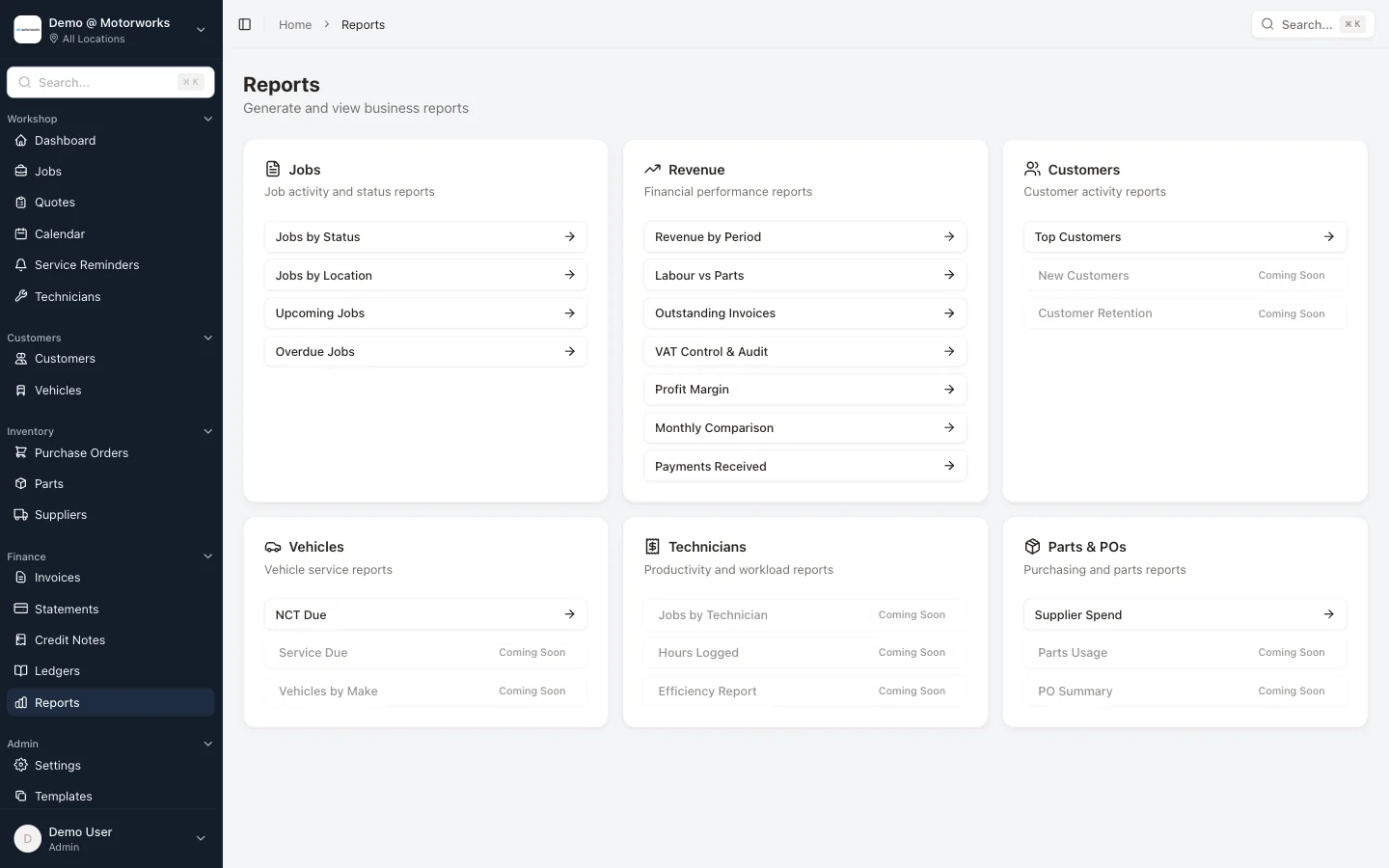
MotorWorks reports give you these numbers without any manual effort — revenue by job type, parts margin, technician productivity, outstanding invoices, receivables aging, and month-on-month trends. Because purchase orders are linked to jobs, you get real margin visibility per job rather than guessing at parts costs. When your actuals match your plan, you can use that data to support future lending conversations or an expansion decision. When they don’t, you know early enough to act.
If you want to understand what your numbers should look like as the business matures, our post on what a garage owner actually earns in Ireland gives a grounded picture of realistic owner income at different stages of growth.
Summary
A complete garage business plan for an Irish independent workshop covers eleven areas: executive summary, business overview, market analysis, services and pricing, operations, premises and equipment, staffing, financial projections, funding requirements, compliance, and appendices.
The financial projections are the core of the plan. Build them from the ground up — capacity, utilisation, average job value — rather than using a round number and working backwards. Stress-test your assumptions. Show your breakeven. Model your cash flow month by month.
The compliance section matters more than most people expect. Lenders and advisors are looking for evidence that you understand what you’re walking into.
And once you’re trading, treat the plan as a live document. The projections you wrote before you opened are your benchmark. Track against them. Adjust. The garages that grow are the ones that know their numbers and act on them.
If you’re in the planning stages and want to see what the operational side of a well-run garage looks like from a systems perspective — job management, invoicing, purchase orders, reporting, scheduling, and a customer portal — book a short demo with MotorWorks. No commitment, just a look at how it works and whether it makes sense for what you’re building.