A customer drops in on a Tuesday morning with their NCT booked for the following week. You do a quick visual walk-around, sort a blown bulb and a wiper blade, and send them on their way. Two days later they’re back — failed on front suspension and tyre condition.
You could have caught both of those. The revenue was right there. And so was the opportunity to be genuinely useful to a customer who trusted you with their car.
This happens in garages across Ireland every single week. Not because mechanics don’t know their trade, but because pre-NCT inspections are often done reactively — a quick look rather than a structured check against the things that actually fail.
The NCTS tests over 1.7 million vehicles every year. In 2024, more than 875,000 of them failed. That’s a failure rate of just over 50% — and the reasons those cars fail are remarkably consistent year on year.
This article breaks down the most common NCT failure categories using real RSA data, tells you exactly what to check in each area, and shows you how to turn that knowledge into a pre-NCT service that generates reliable revenue for your workshop.
The numbers behind NCT failures in Ireland
Before getting into each category, it’s worth understanding the scale. According to NCTS data for 2024 and 2025:
- Over 1.7 million NCT tests are carried out annually
- Just over 50% of vehicles fail on their first attempt
- More than 128,000 cars are classified as dangerously defective each year — approximately 7.4% of all vehicles tested
- The most common single failure item (tyres as a visual defect) accounts for over 14% of all visual failures, with more than 250,000 failures recorded in a 12-month period
The top five failure categories by percentage for 2024 were:
| Category | % of All Failures |
|---|---|
| Steering and suspension | 15% |
| Lighting and electrical | 14.2% |
| Side slip (wheel alignment) | 12.3% |
| Wheels and tyres | 9.9% |
| Brakes | 9.5% |
Those five categories alone account for over 60% of all NCT failures. If your pre-NCT inspection covers these areas properly, you will find work on most cars that come through your door — and you’ll be doing right by your customers at the same time.
1. Steering and suspension — 15% of failures
Steering and suspension is consistently the single biggest cause of NCT failures in Ireland. In 2024, front suspension alone generated over 191,000 failures as a visual defect, with steering linkage adding another 149,000.
What to check
Work through the front and rear suspension systematically:
- Ball joints — check for play and torn or missing dust boots
- Track rod ends and tie rod ends — look for wear, looseness, and boot condition
- Shock absorbers — bounce test and visual check for leaks; watch for uneven tyre wear that points to damper issues
- Control arm bushings — check for cracking, perishing, or excessive movement
- Anti-roll bar drop links and bushings — a common failure point that’s cheap to fix but often overlooked
- Wheel bearings — spin by hand and listen; grumbling at speed is a tell
- Subframe and mounting points — any corrosion or cracking here will fail the structural check
On the steering side, check for play in the steering column, condition of the power steering rack and boots, and any fluid leaks from the rack or pump.
The revenue opportunity
This is your highest-value category. Suspension work ranges from a straightforward anti-roll bar link (€40-80 parts and labour) to a full front-end rebuild. Most pre-NCT checks on vehicles over six years old will find at least something here.
When you quote for suspension work ahead of the NCT, frame it clearly: “This needs to be done before the test or it will fail.” That’s not upselling — it’s accurate. And customers appreciate the honesty far more than discovering it themselves at the test centre.
2. Lighting and electrical — 14.2% of failures
Lighting failures are the most frustrating NCT fail category because they are almost always completely preventable. A blown bulb or a misaligned headlight is not a mechanical failure — it’s a missed check.
What to check
Go through every light on the vehicle, not just the obvious ones:
- Headlights — operation, beam pattern, and alignment (misaligned beams are a common non-visual test failure at 8.64% of all tests)
- Brake lights — have someone press the pedal while you walk around; check the high-level brake light too
- Indicators — front, rear, and side repeaters; check flash rate (too fast usually means a bulb failure elsewhere)
- Fog lights — front and rear, if fitted; rear fog light switch position
- Reverse light — functioning and correct colour
- Number plate light — frequently missed
- Interior lights and dashboard warning lights — any engine warning light will result in a fail
For older vehicles, also check wiring harness condition under the bonnet and at the rear — rodent damage, chafing, and corroded connectors cause intermittent faults that pass the walk-around but fail the test.
The revenue opportunity
Lighting work is low-margin individually but high-volume. More importantly, it builds trust. When you hand back a car with a checklist showing every light was tested and a couple of bulbs were replaced, that customer sees you as thorough. That perception carries over to bigger jobs down the line.
For headlight alignment, a proper beam setter check is quick and worth charging for separately — misaligned headlights are one of the most common non-visual failures, and it’s a service most garages undercharge or skip entirely.
3. Wheel alignment and side slip — 12.3% of failures
The NCT side slip test measures lateral movement as the car rolls across a plate at low speed. It effectively tests whether the wheels are pulling in the same direction — and it catches misalignment that drivers often don’t notice because it develops gradually.
What to check
You need a wheel alignment setup to do this properly, but there are signs to look for before putting it on the ramp:
- Tyre wear pattern — feathering on the inside or outside edge, diagonal wear, or cupping all point to alignment or suspension issues
- Steering wheel position at rest — if it’s off-centre on a straight road, alignment is likely out
- Pull to one side — consistent pull when driving straight is a strong indicator
- Vehicle history — any recent kerbing, pothole impact, or suspension work should prompt an alignment check as standard
If you have a wheel alignment system, include a four-wheel alignment check as part of every pre-NCT inspection. It pays for itself quickly and identifies work that the car definitely needs.
The revenue opportunity
An alignment that’s out rarely fixes itself. Once you show a customer the before/after printout, the conversation is easy. Most four-wheel alignment jobs take 30-45 minutes and can be charged at €60-100. If the car also needs tracking rods or tie rod adjustment, that’s additional billable time.
The side slip test also acts as a downstream indicator of suspension problems. If the alignment is consistently going out between services, there’s likely worn componentry causing it — which takes you back to Category 1.
4. Tyres — 9.9% of failures (and rising)
Tyre failures were the single most common visual defect category in the 12 months to late 2025, accounting for 14.41% of all visual defects — more than 250,000 individual failures. The legal minimum tread depth is 1.6mm, but NCTS inspectors also check for sidewall damage, bulges, cuts, and mismatched tyres on the same axle.
What to check
Check every tyre carefully, not just the tread depth:
- Tread depth — measure with a gauge, not a glance; check across the full width of the tread, not just the centre
- Sidewall condition — look for bulges (a structural failure — immediate replacement required), cuts, cracking, and impact damage
- Age — tyres older than 6-8 years become brittle regardless of remaining tread; check the DOT code (the last four digits give you week and year of manufacture)
- Matching pairs — tyres on the same axle must be the same type and construction; mixing radial and crossply is an automatic fail
- Tyre size — any deviation from the manufacturer’s specified size can cause a fail
- Spare tyre — the NCT does not test the spare, but it’s worth noting for customers
The revenue opportunity
Tyres are significant revenue. A customer who needs two front tyres and two rear tyres is looking at €300-600 depending on brand and size. Many will need at least one or two.
The key is catching tyre issues before they go to the test centre. If you spot a tyre at 2mm during a pre-NCT check, you can have that conversation: “It’s above the legal minimum today but borderline for the test — and it’ll be below the minimum within a few months. Better to replace it now.”
That’s an honest recommendation. Most customers will take it.
5. Brakes — 9.5% of failures
Brake failures split across two types in NCT testing: visual defects (mechanical brake components) and the brake test itself. Mechanical brake component failures were the fourth most common visual defect, while the brake efficiency test generated over 68,000 additional failures in 2024-25.
What to check
Work through the full brake system:
- Pad thickness — measure properly; minimum legal thickness is typically 1.5mm, but most testers want to see 3mm or more for a test pass
- Disc condition — check for scoring, lip, cracking, and minimum thickness (stamped on the disc); run your finger across the face — any step you can feel is likely an issue
- Caliper operation — check for seized sliders and pins, which cause uneven braking and will fail the brake efficiency test
- Handbrake — test mechanical operation; an ineffective handbrake is a fail
- Brake hoses and lines — look for cracking, bulging, corrosion, and leaks; rubber hoses deteriorate with age even without obvious external damage
- Brake fluid — contaminated or hygroscopic fluid reduces braking efficiency and can boil under heavy use
- ABS warning light — if it’s illuminated on the dashboard, the car fails
The revenue opportunity
Brake work is reliable, high-value, and easy to justify to customers. Most people understand that brakes matter — you don’t need to work hard to explain why a worn disc needs replacing before an NCT.
Bundle brake inspections into every pre-NCT check as a standard item. Where you find marginal pads or discs, give the customer the data: current measurement, minimum for test, expected life. Let them make the call with real information.
6. Emissions — a smaller category but easy to miss
Emissions failures account for around 1.65% of non-visual test failures, generating close to 29,000 failures annually. That’s a smaller proportion than the categories above, but emissions failures are often entirely avoidable with basic preparation.
What to check
- Engine warning light — any illuminated engine management light at the time of the test is an automatic emissions fail regardless of actual exhaust values
- Exhaust system — look for leaks, rust-through, loose sections, and missing heat shields; a leaking exhaust will spike CO readings
- Catalytic converter — check for physical damage and that it’s heating up correctly; a cold cat will fail on CO and HC
- Recent service history — a car that’s overdue for a service will often fail on emissions; fresh oil, a new air filter, and clean fuel injectors all help
- Diesel particulate filter (DPF) — becoming more common as diesel cars from 2008 onwards make up a larger share of the fleet; check for DPF warning lights and blockage symptoms
The revenue opportunity
If a customer’s car has an engine light on, that’s a diagnostic job before the NCT even gets mentioned. Engine management diagnostics at €80-120, followed by whatever the fault code points to, is solid revenue — and it’s work the car genuinely needs.
For emissions more broadly, position a pre-NCT engine service (oil, filter, air filter, fuel system cleaner) as standard for any car that’s overdue. Many garages are already doing this — but not always framing it in terms of NCT preparation, which is the most compelling reason for a customer to act on it now.
7. Bodywork and structure — 5% of failures
Bodywork and chassis failures account for around 5% of NCT failures — a smaller percentage than the categories above but significant in terms of the vehicles affected. In practice, bodywork failures tend to cluster around older vehicles where corrosion has had time to take hold.
What to check
- Sill condition — this is the most common structural failure point; prod with a screwdriver if in doubt
- Floor pan — check from underneath for rust-through, particularly around seat mounting points and subframe pick-up points
- Wheel arches — surface corrosion is cosmetic, but penetrating rust into the arch lip or inner structure can fail
- Front subframe and rear beam condition — any cracking or significant corrosion in structural areas
- Boot floor and spare wheel well — often corroded from the inside out due to water ingress
- Sharp edges — any sharp bodywork that could be a hazard will fail
The revenue opportunity
Bodywork and structural work requires honesty with customers. Where repairs are straightforward — a cleaned and sealed sill, an arch liner replaced, a small weld — quote clearly and do the work. Where the car has significant structural corrosion, the pre-NCT inspection is doing the customer a genuine service by identifying it.
The key message here is that body repairs, even minor ones, need to be done before the test — not after a fail. Frame the conversation that way.
Building a pre-NCT service that generates consistent revenue
The categories above give you a structured checklist for every pre-NCT inspection. But the real opportunity is not just doing better inspections — it’s doing them for more customers, more consistently.
Most garages that offer pre-NCT checks do so reactively. The customer calls, you fit them in, you check the car. That’s fine, but it leaves a lot of revenue on the table.
The garages that get the most from NCT preparation are the ones that know which customers have tests coming up — weeks in advance — and reach out before the customer even thinks to call.
When you contact a customer six weeks out from their NCT and offer a pre-check, you’re not competing with any other garage. You’re the only one in the conversation. That converts at a completely different rate to a reactive enquiry.
How MotorWorks supports this
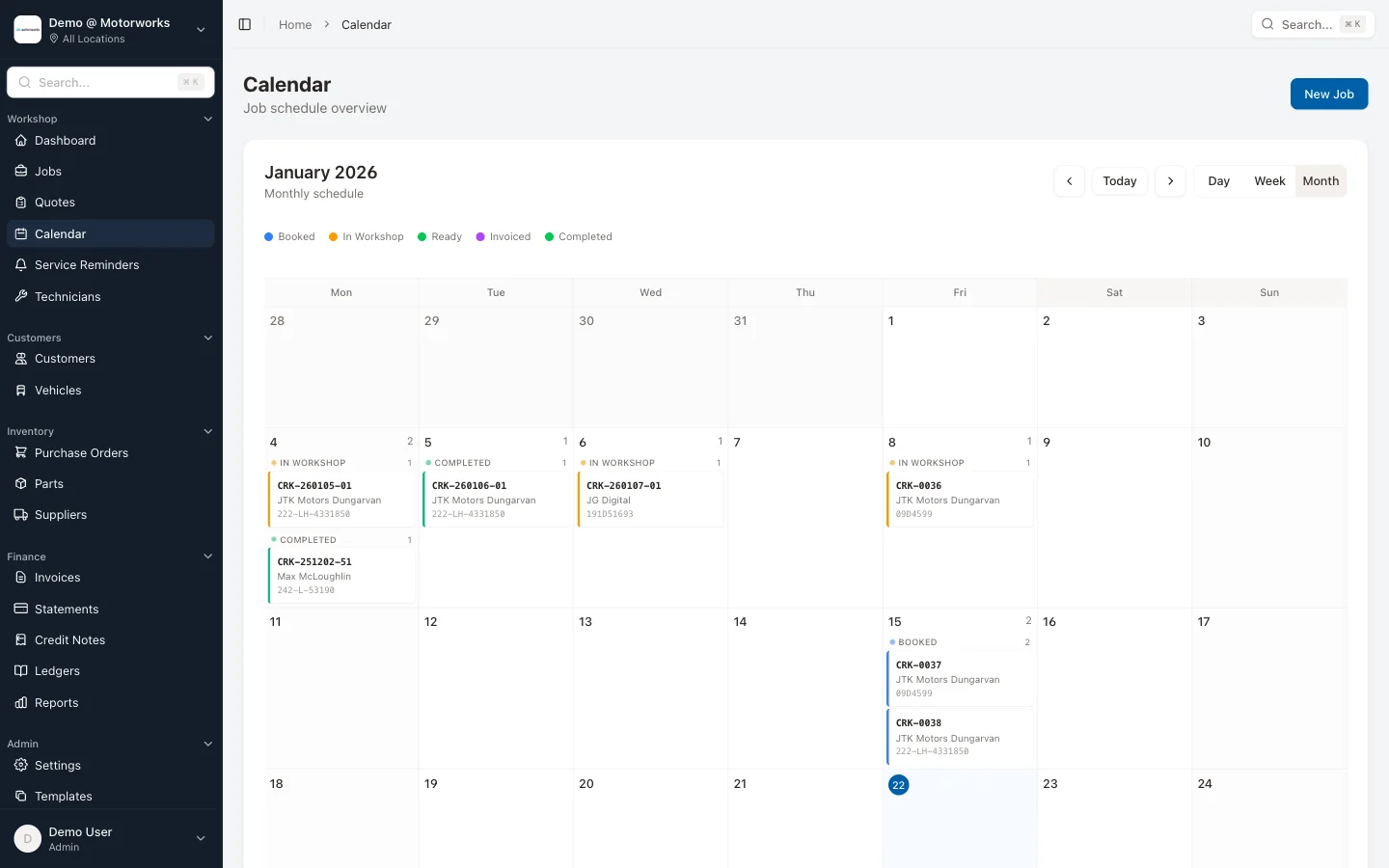
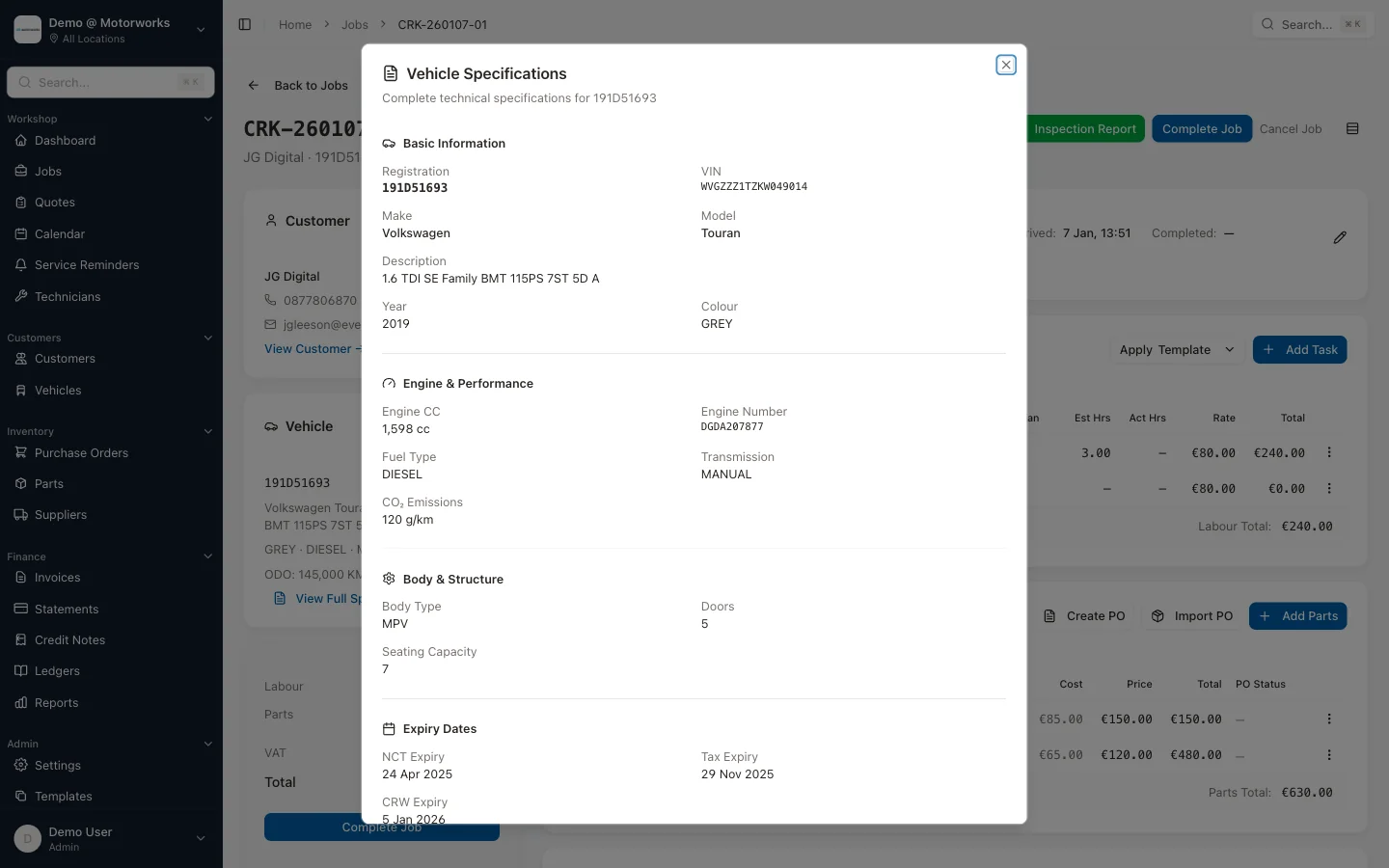
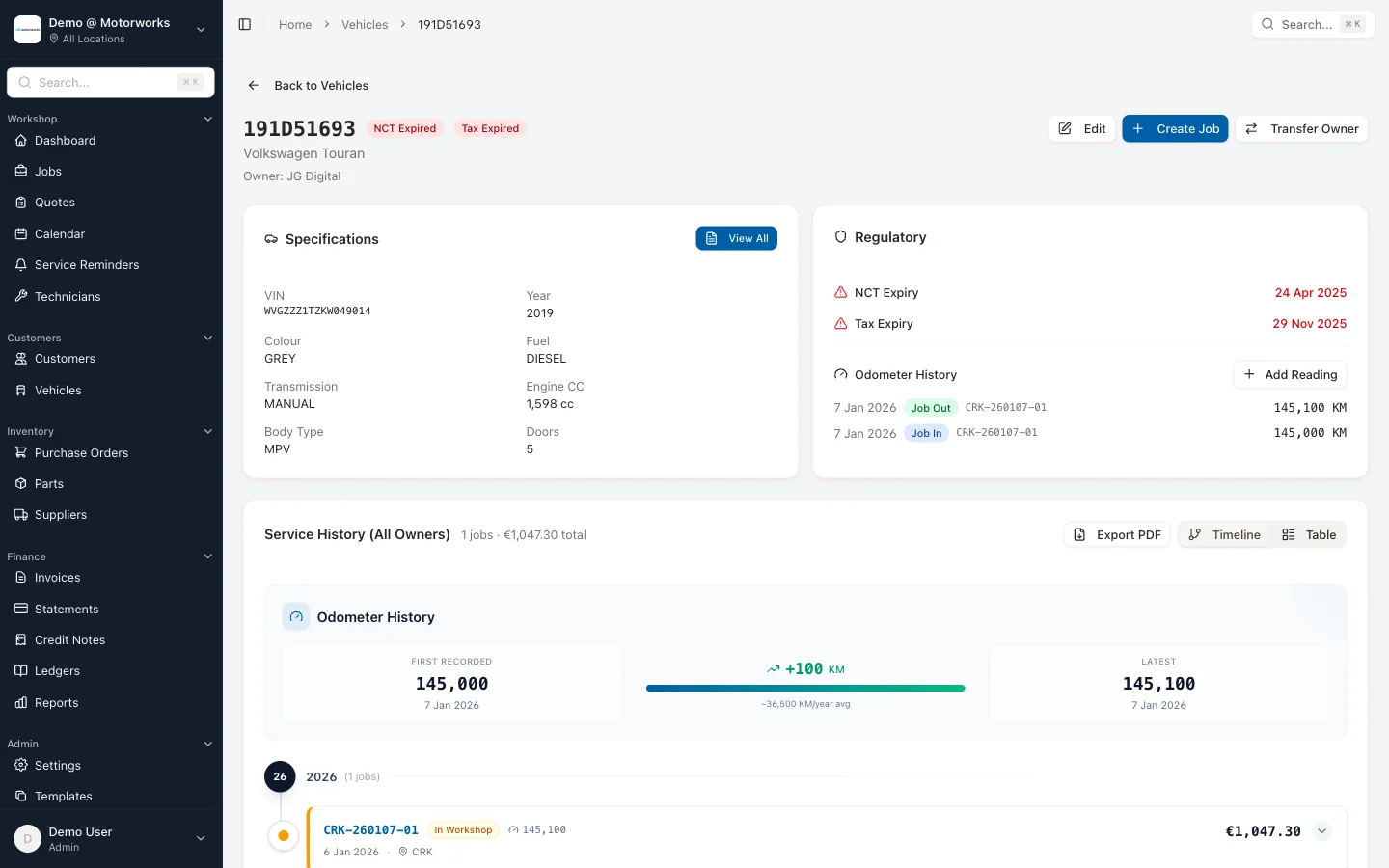
When you look up a vehicle reg through VRM lookup, MotorWorks pulls the NCT due date automatically and stores it against the vehicle record. From there, you can filter vehicles by upcoming NCT date and build an outreach list — or set up automated service reminders to contact customers at the right time without any manual effort.
When the pre-NCT check is booked, job management keeps the work organised from inspection through to follow-on repairs. You can use job templates for your standard pre-NCT checklist, track parts and labour against the job, raise purchase orders for anything you need to order, and convert the job card to an invoice when the work is done — no retyping. If the customer wants to check progress or approve additional work remotely, the customer portal handles that with a simple OTP login.
For a fuller picture of what proactive NCT management can be worth, see The NCT Revenue You’re Losing Without Knowing It.
Putting it together: your pre-NCT inspection checklist
Every pre-NCT inspection should cover these six areas as a minimum:
- Steering and suspension — ball joints, tie rod ends, shock absorbers, bushings, wheel bearings
- Lighting — all exterior lights, beam alignment, warning lights on the dashboard
- Wheel alignment — tyre wear pattern, steering position, pull, and a four-wheel alignment check if available
- Tyres — tread depth measurement, sidewall condition, age, matching pairs
- Brakes — pad and disc measurement, caliper condition, handbrake, hoses, and ABS light
- Emissions — warning lights, exhaust condition, DPF where applicable, service history
Document what you check and what you found on every inspection. Give the customer a written report with measurements. This is what separates a thorough pre-NCT service from a quick look-over — and it’s what justifies charging properly for it.
For a more detailed checklist broken down item by item, see our pre-NCT inspection checklist for Irish garages.
The bigger picture
With more than 875,000 NCT failures per year in Ireland, there is no shortage of work. The cars are already coming into your workshop — or they’re going to someone else’s because that garage was more available, more organised, or more visible at the right moment.
A structured approach to pre-NCT inspections, built on the failure data above, means you catch more work on every car you look at. And a proactive system for identifying upcoming NCTs means you’re looking at far more cars in the first place.
These two things together — better inspections and more proactive outreach — are the whole formula for turning NCT season into reliable, predictable revenue.
If you want to see how MotorWorks handles the tracking and reminder side of this automatically, book a demo. It takes about 20 minutes and you’ll see exactly how it works in practice.