You’ve seen it dozens of times. A customer pulls in, slightly stressed, with their NCT booked for next week — sometimes tomorrow. They want a quick look-over. You do what you can in the time available, catch a few obvious issues, and send them on their way.
The test comes around. They fail on something you couldn’t have spotted in a rushed check. Or worse: they fail on something you would have caught if you’d had a proper system in place.
This post is about building that system. A structured pre-NCT inspection process that gives your customers the best possible chance of passing — and gives your garage a repeatable, professional service that generates real revenue.
Why offering pre-NCT inspections is good business
Before we get to the checklist itself, it’s worth understanding the commercial case for turning pre-NCT checks into a proper service line rather than an ad-hoc favour.
Every car over four years old in Ireland requires an annual NCT. That’s a large, predictable pool of customers who need exactly this service, whether they know it yet or not. The average Irish NCT failure rate consistently runs above 50% at initial test — meaning roughly half the vehicles going through the test have at least one fault.
Many of those faults are ones your garage could have fixed beforehand.
The math is straightforward. A pre-NCT inspection brings in €60-80 in its own right. The follow-on repair work — bulbs, pads, wipers, tyre pressure, minor exhaust work — often adds another €100-200 on top. Multiply that across even 10 customers a week and you’re looking at a significant revenue stream that most garages are currently capturing by accident rather than design.
The other commercial reality: customers who you help pass their NCT remember it. It’s a high-stress moment in the car ownership calendar, and a garage that reliably helps them navigate it earns a loyalty that routine servicing doesn’t always build.
If you haven’t read our post on the revenue garages lose without NCT tracking, it’s worth a look alongside this one — it covers the proactive side of the equation.
The complete pre-NCT inspection checklist
What follows is a checklist organised by the same categories the NCTS uses during the test itself. This structure matters: it means your inspection mirrors what the tester will examine, reducing the chance of anything slipping through.
Print this out. Build it into your job cards. Or better yet, use it as the basis for a digital inspection form in your workshop management system.
1. Lighting and electrical
Lighting failures account for a significant proportion of NCT failures, and almost all of them are preventable. Check every external light on the vehicle — not just that they work, but that they work correctly.
- Front headlights: operation, alignment, and beam pattern (check for condensation inside lens)
- High beam (full beam) operation
- Front fog lights: operation and correct aiming
- Rear fog light: single rear fog, correctly positioned and functioning
- Brake lights: all three (including high-level where fitted)
- Reverse light: operation confirmed
- Indicators front, rear, and side repeaters: flash rate (60-120 flashes per minute)
- Hazard warning lights: all indicators flashing simultaneously
- Number plate lights: sufficient illumination, no dark spots
- Daytime running lights (DRL) where fitted: correct operation
- Interior warning lights: no engine management, ABS, airbag, or TPMS lights illuminated
- Horn: audible and operational
Common failures here: Blown bulbs (including tiny bulbs in fog lights customers forget exist), yellowed or cracked headlight lenses affecting beam quality, and indicator flash rate that’s off due to an incorrect bulb type.
2. Steering and suspension
This category covers anything that affects the vehicle’s ability to be steered safely. Failures here are often classified as “dangerous” or “major” defects — immediate fails that mean the car cannot continue to be driven safely.
- Steering wheel: no excessive play (typically no more than 13mm for power steering vehicles)
- Power steering: operation under load, no noises, fluid level correct
- Steering column: no excessive movement, universal joints sound
- Track rod ends: check for play and condition of rubber boots
- Ball joints: check for play and boot condition
- Tie rods and drag links: no excessive wear
- Wheel bearings: no noise or play when wheel is rocked at 12 and 6 o’clock positions
- Shock absorbers: bounce test and visual inspection for leaks
- Springs: no broken or sagging coils
- Anti-roll bar and drop links: secure, bushes in good condition
- Subframe and suspension mounting points: no corrosion or cracking
Common failures here: Worn track rod end boots (often failed on condition rather than play), corroded suspension mounting points on older vehicles, and noisy wheel bearings that seem minor but are a fail.
3. Brakes
Brake-related failures are among the most common NCT fail categories. A proper brake inspection is the single highest-value thing you can do for a customer before their test.
- Brake pedal: travel, feel, no sponginess or pulling
- Brake fluid: level and condition (dark, contaminated fluid indicates moisture ingress)
- Master cylinder: no leaks or seepage
- Brake lines and hoses: no corrosion, cracking, chafing, or leaks — inspect the full run
- Front brake pads: minimum 1.5mm (NCT minimum), aim to recommend replacement below 3mm
- Rear brake pads or shoes: same minimum — shoes are often overlooked
- Brake disc thickness: measure against manufacturer minimum, check for deep grooving
- Disc and drum condition: surface rust is acceptable; pitting, cracking, or serious scoring is not
- Caliper slides and pistons: free movement, no seized pistons
- Handbrake operation: engages within 3-5 clicks, holds on a slope
- ABS system: no warning lights, system self-test at low speed
- Brake balance: no pulling when applied firmly
Common failures here: Rear brake shoes worn past minimum (often forgotten between services), seized handbrake cables on older vehicles, and cracked brake hoses that look intact until you flex them.
4. Wheels and tyres
Tyre-related failures are straightforward to check and easy to advise customers on ahead of the test.
- Tread depth: legal minimum is 1.6mm, but NCT testers will note tyres approaching this limit — advise customers to replace below 2.5-3mm before the test
- Tread depth across full width of tyre: measure at multiple points, not just the centre
- Tyre condition: cuts, bulges, cracking in sidewall, embedded objects
- Tyre size and type: all four should be the same size and type; mixing crossply and radial is an immediate fail
- Tyre pressure: set to manufacturer specification, including spare if applicable
- Wheel condition: no cracks, significant damage, or missing sections
- Wheel nuts: all present, correct torque
- Valve stems: present, capped, not cracked or leaking
- Wheel alignment: check for uneven wear patterns that indicate alignment issues
Common failures here: Sidewall cracking on older tyres that still have tread, uneven wear indicating alignment or suspension issues, and mismatched tyre types on a vehicle where spare has been fitted without matching the others.
5. Exhaust and emissions
Emissions testing is a significant part of the NCT process, and it’s one of the areas where garages can provide the most value by addressing issues before the customer arrives at the test centre.
- Exhaust system: full visual inspection from manifold to tailpipe — no holes, cracks, blowing joints, or missing sections
- Exhaust mounting brackets and rubbers: all secure, no dragging sections
- Catalytic converter: present and fitted correctly (check for tampering)
- DPF (diesel particulate filter): present, no evidence of removal or bypass
- Lambda sensor/oxygen sensor: no faults logged in OBD
- Engine management light: must not be illuminated — read and address any fault codes
- OBD connection: run a diagnostic scan and clear any codes that have been addressed
- Emissions pre-check: if you have emissions testing equipment, a pre-check here is valuable for diesel vehicles especially
- Fuel cap: seals correctly, no fuel vapour odour around filler area
Common failures here: Blowing joints in the exhaust mid-section (often audible under load but not at idle), engine management lights from minor faults that could be cleared legitimately after repair, and DPF issues on diesel vehicles — a complex area but worth flagging if the regen cycle is overdue.
6. Body and chassis
The structural integrity of the vehicle is assessed both visually and with probing where corrosion is suspected.
- Chassis rails and floor: probe for corrosion, particularly on older vehicles and those from coastal areas
- Sill sections: check inner and outer sills for corrosion — this is a common fail point on Irish-registered vehicles
- Jacking points: present and structurally sound
- Wheel arches and wings: no severe corrosion into structural areas
- Boot floor and spare wheel well: check for water ingress and corrosion
- Engine bay: no significant fluid leaks — oil, coolant, or brake fluid on floor indicates a fail
- Seat belts: all belts present, retract correctly, no fraying or cuts, buckles lock and release properly
- Body panels: no sharp edges or loose sections that could cause injury
- Bonnet: latches correctly, secondary safety catch functioning
- Doors: open, close, and latch correctly on all positions
Common failures here: Corrosion in sill sections and floor pans is the single biggest structural fail category in Ireland — our climate and salted roads accelerate this significantly on vehicles over eight years old. Seat belts are easy to overlook but regularly fail.
7. Glass and mirrors
This is often treated as a quick category, but it generates more failures than most people expect.
- Windscreen: no chips or cracks in the driver’s direct line of sight (zone A — a 290mm wide band directly in front of the driver) and no chips larger than 10mm in zone B (the swept area)
- Windscreen wipers: both wiper blades clear without streaking or juddering; arms hold correct pressure
- Windscreen washers: operate correctly, jets aimed at the swept area
- Rear window: no significant cracks affecting visibility
- Rear window defroster (heated rear window): functioning
- Driver’s side mirror: present, adjustable, no significant damage
- Passenger’s side mirror: present, no significant damage (cracked glass is a common fail)
- Rearview mirror: present and secure
Common failures here: Windscreen chips that the customer has been meaning to get repaired, wiper blades that smear at the first sign of rain, and cracked passenger door mirrors that the customer has been ignoring.
8. Interior and other items
A final category that covers items inside the vehicle and anything not captured above.
- VIN plate: present and legible (often found on the doorframe or under the bonnet)
- Registration plate: clean, legible, correct font and spacing, no damage
- Fuel cap: present and secure
- Speedometer: operational
- Odometer: functional display
- Dashboard warning lights: all extinguished after startup (no ABS, airbag, TPMS, EML, or other warning lights)
- Fuel level: sufficient for test (NCTS will not conduct the test with less than approximately a quarter tank for emissions)
How to use this checklist in your workshop
The checklist above is only as useful as the system around it. Here’s how to make it work in practice.
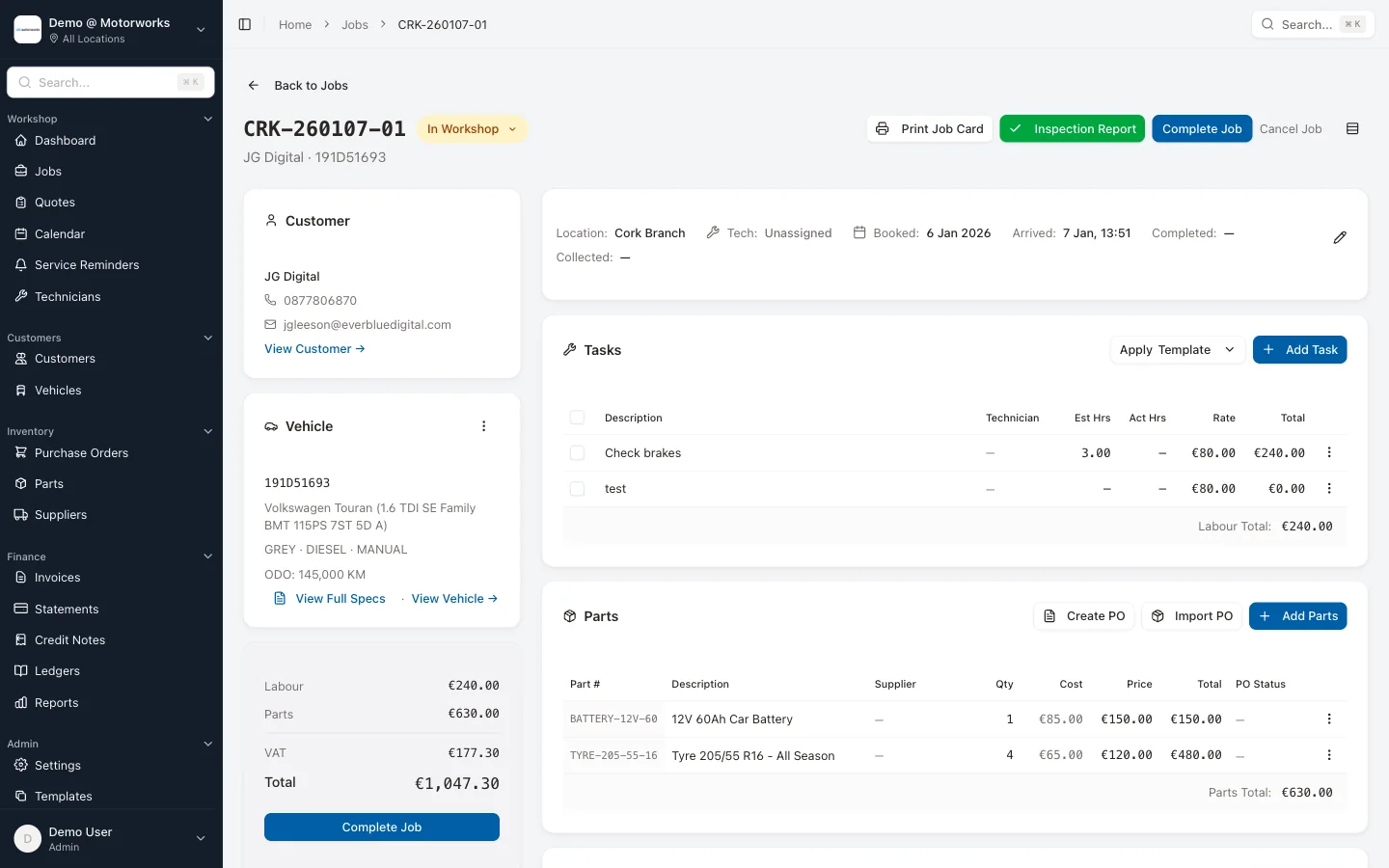
Turn it into a standard job type. Create a dedicated pre-NCT inspection job card in your system with a fixed time allocation — typically 45 to 60 minutes depending on vehicle age. In MotorWorks, you can set this up as a job template so every pre-NCT inspection starts with the same checklist and time allocation. This stops it being squeezed into gaps and ensures it gets the time it needs.
Work through it in order. The categories above follow the NCT test sequence roughly. Working through them systematically, rather than from memory, means you’re less likely to miss anything. A 47-point check that gets to 46 points and stops is a liability, not an asset.
Document every finding. Even items that pass should be noted. If the customer later queries why they failed on something you checked, you need a record. Digital inspection reports, with photos where relevant, are significantly better than handwritten notes for this.
Photograph anything borderline. Borderline tread depth, minor windscreen chips, slight corrosion — photograph these. It helps you explain the finding to the customer, it protects you from any disputes, and it builds trust.
Be honest about what will fail versus what might fail. Customers appreciate clear advice. “This will fail” and “this might be flagged but might not” are both useful. What’s not useful is vague reassurance that sends someone into the test with a borderline issue they should have fixed.
Give the customer a written report. Even a simple summary of what you checked, what you found, and what you recommend is far more professional than a verbal handover. It also gives the customer something to refer back to when they’re deciding what repairs to authorise. With a customer portal, they can review findings and approve recommended work online — no phone call needed.
Pricing your pre-NCT inspection service
Garages often underprice pre-NCT inspections or, more commonly, offer them free as part of other work. Both approaches undervalue the service.
A thorough pre-NCT check — the kind that follows a structured 40+ point process — takes a skilled technician 45-60 minutes. At that level of effort, pricing it at €60-80 is reasonable and defensible. Many customers will willingly pay this when they understand that it represents a proper inspection, not a cursory once-over.
Consider structuring your pricing as follows:
- Pre-NCT inspection (visual and mechanical check, written report): €60-70
- Pre-NCT inspection with OBD diagnostic scan: €70-85
- Pre-NCT inspection with emissions pre-test (where equipment available): €80-95
The other consideration is bundling. A pre-NCT inspection booked at the same time as a service becomes a strong upsell opportunity — one combined appointment, one vehicle health report, and the customer leaves confident their NCT is covered.
Whatever you charge, be clear about what the price includes and that it is a pre-inspection, not a guarantee of passing. Customers understand this, and managing expectations upfront prevents friction afterwards. (For more on setting rates, see our guide to setting labour rates for Irish garages.)
Automating your NCT pipeline to generate bookings
The checklist gives you the process. But the bigger opportunity — and the one most garages miss — is in knowing who needs this service before they call you.
Right now, how many of your existing customers have NCTs due in the next 30 or 60 days? For most garages operating on manual systems, the honest answer is: no idea.
This is where service reminders change the model entirely. When you capture NCT due dates for every vehicle in your database — which happens automatically through VRM lookups when you first enter a registration — you can build a pipeline of upcoming pre-NCT work.
Rather than waiting for customers to remember and ring you, you contact them six weeks out:
“Hi Tom, we’ve got your Ford Focus’s NCT coming up on 22nd April. We’d recommend booking a pre-NCT check before then to make sure everything’s in order — we can usually get any minor issues sorted at the same time. Give us a call or reply to this message and we’ll get you booked in.”
That message takes thirty seconds to generate if your system is set up correctly. The job management side handles the rest — the booking comes in, the inspection gets scheduled, and the work flows through your workshop like any other job.
The garages that have built this process report that pre-NCT inspections go from occasional, reactive bookings to a steady, predictable weekly workload. That predictability matters for staffing, for workshop scheduling, and for cash flow.
Making pre-NCT preparation a cornerstone of your garage
A structured pre-NCT inspection service does three things at once. It helps your customers pass their test. It generates consistent revenue from a predictable annual need. And it positions your garage as the one that actually looks after people rather than waiting for problems to arrive.
The checklist is the starting point. The system around it — the scheduling, the documentation, the follow-up, the proactive outreach — is what turns it from a useful list into a genuine service offering.
If you’d like to see how MotorWorks helps garages build and automate this kind of process — from NCT date tracking to customer reminders to digital inspection reports — book a demo and we’ll walk you through it. Or if you’d prefer to explore on your own, you can start a free trial and see how it fits into your workflow.
For a deeper look at what actually fails most often and how to advise customers, see our post on common NCT failures and what garages should check. And if you’re thinking about building pre-NCT work into a proper revenue stream, our guide to building a profitable pre-NCT service covers the commercial side in more detail.
The NCT season never really ends. Make sure your garage is set up to capture it properly.