A garage invoice has two jobs. It must be a correct financial document, and it must explain the work well enough that the customer recognises what they approved.
Those jobs begin before the invoice is created. A clear written quote, a record of additional authorisation and a detailed job card make the final bill much easier to produce and defend. An invoice assembled from a technician’s memory at collection time does not.
This guide combines Revenue’s current VAT invoice requirements with the Competition and Consumer Protection Commission’s guidance on servicing and repairs. It is general operational information, not legal or tax advice.
Start with the quote, not the invoice
The CCPC advises consumers to request a detailed written quote before work begins. Its guidance says the total price should be provided before the customer agrees to the work. If a total cannot be given, the business should explain how the price will be calculated.
The CCPC also says the quote should break down labour and parts and include VAT. It distinguishes a quote, which fixes the price, from an estimate, which can change. Read the current CCPC servicing and repairs guidance.
For the garage, a sensible pre-work record includes:
- the customer’s identity and contact details
- the correct vehicle registration and vehicle record
- the work requested or reported symptoms
- whether the document is a quote or an estimate
- labour, parts, outside services and VAT treatment
- assumptions or work specifically excluded
- how and when the customer approved it
Do not label an estimate as a quote for convenience. The words create different expectations, and the customer’s copy should match the record retained by the garage.
Record approval for additional work
The CCPC tells consumers to instruct the garage not to perform extra work without permission. That makes additional authorisation an important workshop control, not an optional note.
When an inspection finds more work, record:
- what was found
- the proposed repair and price impact
- whether the original completion date changes
- who approved or declined the work
- the date, time and communication method
- any follow-up date for deferred work
A vague note such as “customer said OK” is better than nothing, but it leaves room for argument. A named staff member, timestamp and specific approved items make the record useful.
Motorworks vehicle inspections let workshops classify defects, record fitted prices and follow-up dates, and move approved items into a quote or job. The job card then holds the work, labour, parts, notes and attachments in one place.
Revenue’s VAT invoice fields
Revenue’s current guidance says a VAT invoice must show the following core information:
- date of issue
- a unique sequential number
- the supplier’s full name, address and VAT registration number
- the customer’s full name and address
- the quantity and nature of goods supplied
- the extent and nature of services rendered
- the VAT-exclusive unit price
- payments received net of VAT
- discounts or price reductions
- the consideration exclusive of VAT for each rate
- the rate or rates of VAT
- the total VAT payable
- the date of supply, where it differs from the issue date
Additional requirements apply to certain transactions, including reverse-charge and intra-Community supplies. Use Revenue’s complete VAT invoice requirements as the definitive checklist.
What this looks like on a garage invoice
The invoice should identify the vehicle as well as the customer. Registration, make, model and mileage are useful operational fields even where they are not listed as universal VAT invoice requirements. They make it easier to connect the document to the relevant job and service history.
Line descriptions should say what was supplied. For example:
- diagnostic inspection, one hour
- replace front brake pads
- front brake-pad set
- engine oil and filter service
- puncture repair
Descriptions such as “work done” or “parts” make later queries harder and can obscure mixed VAT treatment.
Number invoices consistently
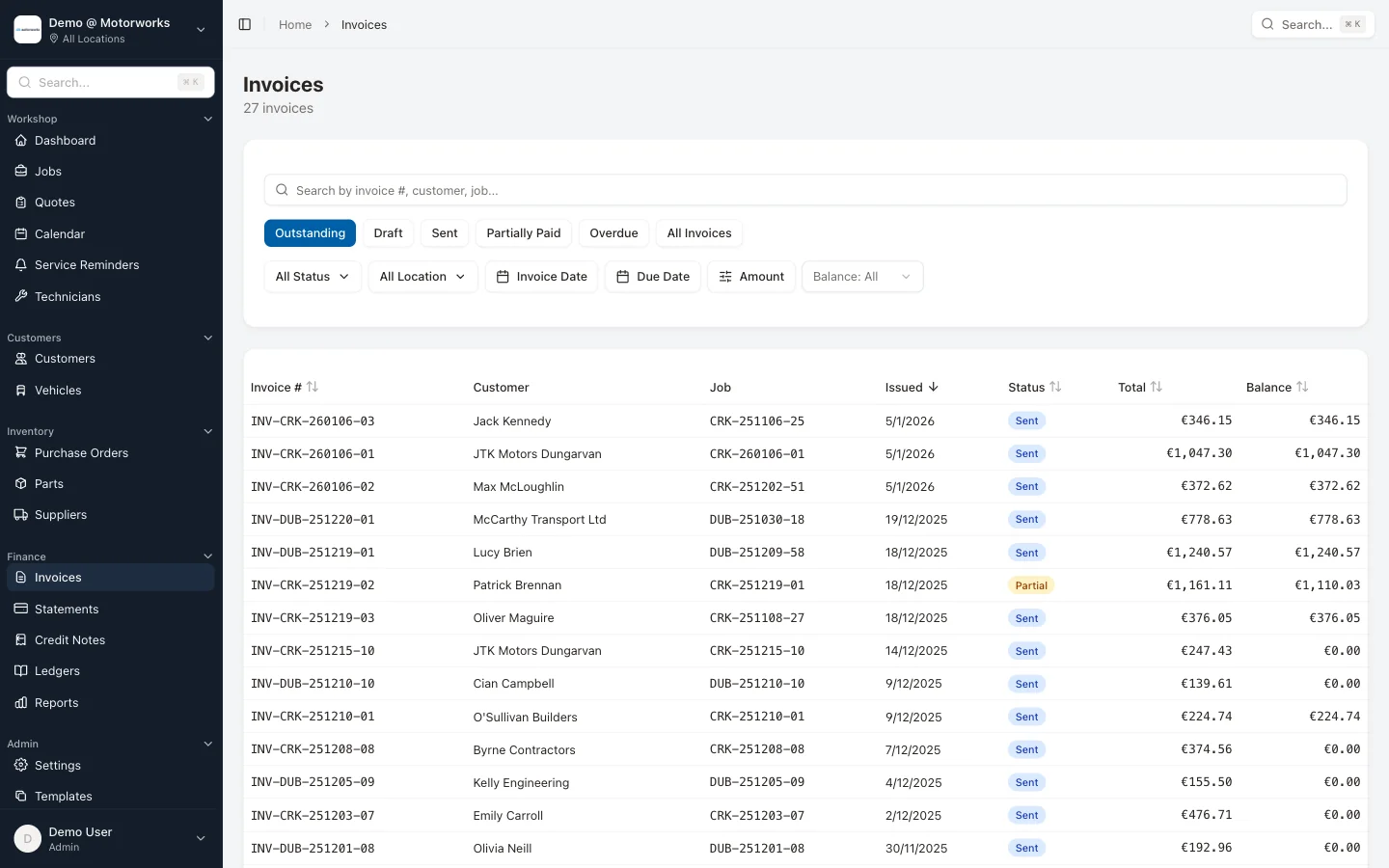
Revenue requires a unique sequential invoice number. The sequence does not need to look the same in every business, but each issued document needs a stable unique identity.
Useful controls include:
- assigning the number at a defined point in the issue process
- preventing duplicate numbers within the garage or agreed series
- retaining cancelled or superseded document history
- never reusing a number because an earlier invoice was corrected
- keeping location prefixes consistent where separate series are used
Motorworks supports location-aware numbering for multi-location workshops. The numbering policy should be agreed during setup and reflected in the accountant’s records.
Apply VAT by line, with garage-specific exceptions
Revenue currently lists qualifying motor-vehicle repair services at the reduced rate but specifically excludes items including mirrors, batteries, media players, tyres and tyre flaps. Those exclusions remain standard-rated when supplied during a repair. Supplying and fitting tyres is standard-rated, while a puncture-repair service is reduced-rated.
That means an invoice may contain more than one VAT rate. The document must show the breakdown correctly, and staff need defaults that match the treatment agreed with the garage’s accountant.
Read the VAT guide for Irish garages for the relevant Revenue sources and a practical configuration checklist.
Correct mistakes with linked documents
An issued invoice should not quietly change after the customer and accountant have received it.
Revenue’s invoice correction guidance explains the correct document path:
- use a supplementary invoice for a price increase
- issue a credit note for a price reduction
- use a credit note and revised invoice to correct an incorrect VAT rate or amount, following Revenue’s stated process
Revenue says a VAT credit note must include a unique number, reason for issue, reference to the original invoice, amended consideration, applicable VAT rates and tax amounts, along with supplier and customer information. See the full VAT credit-note requirements.
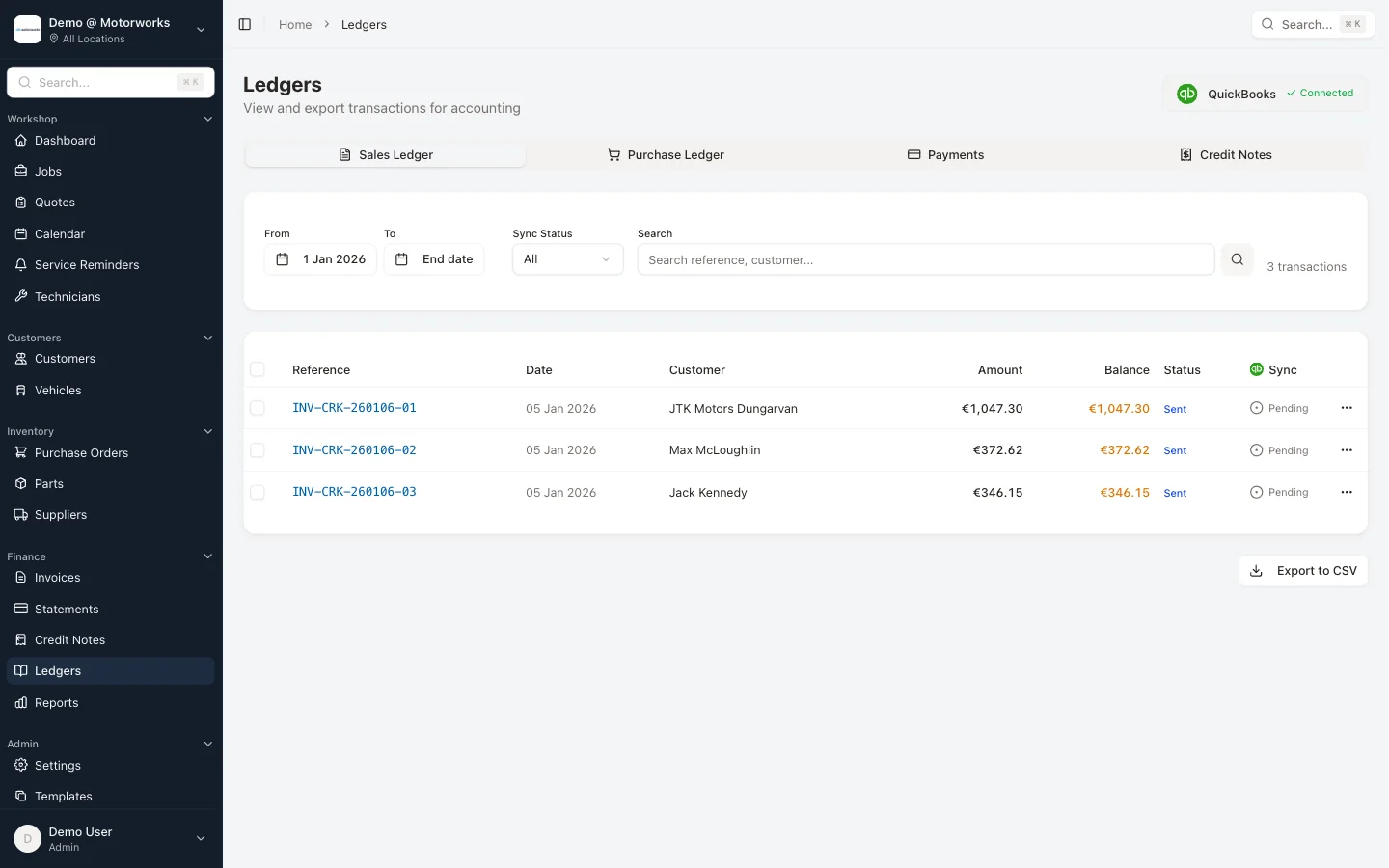
Motorworks keeps credit notes and statements linked to the customer account so the adjustment does not become an unexplained line in a spreadsheet.
Keep evidence of delivery and payment
Creating the invoice is not the end of the document trail. A useful account history also records:
- when the document was created
- whether an email was delivered, failed or bounced
- when a downloadable file was requested
- payments, part payments and payment methods
- credit notes or other corrections
- the remaining customer balance
Do not describe an email as delivered merely because the send request was accepted. Delivery and bounce events provide stronger evidence. If a customer disputes receiving a document, the workshop should be able to see what actually happened.
Motorworks document history records document creation and supported email or download events. It does not claim that a paper copy was printed unless a corresponding print event is actually captured.
A final invoice check before issue
Before issuing an invoice, confirm:
- The customer and vehicle are correct.
- The final work agrees with the approved scope and recorded additions.
- Labour, parts and outside services have clear descriptions.
- Quantities, unit prices and discounts are correct.
- VAT rates and totals have been reviewed.
- Supplier-specific or fleet references are included where agreed.
- The payment status is accurate.
- The document contains the garage’s current legal and VAT details.
For most jobs, that check should take less time than finding the vehicle keys. The benefit is a document that works for the customer, the garage and the accountant.
Choosing garage invoicing software
Look beyond whether the software can produce a tidy PDF. Check whether it can:
- convert approved quotes into jobs and invoices without retyping
- preserve customer authorisation and inspection evidence
- handle line-level VAT and workshop-specific defaults
- issue sequential invoices and linked credit notes
- allocate full and partial payments
- produce customer statements and aged balances
- export structured records for the accountant
- keep customer, vehicle and document history connected
Motorworks combines those controls with workshop scheduling, parts purchasing and job profitability. Book a demo to test the workflow with a realistic repair rather than a blank sample invoice.
Official sources
- Revenue: Information required on a VAT invoice
- Revenue: Correcting a VAT invoice
- Revenue: Information required on a VAT credit note
- CCPC: Servicing and repairs
Reviewed against the linked official guidance on 2 September 2026. Confirm tax and legal requirements for your circumstances with a qualified adviser.