A customer comes in for a routine service in January. While you’re chatting, they mention their NCT is due in April. You’ve been doing their pre-NCT checks for years — same process, same checklist. But there’s a quiet question underneath every conversation like this one: is the test the same as it was last year, or is there something new to watch out for?
It’s a fair question. The NCT is not a static thing. The NCTS updates its testing procedures in response to RSA directives, EU Roadworthiness Directive requirements, and fleet-wide trends in pass and fail rates. Some years bring significant changes. Others bring smaller adjustments that are easy to miss but matter in practice.
This is what’s current for the NCT test in Ireland 2026 — including what’s new, what’s changed in emphasis, and what the failure data tells you about where to focus your pre-NCT inspections.
The regulatory backdrop: EU Roadworthiness Directive
The framework behind the Irish NCT is the EU Roadworthiness Directive (2014/45/EU), which Ireland implemented through the Road Traffic (National Car Test) Regulations. This directive requires periodic alignment across EU member states on vehicle inspection standards, test categories, and defect classification.
Under the Directive, defects are classified into three tiers:
- Minor defects — recorded but do not result in a fail; the vehicle may be driven
- Major defects — result in a fail; the vehicle must be repaired and retested
- Dangerous defects — result in an immediate fail and, in some cases, the vehicle should not be driven until repaired
The RSA and NCTS review the application of this classification framework on an ongoing basis. Adjustments are made when evidence from test data suggests that particular defects are being classified inconsistently, or when new vehicle technologies require updated testing procedures.
For 2026, the focus areas coming out of the most recent RSA review include more consistent application of dangerous defect classifications for structural corrosion, updated guidance on ADAS-equipped vehicles, and continued attention to diesel vehicle emissions testing as older Euro 5 vehicles make up an increasing proportion of the national fleet.
What has changed for 2026
Structural corrosion: stricter application of dangerous defect thresholds
This is the most operationally significant change for pre-NCT preparation in 2026. Updated NCTS guidance clarifies the threshold at which chassis and body corrosion is to be classified as a dangerous defect rather than a major defect.
The practical effect: vehicles with sill corrosion, floor pan rust-through, or subframe corrosion that previously might have been classified as a major defect (fail but driveable) are more likely to be classified as dangerous in 2026 where the structural integrity is materially compromised.
For garages doing pre-NCT checks, this matters in two ways.
First, your own assessment of structural corrosion needs to be sharper. A sill that looked borderline last year may now be firmly on the wrong side of the line. Probe it properly. If there’s doubt, treat it as a likely fail and discuss it with the customer before they go to the test centre.
Second, the conversation with customers needs to reflect the severity. A dangerous defect classification carries different implications to a standard fail. It is worth being direct with customers about what that means for the vehicle’s roadworthiness — not just for the test, but in general.
Advanced Driver Assistance Systems (ADAS) and camera systems
The 2026 update includes new guidance for inspecting vehicles equipped with ADAS — including lane-keep assist cameras, forward collision warning systems, parking sensors, and rear-view camera systems.
These systems are not yet formally tested as functional units in the standard NCT process. However, the updated guidance clarifies that ADAS warning lights — including those for lane departure warning, collision warning, and parking assist malfunctions — are now to be treated consistently with other dashboard warning lights. A persistent ADAS warning light at the time of test is treated as a major defect.
This is relevant because ADAS warning lights are frequently present on newer vehicles in the Irish fleet and customers often do not realise they constitute a problem for the NCT. A dashboard scan as part of your pre-NCT inspection should now explicitly cover ADAS fault indicators, not just the traditional set of engine management, ABS, and airbag lights.
Diesel emissions: DPF and Euro 5 fleet
Diesel vehicle emissions testing is not new, but the 2026 guidance tightens the procedures around DPF verification for vehicles where the DPF is a factory-fitted component.
NCTS inspectors are applying increased scrutiny to visual evidence of DPF removal or bypass — which has been an ongoing issue as some owners of older diesel vehicles have had the DPF removed to avoid expensive replacements. The updated guidance makes clear that visual evidence of DPF removal is to be treated as a dangerous defect.
For pre-NCT preparation, this means:
- Check for DPF warning lights and advise customers to address them before the test
- Where a diesel vehicle has had recent DPF work, ensure the repair is documented and the filter is correctly reinstalled
- Be alert to vehicles where the DPF has been removed as part of a previous repair elsewhere — a warning light that never illuminates may not be absent for good reasons
The practical reality is that older diesel vehicles from the 2008 to 2015 period now make up a large and growing portion of the national fleet. Many of these are approaching or past the age where DPF issues become likely. Building DPF checks into your pre-NCT process for diesels in this age range is no longer optional.
Electric vehicles: battery and isolation system checks
The EVs now entering the annual NCT cycle in meaningful numbers for the first time are those registered from 2019 and 2020. The 2026 guidance includes updated procedures for EV-specific inspection points that NCTS inspectors are now applying more consistently.
The main areas:
- High-voltage isolation warning systems — the HV isolation fault indicator must not be illuminated at time of test
- High-voltage cable and connector condition — visible deterioration is classified as a dangerous defect
- Traction battery warning lights — any battery management fault light is treated as a major defect
For most garages doing pre-NCT work on EVs, the HV warning light check is the most actionable item. Unless your workshop is set up for HV diagnostics, your role in EV pre-NCT preparation is primarily to identify warning lights and advise customers to have them assessed by a suitably equipped specialist before the test.
What has not changed: the core failure categories
It is worth being clear about what has not changed for 2026 — because the conversation about annual NCT updates can sometimes create the impression that the test is being substantially overhauled each year. For the most part, it is not.
The test categories, the checklist items within each category, and the fundamental approach to vehicle inspection have been consistent for several years. The 2026 changes are adjustments and clarifications, not a redesign.
This matters practically because the things that drove over 875,000 NCT failures in the last full test year in Ireland are the same things that will drive failures in 2026. Steering and suspension failures at around 15% of all failures. Lighting failures at 14.2%. Side-slip and wheel alignment at 12.3%. Tyres at close to 10%. Brakes at 9.5%.
These five categories account for more than 60% of all failures. Nothing in the 2026 updates changes that picture.
If your pre-NCT inspection process covers these areas systematically, you are doing more to help your customers pass the NCT test in Ireland 2026 than any update to the testing guidance will require.
Pass and fail trends: what the 2025 data tells us
The most recent full-year NCTS data covers the 2024-2025 test period. The headline numbers:
- Over 1.7 million vehicles tested annually
- Approximately 51-52% of first-attempt tests resulting in a fail
- More than 128,000 vehicles classified as dangerously defective
The failure rate has remained stubbornly above 50% for several years. It has not responded significantly to the ageing of the fleet in either direction — as older, higher-risk vehicles are retired, new vehicles join the NCT cycle and present their own, different failure profiles.
What has changed in the trend data is the composition of failure reasons. Older failure categories like basic lighting defects (blown bulbs) have edged down slightly as LED lighting becomes more common on newer vehicles — LEDs do not blow in the same way as halogen bulbs. Alignment and suspension failures have remained consistently high, as Irish road conditions continue to take a toll on running gear. And emissions-related failures, particularly DPF-related failures for diesels, have been rising as the 2009-2015 diesel cohort ages into the failure-prone zone.
What this tells you practically: the core of your pre-NCT checklist is well-calibrated, but it is worth giving specific attention to DPF and emissions on diesels in the eight-to-fifteen-year age bracket, and to ADAS warning lights on vehicles from 2018 onwards.
What this means for your pre-NCT service in 2026
Bringing this together into practical terms for your workshop:
Update your inspection process to include ADAS warning lights. Add a specific dashboard scan step that covers ADAS indicators — lane departure, forward collision, parking sensor faults — alongside the standard engine management, ABS, and airbag lights. It takes thirty seconds and catches a fail that customers regularly walk into blind.
Be more thorough on structural corrosion assessment. The stricter application of dangerous defect classification for chassis and body corrosion means you need to probe more carefully and be more precise in how you characterise what you find. Use a probe. Document your findings. Have the conversation with the customer before they go to the test centre, not after they come back with a dangerous defect classification.
Expand your diesel pre-NCT check to include DPF verification. For any diesel vehicle from 2008 onwards, include a DPF visual check and confirm there are no DPF-related warning lights. If the vehicle has had DPF work, ask for the documentation.
Know what to flag versus what to fix for EVs. If you are doing pre-NCT checks on EVs, HV warning lights and traction battery faults need to be identified and customers directed to the right specialist if you are not set up for HV work. Being honest about this is better than missing a dangerous defect classification.
Keep your core checklist sharp. The updates for 2026 do not reduce the importance of the fundamentals. Suspension, lighting, alignment, tyres, brakes — these remain where the failures are. Do not let attention to the new items come at the expense of what has always mattered most.
For a detailed breakdown of each of these core categories with practical inspection guidance, the pre-NCT inspection checklist for Irish garages covers each area with the specifics you need in the workshop. If you want to understand where failure risk is concentrated by vehicle type and age, the common NCT failures guide gives you the data behind each category. And for turning pre-NCT work into a consistent revenue stream, see the guide on building a profitable pre-NCT service.
The proactive opportunity in 2026
One thing the annual update cycle does very reliably is generate search activity. People who have not thought about their NCT for months suddenly become interested in NCT test Ireland 2026 when they see an article, hear something on the radio, or notice the date getting closer on the disc in their windscreen.
That search activity — and the accompanying phone calls and enquiries — is predictable. The garages that benefit from it most are the ones that are already in front of their customers before the search begins.
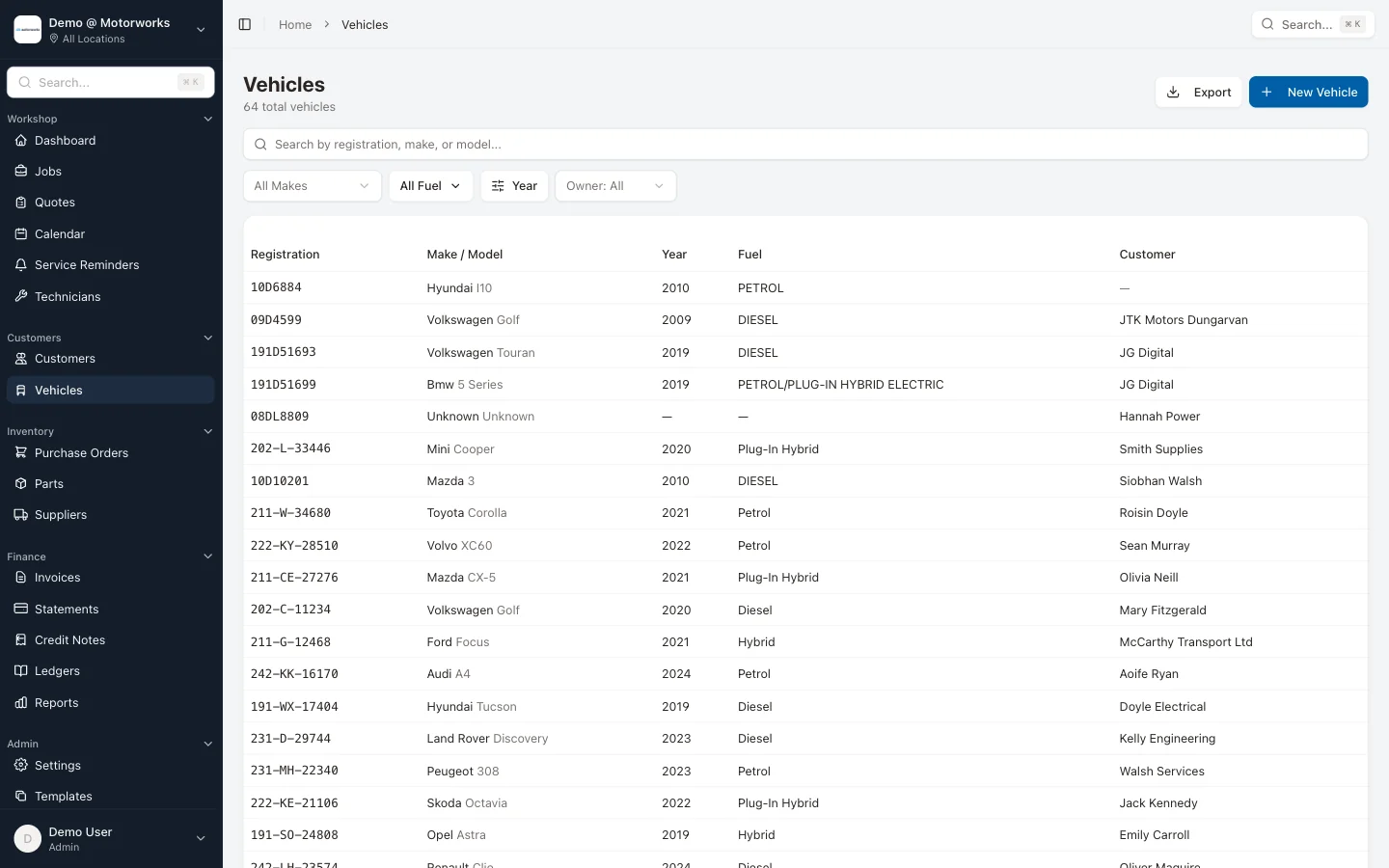
Having NCT due dates recorded against vehicles in your system is what makes this possible. When you add a vehicle via VRM lookup, MotorWorks pulls the registration data including the NCT due date. With that data in place, you can identify which customers have tests coming up in the next 30, 60, or 90 days — and reach out proactively, before they start searching.
Paired with service reminders that contact customers at the right interval, this becomes a workflow that generates pre-NCT bookings without manual effort each week. The customer gets an early heads-up at a time when they can actually act on it. You fill your schedule with work that was always going to need doing somewhere.
The 2026 changes to the NCT give you a specific, timely reason to make contact with customers who have tests coming up: “There are a few things the NCTS is applying more consistently this year — worth a quick check before you go in.” That framing is genuinely useful, and it converts.
Summary
The NCT changes for 2026 are specific rather than sweeping, but they are worth knowing in detail:
- Structural corrosion is being classified more strictly under dangerous defect thresholds — be more thorough, and be direct with customers about the implications
- ADAS warning lights are now consistently treated as major defects — add these to your dashboard warning light check as standard
- DPF verification for diesels is under increased scrutiny — build it into your pre-NCT process for all diesels from 2008 onwards
- EV-specific checks are more consistently applied — know what to flag and where to direct customers for HV work
The core pass and fail picture has not changed. Suspension, lighting, alignment, tyres, and brakes remain the dominant failure categories, and a thorough pre-NCT check that covers these areas is still the highest-value thing you can do for customers approaching their test date.
If you want to see how MotorWorks helps garages stay on top of pre-NCT work — from vehicle data captured via VRM lookup, through service reminders, to job management with checklists and templates for pre-NCT inspections — book a demo and we can walk you through it in about twenty minutes.