It’s a Thursday afternoon and a customer rings to ask whether their Skoda is ready. You’re under a Volkswagen, your receptionist is with someone else, and the job card for the Skoda is — somewhere. In the pile on the desk? Clipped to the board? Filed? You put them on hold, spend three minutes sorting through paper, and eventually find it under a parts catalogue.
The job has been ready since Tuesday.
That scenario happens in garages that run on paper every single day. It doesn’t mean paper is broken — it means paper has limits. And those limits become more visible as you get busier.
This post is a genuine comparison of digital job cards versus paper ones. Not a sales pitch. Both approaches have real strengths, and some garages have legitimate reasons to stick with what they know. But if you’re going to make an informed decision, you deserve an honest look at both sides.
What paper job cards actually do well
Let’s start here, because most software comparisons skip it entirely.
Paper job cards have been the backbone of garage operations for generations. There are good reasons they’re still in use everywhere.
No learning curve
A paper job card is self-explanatory. New mechanic starts on Monday — hand them a pad and they know what to do. There’s no login, no training, no system to figure out. Everyone understands how to write something down.
That simplicity has real value, especially in a busy workshop where you don’t have time to hand-hold someone through software.
Works without internet or power
This one comes up a lot, and it’s a fair concern. If the wifi goes down or the power cuts out, paper keeps working. You’ve got a physical record in your hands regardless of what’s happening with technology.
In rural parts of Ireland especially, where connectivity isn’t always reliable, this isn’t a trivial consideration.
Low upfront cost and no monthly fees
A pad of job cards costs a few euro. That’s it. There’s no subscription, no per-user fee, no annual contract. For a one-person operation doing low volume, the economics of paper are genuinely hard to argue against.
Tangible and immediate
There’s something about having a physical card in your hand that feels concrete. Some mechanics like being able to scribble a quick note, hand the card to a colleague, or pin it to the car. It’s fast, it’s visible, and it doesn’t require a screen.
These strengths are real. If your paper system is genuinely working — if you’re not losing job cards, not missing follow-ups, not spending weekends doing invoices — then changing for the sake of it doesn’t make sense.
But most garages who’ve been running a few years have run into at least some of the following problems.
Where paper job cards break down
Finding old information
Ask a paper-based garage where the job card for a car they serviced fourteen months ago is, and watch what happens. Somewhere in a box, probably. Maybe filed. Maybe in storage. Finding it will take time, and there’s a reasonable chance it won’t be found at all.
This matters more than people realise. Customers ask about previous work. Warranties come up. A vehicle comes back with a recurring fault and you need to know what was done last time. With paper, that information is theoretically there — but practically, it’s often gone.
Searchability
Paper isn’t searchable. If you remember a customer’s name, you might find their cards quickly. But what if you only remember the reg? What if you want to find all the jobs done in January, or everything involving a particular parts supplier? With paper, those questions can’t be answered — at least not without someone physically going through every single card.
With digital job cards, you type a reg, a name, or a phone number and you have the answer in under five seconds. Every job is searchable by any field on the card — technician, date, job type, status.
Tracking parts
Parts management on paper is genuinely difficult. You write what you used on the job card, but connecting that to what was ordered, what was returned, and what was charged is a separate exercise. Parts ordered but not used sit in the corner. Parts used but not logged don’t get charged.
It adds up over time. Not usually in one dramatic mistake, but in a steady drip of small errors.
Understanding profitability
This is where paper falls furthest short, and it’s the one most garage owners don’t fully register until they’ve seen the alternative.
When every job card is a standalone piece of paper, you have no way to see patterns across your whole business. Which jobs are your most profitable? Which technician is most efficient? Which customer accounts are worth keeping? You can feel your way toward answers through experience, but you can’t actually know.
A garage that can’t measure its own profitability is making every pricing and staffing decision based on gut instinct. Sometimes gut instinct is right. Sometimes it’s quietly wrong for years.
The physical card can disappear
Paper gets lost. It gets wet. It ends up in the wrong pile. It gets thrown away by mistake. A digital job card in a properly hosted system won’t be in someone’s jacket pocket on Friday night.
How digital job cards compare
The search problem, solved
Every job card in a digital system is instantly searchable by any piece of information on it. Customer name, registration, phone number, date, job type — type anything and find the relevant jobs. For a garage that’s been open five years and has seen thousands of cars, this changes how you work.
A customer calls about work done a few years ago. With paper, that’s a research project. With a digital system, it’s a fifteen-second lookup.
Vehicle history that builds itself
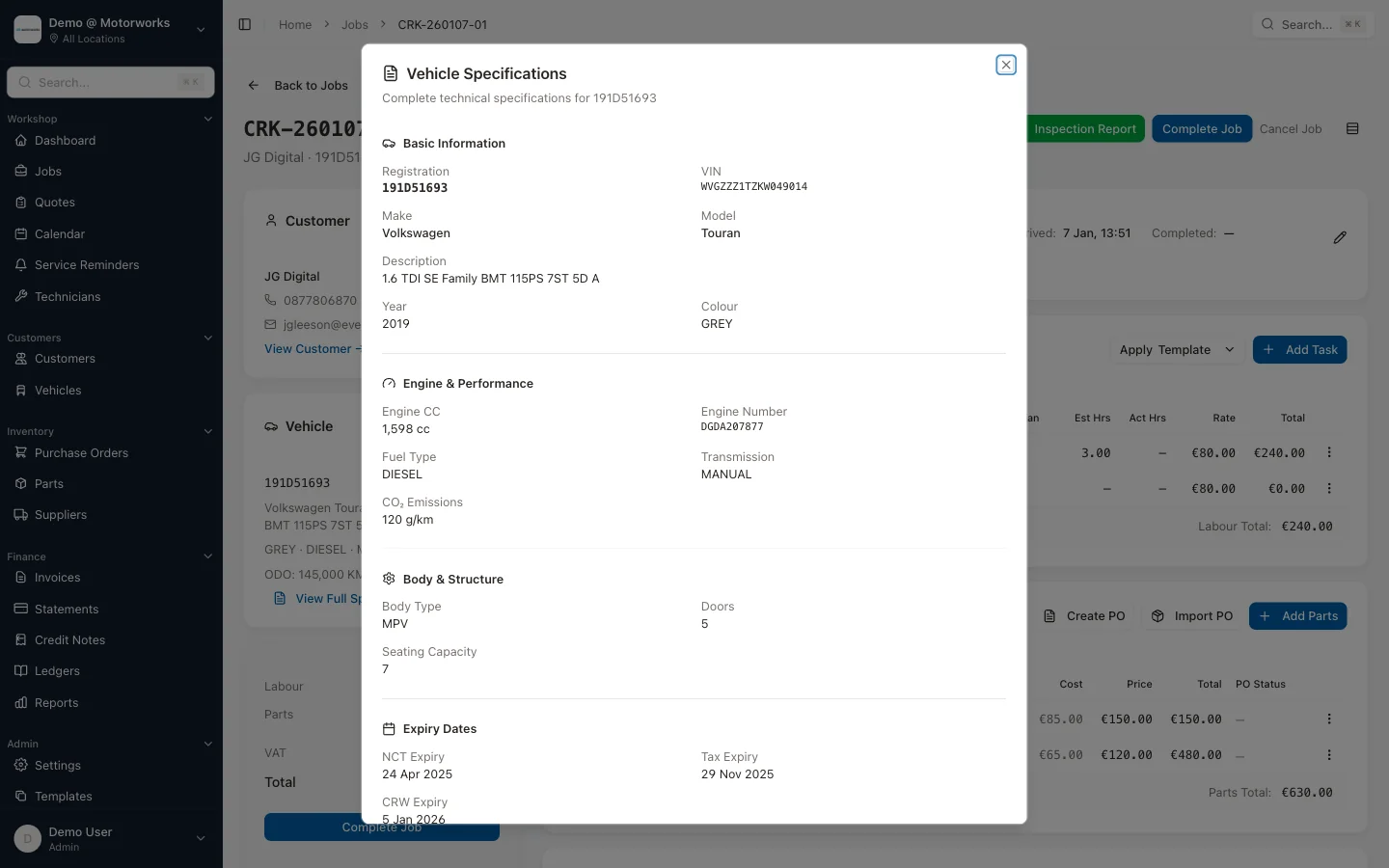
One of the most useful things about digital job cards is that the vehicle history builds automatically. Every time you complete a job, it’s added to that vehicle’s record. Over time, you build a complete picture of every car you’ve worked on — parts fitted, work done, dates, costs, technician notes.
That record is genuinely valuable. When a car comes back, you can see exactly what was done and when. When a customer asks “did you replace the timing chain?” you can tell them immediately. When you notice the same part has been replaced twice in eighteen months, you catch a pattern that might otherwise have been missed.
Vehicle history in a digital system doesn’t require any extra effort — it’s just what happens when you complete work normally.
Parts and purchase orders that connect to jobs
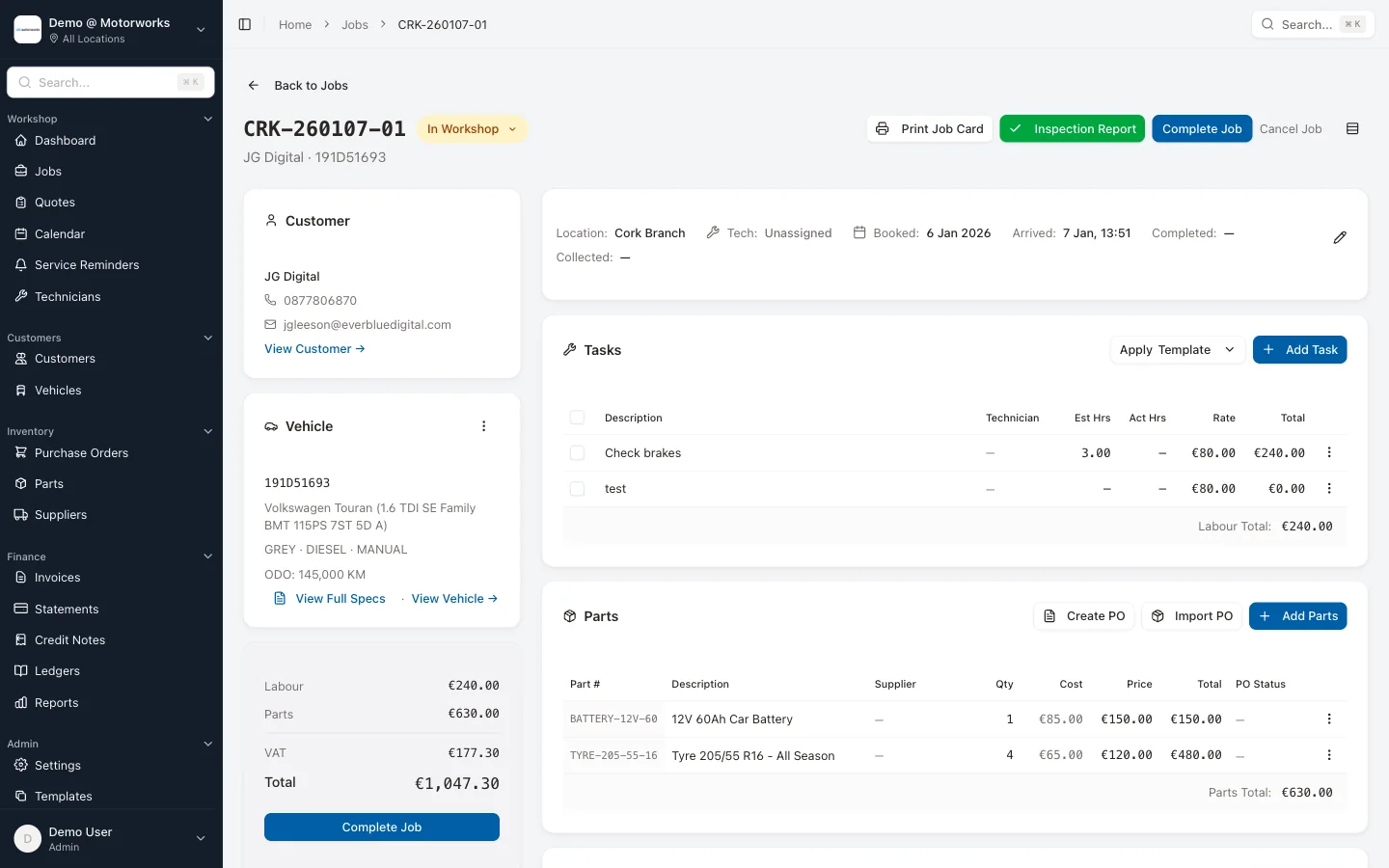
When parts are attached to a job card digitally, they stay connected. With purchase orders linked to jobs, you can see exactly what was ordered for which job, what was used versus what was returned, and what was charged versus what was actually fitted. That connection is automatic — it’s not a separate exercise at the end of the week.
Over a month, the difference in captured parts revenue can be significant. For more on why this matters, see our breakdown of where money actually goes missing in a garage.
Visibility into what’s actually profitable
This is the area where digital job cards deliver the most value for owners who want to understand their business.
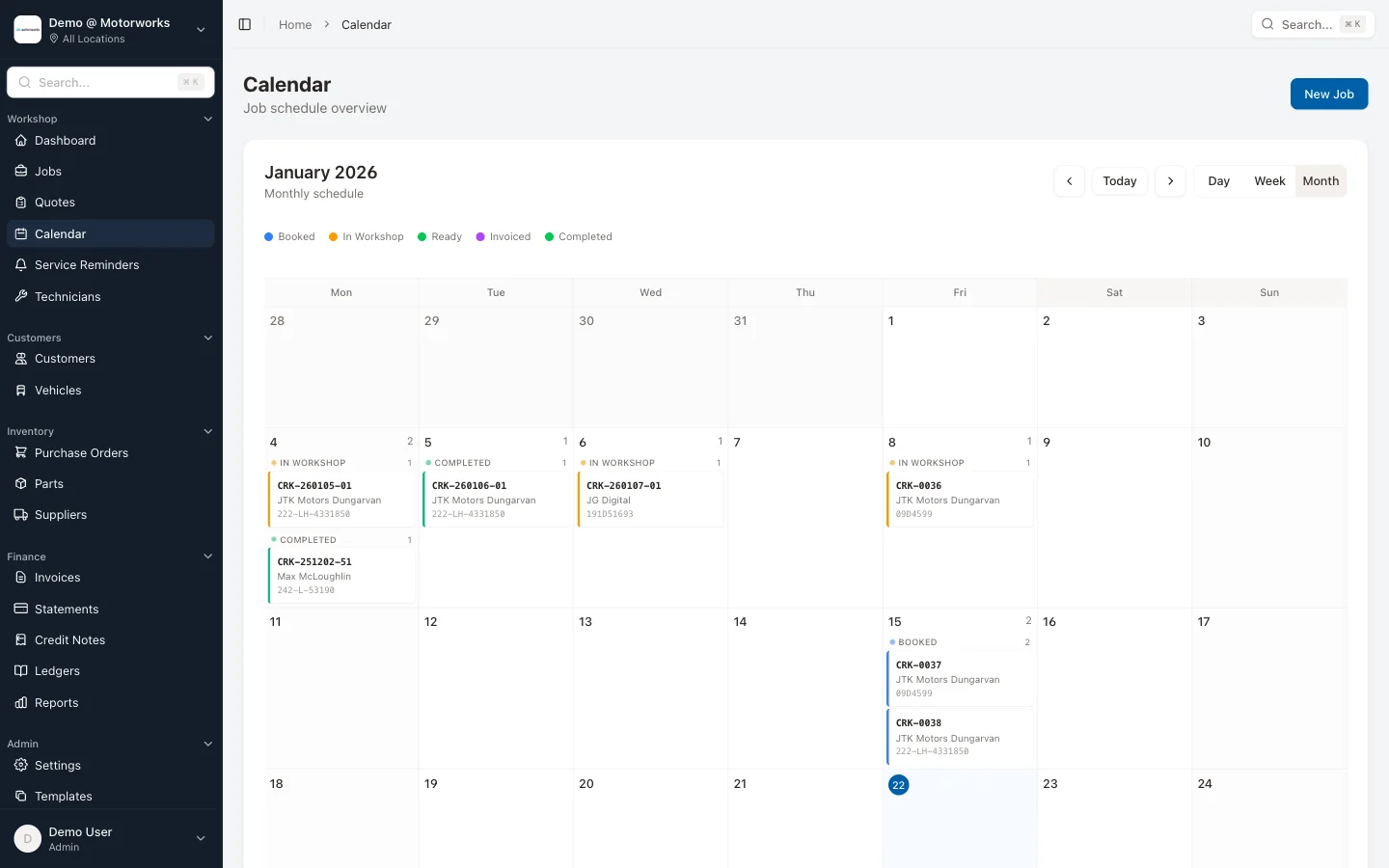
When job costs — labour time, parts, subcontractors — are tracked against job revenue, you can see which jobs make money and which don’t. You can see if certain job types are underpriced. You can see if one technician consistently takes longer than another on the same work. You can see if a particular customer account has margins that justify the volume. Profitability reports break this down by job, by technician, and by service type — so you’re making pricing decisions based on data, not gut feel.
None of this requires extra work. It’s a by-product of recording the information you’d record anyway — just in a way that can be analysed. If you want to see the specific numbers worth tracking, our post on the five reports every garage owner should review covers this in more detail.
Mobile access means the card follows the car
With paper, the job card usually stays in one place — the desk, the board, the filing system. With a digital system, the job card is accessible from anywhere. A technician on the workshop floor can check a job on a tablet or phone via a mobile app. A manager can see what’s happening from home. A customer can see the status of their car through a customer portal — no phone call needed.
That accessibility reduces the phone tag and the shouted questions across the workshop.
Offline concerns: how real are they?
The wifi concern is legitimate, but it’s worth examining how often it actually affects operations. Most modern garage management systems work on cloud infrastructure that’s highly reliable. Many have offline modes that cache data locally and sync when connectivity returns.
If your area has frequent connectivity problems, it’s worth asking any software provider directly how they handle it. It’s a fair question, and the answer varies by system.
A side-by-side summary
Here’s a straightforward look at how the two approaches compare across the things that matter most in a working garage.
Finding a specific job or vehicle history Paper: requires physical search, often slow, sometimes impossible for older records. Digital: instant search by any field, results in seconds.
Parts tracking against jobs Paper: manual, prone to gaps, easy to miss items. Digital: attached directly to the job, automatic running total.
Understanding job profitability Paper: not possible without significant manual calculation. Digital: built into normal job completion, available as reports.
Reliability when internet is down Paper: fully reliable. Digital: depends on the system — ask before you commit.
Cost to get started Paper: near zero. Digital: monthly subscription, varies by provider and garage size.
Training new staff Paper: none required. Digital: typically a few hours to a day, depending on the system.
Accessing records from multiple locations or devices Paper: not possible. Digital: available anywhere with a login.
Building a vehicle service history over time Paper: stored records can work, but retrieval is difficult. Digital: automatic, searchable, permanent.
Who should stay on paper?
Genuinely: some garages are fine on paper.
If you’re a sole trader doing low volume, the economics of a monthly subscription may not make sense. If you’ve got a system that works and you’re not losing jobs or missing follow-ups, the disruption of changing might not be worth it for where you are right now.
If connectivity in your area is genuinely unreliable and you can’t get a clear answer from software providers on how they handle it, that’s a reasonable concern to take seriously.
Paper is a legitimate choice for some garages at some stages of their business. The mistake is staying on paper because it’s what you’ve always used, rather than because it’s actually the right tool for where you are now.
Who benefits most from going digital?
The case for digital job cards becomes stronger as volume increases, as teams grow, and as the gaps in paper start to cost money.
If you’re doing more than fifteen or twenty jobs a week, the searchability alone starts to justify the shift. If you’ve got more than one or two technicians, the coordination benefits become significant. If you want to understand your own profitability — not just feel busy, but actually know which work is worth doing — digital job cards are the only way to get there.
The garages that tend to see the clearest benefits from making the switch are ones that have been running for a few years and have accumulated a sense that they’re busier than they feel profitable. Often that’s not because of bad work — it’s because parts aren’t being tracked properly, follow-up quotes aren’t being chased, and nobody knows which job types are actually worth prioritising.
Making the decision
The honest answer is that this isn’t a binary choice. Most garages that move to digital job cards don’t abandon paper overnight. They run both for a few weeks until they trust the new system, then gradually lean on paper less and less.
If you’re curious about what digital job cards actually look like in practice, our going digital guide walks through the transition process in detail — including how to get your team on board without disruption.
The job management feature in MotorWorks was built specifically around how Irish independent garages actually work — not how dealership software assumes you work. Jobs move through a clear lifecycle (booked, in workshop, ready, invoiced, completed) with technician assignment, checklists, time logging, and a full audit trail. The mobile app means your team can access job cards from the workshop floor without walking to the office. Purchase orders link directly to jobs so every part ordered is tracked and billed. And vehicle history builds itself automatically, so you’re not maintaining records manually.
If you’re sitting on the fence, the most useful thing you can do is see it in action before committing to anything. A demo takes about thirty minutes and you’ll know pretty quickly whether it fits how your garage operates.
Paper isn’t going away, and neither is the option to keep using it. But if you’re running into the same problems every week and wondering whether there’s a better way, there usually is.