It’s the second week of February. Christmas is behind you, the January rush has quieted down, and the diary looks thin. You’ve got a parts supplier payment due on Friday, wages going out Monday, and the bank account is sitting at a level you’d rather not look at too closely.
The garage turned over €580,000 last year. You know it did. So where is the money?
This is one of the most common financial experiences in garage ownership, and one of the least talked about. Cash flow problems in garages rarely come from a lack of revenue. They come from the gap between when money goes out and when it comes in — and from a handful of patterns that repeat themselves every year, almost like clockwork, if you don’t plan for them.
This guide covers garage cash flow from a practical standpoint: seasonal patterns, parts purchasing, supplier terms, building a forward view, and what a cash buffer actually looks like. Not theory. Real things you can act on.
Why cash flow feels tight even when revenue is good
Revenue and cash are not the same thing. This sounds obvious, but it’s worth sitting with for a moment, because it explains a lot.
When you complete a job and invoice it, you’ve earned revenue. But if the customer is on 30-day account terms, that money won’t land in your account for another month. In the meantime, you’ve already paid for the parts. You’ve already paid your technicians. You’ve already covered the electricity bill and whatever else came out that week.
The gap between work done and money received is where cash flow problems live.
For most garages, this gap is made wider by a few specific patterns:
Parts purchased on credit, jobs invoiced on credit. You buy from a trade supplier on 30-day account. Your customer is also on 30-day terms. In the best case, everything lines up and the timing works. In practice, your supplier wants payment before your customer has paid you — and the gap falls on you.
Invoices raised late. If jobs are completed on a Monday but invoices aren’t raised until Friday, you’ve lost five days of payment cycle before you’ve even started. Over a month, that adds up.
Uneven demand. Some months are naturally busier than others. If your quiet months cost as much to run as your busy months — which they largely do — the cash shortfall hits in a predictable pattern each year.
Aged debt. Outstanding invoices that you’ve earned but haven’t collected yet. We covered this in detail in our post on getting paid faster as a garage, but aged debt is a significant cash flow drag for workshops that don’t manage it actively.
Understanding which of these is causing the problem is the first step. Not all cash flow issues have the same fix.
The seasonal pattern most garages don’t plan for
Garage cash flow follows a fairly predictable pattern across the year. Once you’ve seen it once, you’ll recognise it.
January and February are typically slow. The post-Christmas dip is real. Customers who stretched their budget over December are reluctant to spend in January. Pre-summer servicing isn’t on anyone’s radar yet. Cash coming in reflects the lower volumes of the previous month. Costs don’t drop.
March and April tend to improve. People start thinking about summer. There’s usually a spike in service and general repair work as the weather improves and people notice their car after months of dark commutes.
May to August is generally the busiest stretch for most Irish garages. Longer days, more driving, pre-holiday checks. Revenue peaks, and if you’ve priced correctly and managed your parts costs, cash should follow.
September and October are steady. Back-to-school means less discretionary spending, but general repair and service work holds up.
November and December can be strong on revenue but brutal on cash. Parts suppliers start pushing for year-end payment. Your own stock purchasing goes up as you prepare for the Christmas shutdown period. Customers spend on essentials but defer non-critical work. And then the shop closes for a week or two, with staff holidays and wages still going out.
If you look at the cash in your account at the same point each year, you’ll likely see the same dip in roughly the same months. That’s not bad luck. That’s a pattern — and patterns can be planned for.
Planning for your quiet months before they arrive
The best time to prepare for a slow February is September. That sounds counterintuitive, but it’s the most practical approach.
When cash is flowing well in summer, the temptation is to spend or draw. A better approach is to build what your account needs to look like three months from now into your decisions today.
A simple cash flow forecast doesn’t need to be complicated. It needs three things:
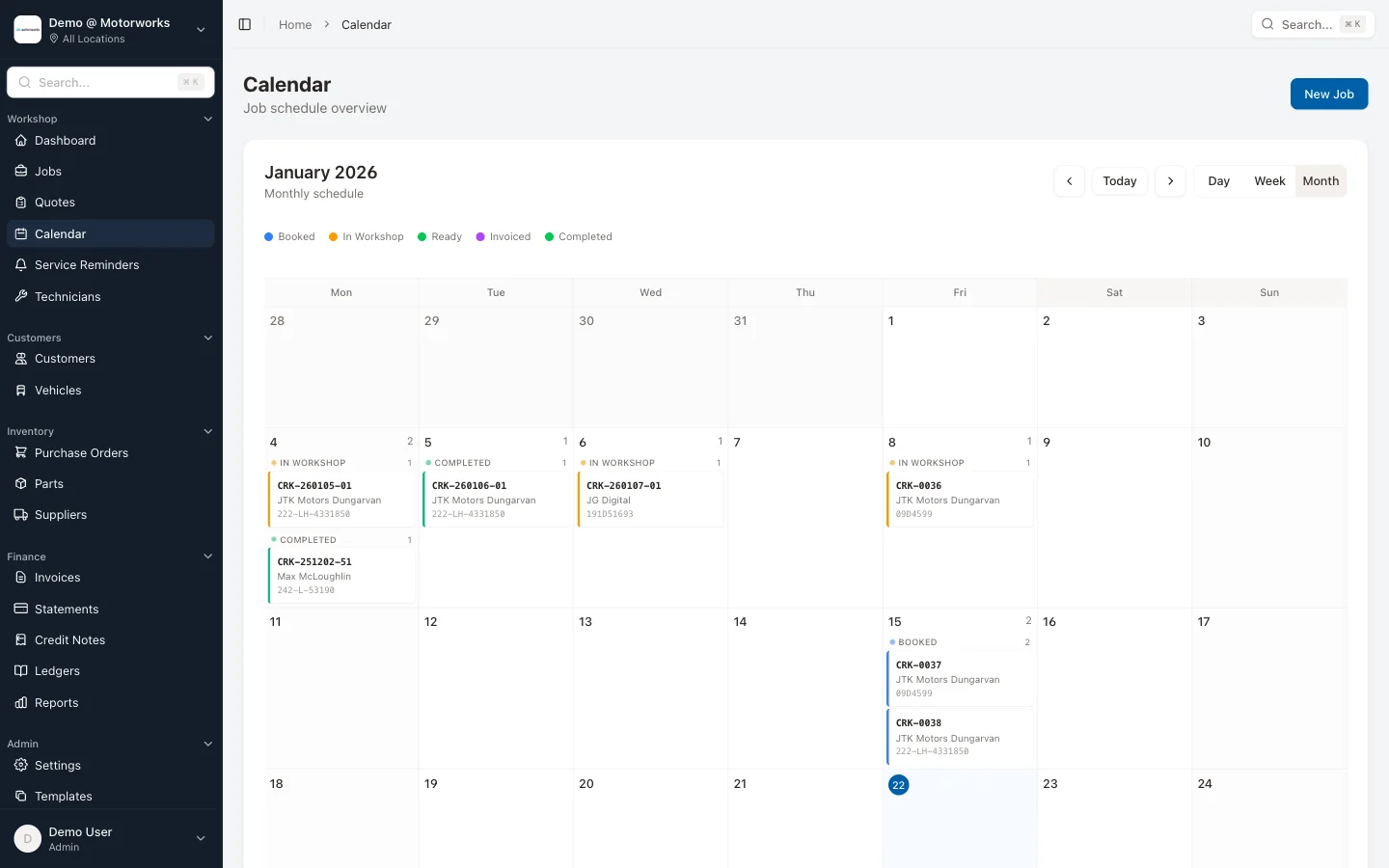
A realistic revenue projection by month. Based on the previous two or three years, what does each month typically bring in? Not what you hope — what history says. If February is consistently your lowest month, project accordingly. If October is strong, plan for that too.
A fixed cost baseline. Your wages, rent, insurance, and supplier minimums don’t change much from month to month. These are your floor — the minimum amount of cash going out regardless of how busy you are. For a typical independent Irish garage, this is somewhere between €15,000 and €30,000 per month just to keep the doors open.
A running cash balance projection. Start with what’s in the account now. Add projected revenue receipts (accounting for your payment terms — if customers pay in 30 days, your February revenue arrives in March). Subtract projected outgoings. The number you’re left with each month tells you whether you’re heading for a problem.
This doesn’t need to be a spreadsheet masterpiece. Even a simple month-by-month table in a notebook tells you whether February is going to be tight — and gives you time to do something about it, rather than discovering the problem when you’re already in it.
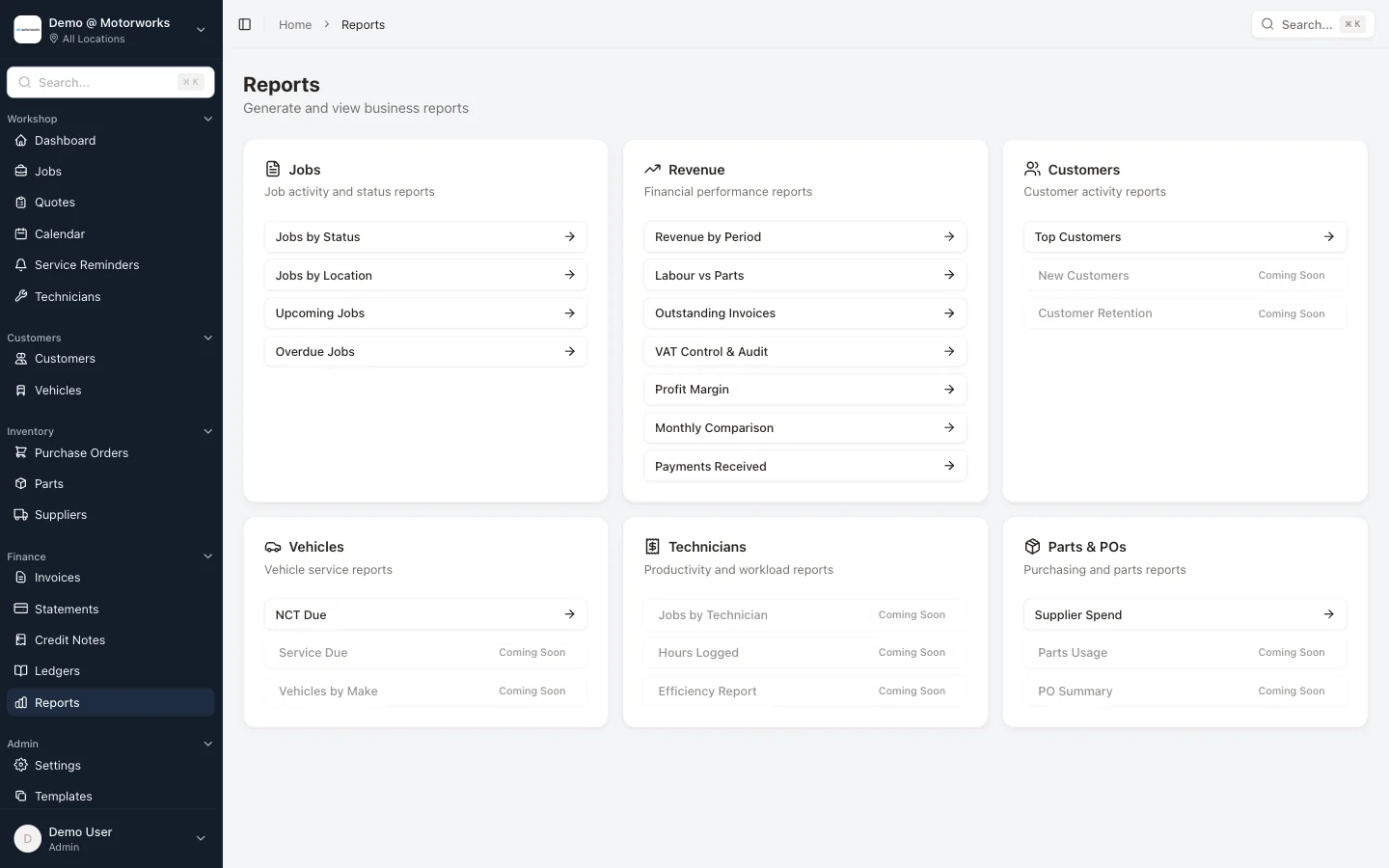
Cash flow and revenue reports in MotorWorks give you the historical picture automatically, so you can see what each month has looked like over the past year without pulling invoices manually. That’s the baseline for any sensible forward projection.
Managing parts costs and purchasing
Parts purchasing is one of the most significant controllable cash flow variables in any garage. How you buy, when you buy, and how much you hold in stock all affect your cash position directly.
Stock holding: less is usually better
Many garages carry more parts stock than they need to. A shelf full of filters, brake pads, and consumables feels like security — you can do any job without waiting. But it’s also cash sitting on a shelf, not in your account.
The shift toward same-day and next-morning delivery from trade suppliers has changed the economics of stock holding significantly. For most common parts, there’s little practical advantage to holding large quantities on site. You order, it arrives, you fit it, you invoice it.
Reducing your average stock holding from, say, €15,000 to €8,000 puts €7,000 back into your cash position immediately — and it stays there, rather than cycling through parts that sit for weeks before they’re used.
The parts worth holding are genuinely fast-moving items that you use consistently and would lose meaningful time waiting for: common oil grades, filters for your highest-volume vehicle types, standard brake pads. Everything else can be ordered as needed.
Buying on account: the timing trap
Most garages buy parts on trade account — which typically means 30-day payment terms with the supplier. That’s a useful credit facility. But it can create a cash timing problem if you’re not careful.
If you buy €6,000 of parts in January and those parts go into jobs invoiced on 30-day terms, you could be paying your supplier in February while your customer pays you in March. You’ve funded the materials for a full month out of your own cash.
A few ways to manage this:
Match your purchasing timing to your invoicing cycle. If you know a large job is going out this week and will be paid in 30 days, time your parts order so the supplier payment falls around the same date the customer will settle. It’s not always possible, but it’s worth being intentional about on bigger jobs.
Use purchase orders linked to jobs. When every part ordered is tied to a specific job, you can see exactly what’s been spent on each job before it’s invoiced. This prevents parts cost surprises and makes it easier to match your payment obligations to expected income.
Negotiate terms where you have leverage. If you’ve been a reliable account customer with a supplier for years and you have good payment history, it’s worth asking whether 45-day or 60-day terms are available, particularly for high-volume purchases. The worst they can say is no.
Watch for supplier cost creep
One subtle cash flow drain is parts cost inflation that happens gradually without anyone noticing. The price you pay per brake pad today may be 10% or 15% higher than it was two years ago. If your selling price hasn’t kept pace, your parts margin has quietly compressed — which means you’re spending more of your revenue on parts than you were, and less is left over.
Purchase orders that capture cost price at the time of ordering make this visible. You can compare what you paid versus what you charged, at job level, rather than discovering a margin problem six months later when you look at your annual accounts.
Getting paid faster: the cash flow side of invoicing
A significant portion of garage cash flow management isn’t about spending — it’s about the speed of collection. The faster you invoice and the faster customers pay, the less of a gap you’re bridging with your own cash.
The practical levers here:
Invoice on completion, not at the end of the week. Every day between job completion and invoice sent is a day you’ve delayed the start of the payment clock. If a job is done Monday and the invoice goes out Friday, you’ve already lost five days before the customer has even seen the bill. Digital invoicing that builds from the job card means the invoice is ready to send the moment the car is done — by email or through the customer portal, where customers can view and pay immediately.
Collect payment at the point of collection wherever possible. For retail customers, payment on collection is the cleanest approach. The car is ready, the customer comes in, they pay. There’s nothing to chase. A card reader eliminates the “I’ll transfer it later” conversation entirely.
Set clear terms for account customers — and send statements consistently. Account customers need to know when payment is expected. “30 days” is a payment term. “When you get a chance” is not. Monthly statements sent on a fixed date give account customers a clear prompt and give your accounts payable contact exactly what they need to process payment. For more on building a systematic approach to this, the post on getting paid faster as a garage covers the full process.
Building a cash buffer: what it actually means in practice
Every piece of financial advice for small businesses mentions a cash buffer. Few explain what that looks like concretely for a garage.
A cash buffer is not savings in a separate account you never touch. It’s a minimum cash balance you aim to keep in your operating account at all times — a floor below which you don’t let the balance fall without a plan.
For a garage with fixed monthly costs of €20,000, a reasonable buffer is one month’s worth of fixed costs: €20,000 always available. That means if revenue completely stopped for a month — which won’t happen, but is the stress test — you could pay your bills without emergency borrowing.
Getting there from a position where the buffer doesn’t exist yet requires a deliberate approach:
Pick a number. Decide what your buffer should be, based on your fixed monthly costs. One month’s fixed costs is the minimum; six weeks is more comfortable.
Build it gradually in good months. In a strong month, instead of drawing everything, leave some in the account. Even €500 to €1,000 per month in a good run will build the buffer over a summer season.
Treat it as non-negotiable. The buffer is only useful if it actually exists when you need it. That means not dipping into it for discretionary spending and not drawing it down “just this once” when cash feels tight.
Use an overdraft facility as a backstop, not a routine. A business overdraft is a useful safety net for genuine timing mismatches. It’s not a replacement for a buffer, and using it routinely is an indicator that something structural needs addressing.
Some garages keep a separate savings account for the buffer, which makes it psychologically easier to leave untouched. Others manage it within the main account with a clear mental or recorded minimum balance target. Either approach works.
Using your reporting to see cash flow in real time
The biggest reason garage cash flow problems catch owners off guard is a lack of visibility. You know roughly what the account looks like today. You don’t know what it’s likely to look like in three weeks.
Visibility comes from combining two things: accurate, up-to-date financial data from your management system, and a habit of looking at it regularly.
The numbers worth reviewing weekly, not monthly:
Outstanding invoices by age. How much is owed to you, and how old is it? Anything over 30 days that’s from an account customer should prompt a follow-up. Anything over 60 days should already be getting active attention.
Parts purchased but not yet invoiced out. Money spent on parts for jobs that haven’t been completed or invoiced yet. This is cash that’s gone out but hasn’t come back in. In a busy workshop, this can build up without anyone noticing. Purchase orders linked to jobs make this visible in real time rather than at month-end.
Upcoming supplier payments. What you owe your trade accounts and when it’s due. If you know a €4,000 supplier payment is due in ten days and your current cash position is €5,500, that’s information you need now, not on the day the direct debit goes.
Month-to-date revenue versus the same period last year. A simple early warning signal. If you’re running 20% behind where you were last February, you can respond — adjust the schedule, push harder on outstanding reminders, tighten spending — rather than finding out at month-end.
Profitability and financial reporting built into your garage management system gives you this view without building spreadsheets or waiting for the monthly accountancy summary. The goal is to be looking at accurate numbers weekly, so that nothing catches you by surprise.
The overlooked connection between cash flow and profit margins
It’s worth being direct about something: sometimes cash flow problems are actually margin problems in disguise.
If your garage is genuinely profitable — if your parts margins are healthy, your labour rate covers your costs, and jobs are being correctly billed — cash flow should be manageable with the right timing and planning. If you’re managing cash flow constantly and there’s never a surplus even in good months, the problem might be that the margin isn’t there to begin with.
The benchmarks for Irish independent garages — a 50 to 60% gross margin, 8 to 15% net margin — are achievable with the right pricing and cost management. If you’re not hitting those, the post on garage profit margins and benchmarks for Irish workshops covers where the gap usually comes from and what to do about it.
Cash flow management and margin management are related. You can improve cash flow through better timing and planning. But if the underlying margins aren’t there, planning only goes so far.
A practical cash flow checklist
If you’re looking for somewhere to start, these are the changes that tend to make the most immediate difference for garage cash flow:
- Invoice on job completion, not at the end of the week
- Collect payment at collection for retail customers — a card reader removes the “I’ll transfer it” option
- Send monthly statements to all account customers on a fixed date
- Review aged debt weekly and chase anything over 30 days
- Order parts as needed rather than holding large stock
- Link all purchase orders to specific jobs so parts costs are captured at time of order
- Build a simple month-by-month cash projection based on the previous year’s revenue pattern
- Set a minimum cash buffer target and protect it in good months
None of these require a financial background. They require consistent process — which is easier when your management system does the heavy lifting on tracking and reporting.
MotorWorks gives you job-level financial reporting, integrated purchase orders that track parts costs against jobs, and digital invoicing that raises invoices the moment a job is complete. Together, they give you the visibility to manage cash flow proactively rather than reactively. Book a demo to see how it works in a real workshop.
Frequently asked questions
Why does my garage have good revenue but poor cash flow? The most common causes are timing gaps between work done and payment received, parts purchased on credit before customer invoices are settled, invoices raised late, and aged debt that hasn’t been actively managed. Revenue and cash are not the same thing — cash flow reflects when money actually moves, not when it’s earned.
How much cash buffer should a garage keep? A practical minimum is one month’s fixed operating costs — typically €15,000 to €25,000 for a small to medium independent garage. This gives you enough to cover wages, supplier payments, and overheads if a slow period hits without having to resort to emergency borrowing.
What are the slowest months for garage cash flow in Ireland? January and February are typically the most challenging. Demand drops post-Christmas, while costs stay constant. November and December can also be difficult despite reasonable revenue, because supplier payments, stock purchases ahead of shutdown, and holiday pay all coincide. Planning for these months during the summer busy period is the most effective mitigation.
How can I improve garage cash flow without cutting costs? Collect payment at point of collection rather than on credit terms, invoice immediately on job completion, send monthly statements to account customers, reduce parts stock holding, and chase aged debt consistently. These changes improve the timing of cash coming in without requiring any reduction in spending.
Should I separate my cash buffer from my main business account? Either approach can work. A separate account makes the buffer psychologically easier to preserve — you’re less likely to spend it if it’s not sitting in your current account. Some owners prefer to track a minimum balance target within the main account instead. What matters is that the buffer actually exists and is treated as untouchable for routine spending.