It’s Thursday afternoon. You’ve got a parts supplier to pay by Friday and three invoices sitting unpaid from last month. One of them is for a fleet customer who’s been “dealing with it internally” for six weeks. Another is a regular who picked up his car on a Tuesday and promised he’d transfer it that evening. You’ve sent two reminders. You haven’t heard back.
You’ve done the work. The customer has their car. But you don’t have your money.
Garage payment collection is one of those problems nobody talks about at trade shows, but almost every workshop owner deals with it every month. The awkward phone calls. The invoices that somehow get lost. The “cheque’s in the post” from an account customer who’s been saying the same thing for three weeks. The cash flow crunch that shouldn’t exist given how busy you are.
This post covers practical strategies to improve how your garage gets paid — from setting the right payment terms upfront to using digital invoicing and card payments on collection. The good news is that most of the problem is solvable with the right systems.
Why garages end up chasing payments
Before getting into the fixes, it’s worth understanding why this happens in the first place.
Most garages in Ireland have grown up around a culture of account credit and informal trust. A good customer has been coming for ten years. Asking them to pay before they leave feels awkward, like you don’t trust them. So you send an invoice. They say they’ll sort it. And then life gets in the way.
There’s also the problem of unclear expectations. If you’ve never told a customer when payment is due, they’ll assume “whenever.” Some customers interpret that as within a week. Others interpret it as within three months. Neither is technically wrong if you never specified.
And then there’s the invoicing itself. If your invoices are sent days after the job is done — because you’re too busy to raise them in real time — the customer has already mentally moved on. The car is fixed. The urgency is gone. Your invoice is now just a bill they’ll get to when they get to it.
None of these are disasters individually. But together, they create a pattern where your garage is essentially funding your customers’ cash flow instead of your own.
Start with payment terms — and actually communicate them
The most effective thing you can do costs nothing: decide on your payment terms and tell every customer what they are.
“Payment on collection” is the simplest and most effective policy for retail customers. The car is ready, they come in, they pay. Done. It avoids every subsequent chase because there’s nothing to chase.
If you do offer credit terms to account customers, be specific. “30 days” is a full sentence. “At your convenience” is not a payment term.
A few things worth putting in writing:
- Payment due date. Invoice date plus 30 days, or a specific date. Either works. Vague doesn’t.
- Accepted payment methods. If you take card, bank transfer, and cash, say so. If you don’t take cheques anymore, say that too.
- Late payment consequences. You don’t have to be aggressive about it, but mentioning that overdue accounts may incur interest gives you standing if things escalate.
For new account customers especially, having this conversation upfront — before the first job — sets expectations clearly and removes the awkwardness later. They know the rules. You know the rules. There’s nothing to negotiate when the invoice arrives.
Invoice immediately — not at the end of the week
Here’s a pattern that kills cash flow: the car goes out on Monday, the invoice gets raised on Friday when you have a moment, it lands in the customer’s inbox on Friday afternoon, they open it on Monday (if you’re lucky), and payment arrives somewhere in the following fortnight.
That’s a three-week delay that started the moment the job was done.
The fix is simple: invoice when the job is complete, not when you find the time.
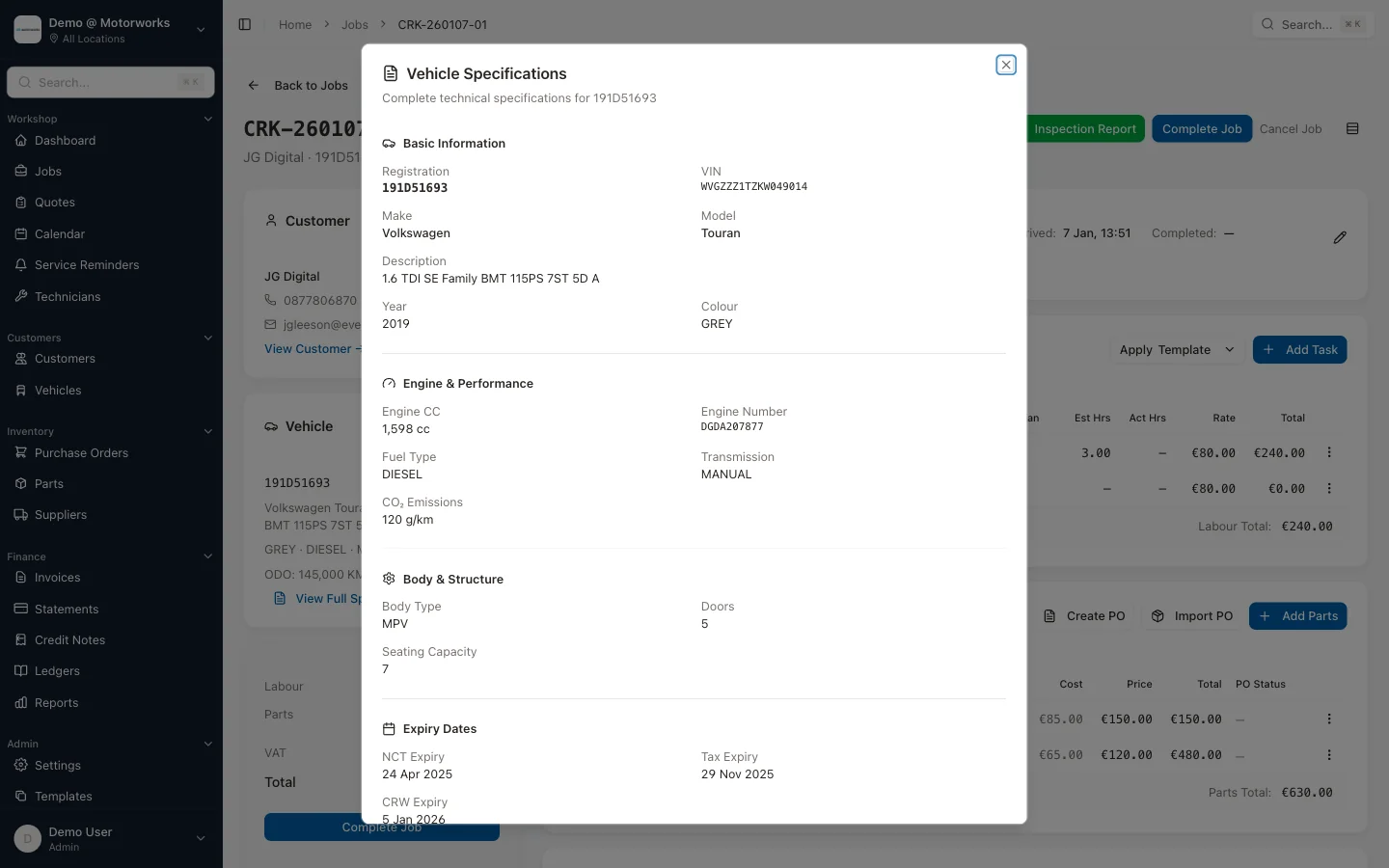
Digital invoicing makes this possible because the invoice is already built during the job. Parts are added as they’re used. Labour is logged as it’s done. When the car is ready, you review the invoice, click send, and it’s in the customer’s inbox before they’ve even arrived to collect. They walk in knowing what they owe. They pay on the spot.
The psychology matters here too. An invoice that arrives when the car is still fresh in their mind — when they’re relieved it’s sorted and grateful for the service — is paid faster than one that arrives days later when the moment has passed.
Make card payments the default, not the exception
This is the single biggest change most garages can make to improve garage payment collection: stop treating card payments as a special case and start treating them as the standard.
A customer who arrives to collect their car with no cash on them is not going to walk to the nearest ATM while you wait. They’re going to tell you they’ll transfer it later. And now you’re chasing.
A card reader eliminates that conversation entirely. They tap their card. You take payment. They drive away. No follow-up needed.
The small percentage fee on card transactions is nothing compared to the administrative cost of chasing an unpaid invoice for two months. It’s not even a comparison.
For trade customers and fleet accounts who genuinely need monthly invoicing, card payment on collection still works — ask them to pay each invoice by card when they pick up, rather than running tabs that need reconciling at month-end. Many garages that have made this switch report that even long-standing account customers are happy to pay by card if you just ask.
Use statements to manage account customers professionally
For businesses or fleet customers who legitimately need account terms, account statements are your best tool for getting paid on time without awkwardness.
A monthly statement showing every invoice, the date issued, the amount, and the balance due is far more effective than a reminder email saying “just checking in on those invoices.” It’s professional. It looks like you know what you’re doing. And it gives the customer’s accounts payable team exactly what they need to process the payment.
The best practice:
- Send statements on the same date every month — the last working day is standard.
- Include a clear total due and a due date.
- Follow up with a phone call if payment doesn’t arrive within a week of the statement date.
The key is consistency. If you send statements reliably every month, they become expected. Payment follows a predictable pattern. If you only send statements when you get around to it, the customer’s payment schedule will be equally unpredictable.
Bulk sending statements to all outstanding accounts at once turns what used to be an afternoon’s work into a two-minute job. You’ll actually do it consistently because it’s not a burden.
Segment your outstanding invoices by age
Not all unpaid invoices are the same problem.
An invoice that’s seven days old is probably fine. An invoice that’s 60 days old is a problem. An invoice that’s 90 days old is a serious problem and needs a different approach.
Aged debt reports — sometimes called aged debtor reports — show you exactly where your outstanding money sits:
- 0-30 days: Normal. Keep an eye on it.
- 31-60 days: A reminder is appropriate. A polite email or a statement.
- 61-90 days: This needs a phone call. Not an email. A conversation.
- 90+ days: Escalate. This may need a formal letter of demand before you consider further options.
Without this visibility, you’re chasing everything at the same level of urgency, which means you’re spending time chasing invoices that would have been paid anyway, and not enough time on the ones that are genuinely at risk.
Profitability and payment reports in your garage management software give you this picture at a glance. You can see aged debt by customer, by invoice date, and by amount. That tells you exactly where to focus your energy.
Give customers more ways to see what they owe
One underrated reason invoices go unpaid is that the customer has lost track of them. The email landed in a folder. They meant to pay it but can’t find the details now. They’re not deliberately avoiding you — they’ve genuinely lost the invoice in the noise of their own inbox.
A customer portal solves this without any effort on your part. Customers log in with a one-time passcode (no passwords to remember), see every invoice on their account, and pay directly — whenever it suits them, from their phone. No chasing email, no phone call, no hunting through their inbox for a PDF you sent three weeks ago.
This is particularly useful for fleet customers or businesses where the person authorising payment is different from the person who brought the car in. Instead of the job getting lost between departments, the finance team can log in, see the invoice, and process it cleanly.
Set a late payment policy and enforce it (gently)
This is where most garages lose their nerve. They have a late payment policy in theory. In practice, they’re too worried about upsetting a good customer to enforce it.
Here’s the thing: good customers are not upset by professional follow-up. Good customers pay their bills. If a customer reacts badly to a polite reminder that an invoice is overdue, that’s information about what kind of customer they are.
Late payment interest is permitted under Irish commercial law for business-to-business invoices. You’re not required to apply it, but having it as a policy — and mentioning it on the invoice — encourages prompt payment without you having to say anything.
For genuinely problematic accounts, a firm but professional escalation process works better than continued gentle chasing:
- Invoice sent on job completion
- Reminder at 14 days if unpaid
- Statement at 30 days
- Phone call at 45 days
- Formal letter of demand at 60 days
Most debts get resolved at step 3 or 4. Having a clear process means you apply it consistently, rather than leaving it to individual judgement call each time.
The system problem behind the cash flow problem
Most garage payment collection problems aren’t really about individual customers being difficult. They’re about systems — or the absence of them.
When invoicing is manual and happens days after the job, payment is delayed before it starts. When payment terms aren’t communicated, expectations are inconsistent. When there’s no reminder process, invoices get forgotten. When there’s no visibility into aged debt, you don’t know how serious the problem is until it’s already a crisis.
Good garage accounting practice is the foundation here — something we covered in depth in our guide to garage accounting software for Irish workshops. When invoicing, payments, and debt reporting are all in one place, you can see exactly what’s owed, by whom, and for how long — and you can act on it without having to pull information from three different places first. Our post on cash flow management for garage owners goes deeper on how to structure this across your whole business.
What a better process looks like in practice
Here’s what a well-run garage payment collection process looks like from start to finish:
When the booking is made: Payment terms are confirmed. For new customers or large jobs, a deposit may be taken.
During the job: Parts and labour are logged against the job card in real time — including purchase orders for any parts ordered — so the invoice is already built before the car is done.
When the car is ready: The invoice is reviewed, sent to the customer, and payment is taken on collection — by card or bank transfer. The job closes.
For account customers: Monthly statements go out on the last working day of the month, covering all open invoices. Payment is due within 30 days.
For overdue accounts: A structured reminder process runs automatically — email at 14 days, statement at 30, phone call at 45.
At month-end: An aged debt report shows the full picture. Any accounts over 60 days get a direct conversation.
That process eliminates most of the cash flow problems garages face. It’s not complicated. But it does require systems that support it — rather than leaving it all to memory and goodwill.
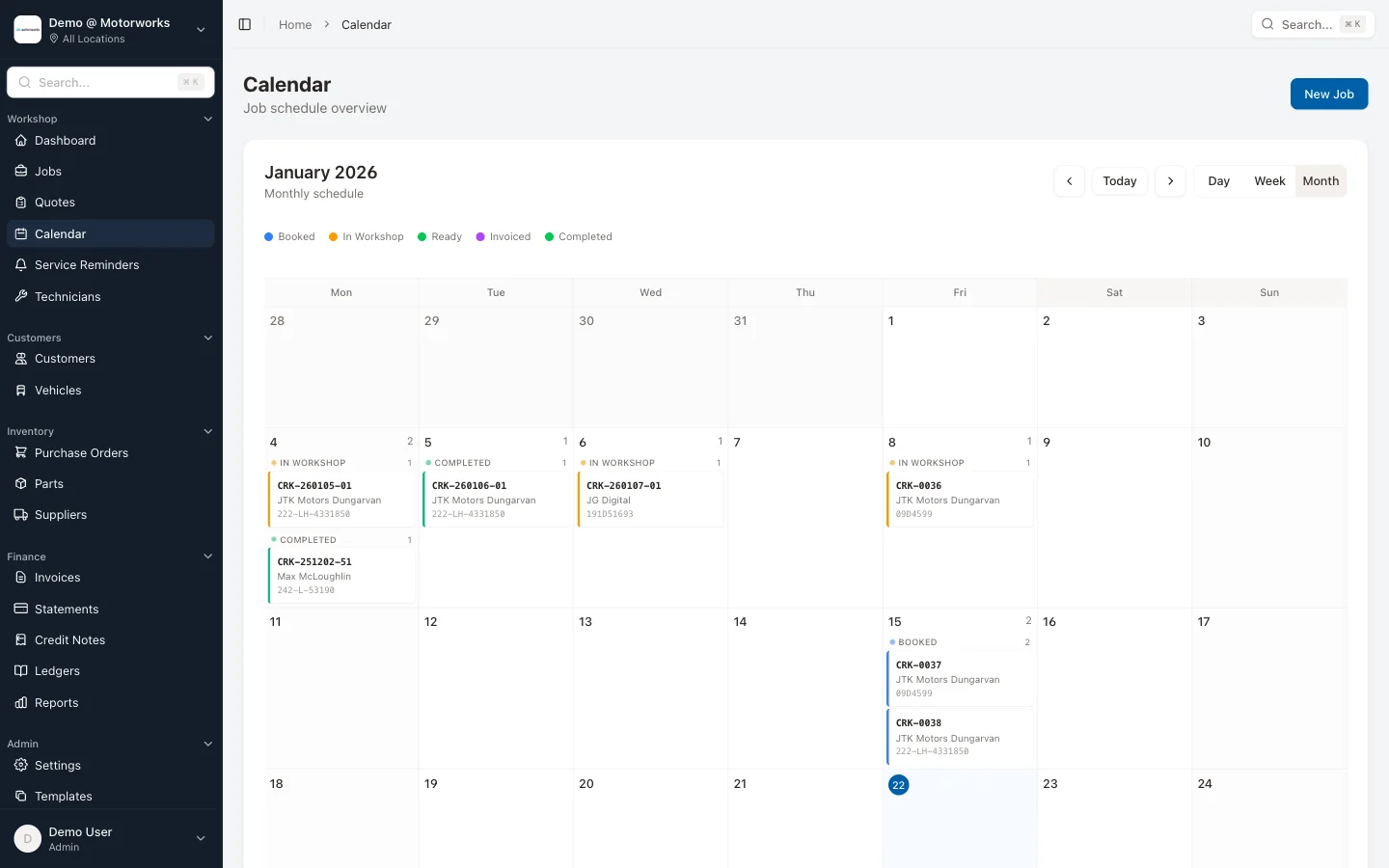
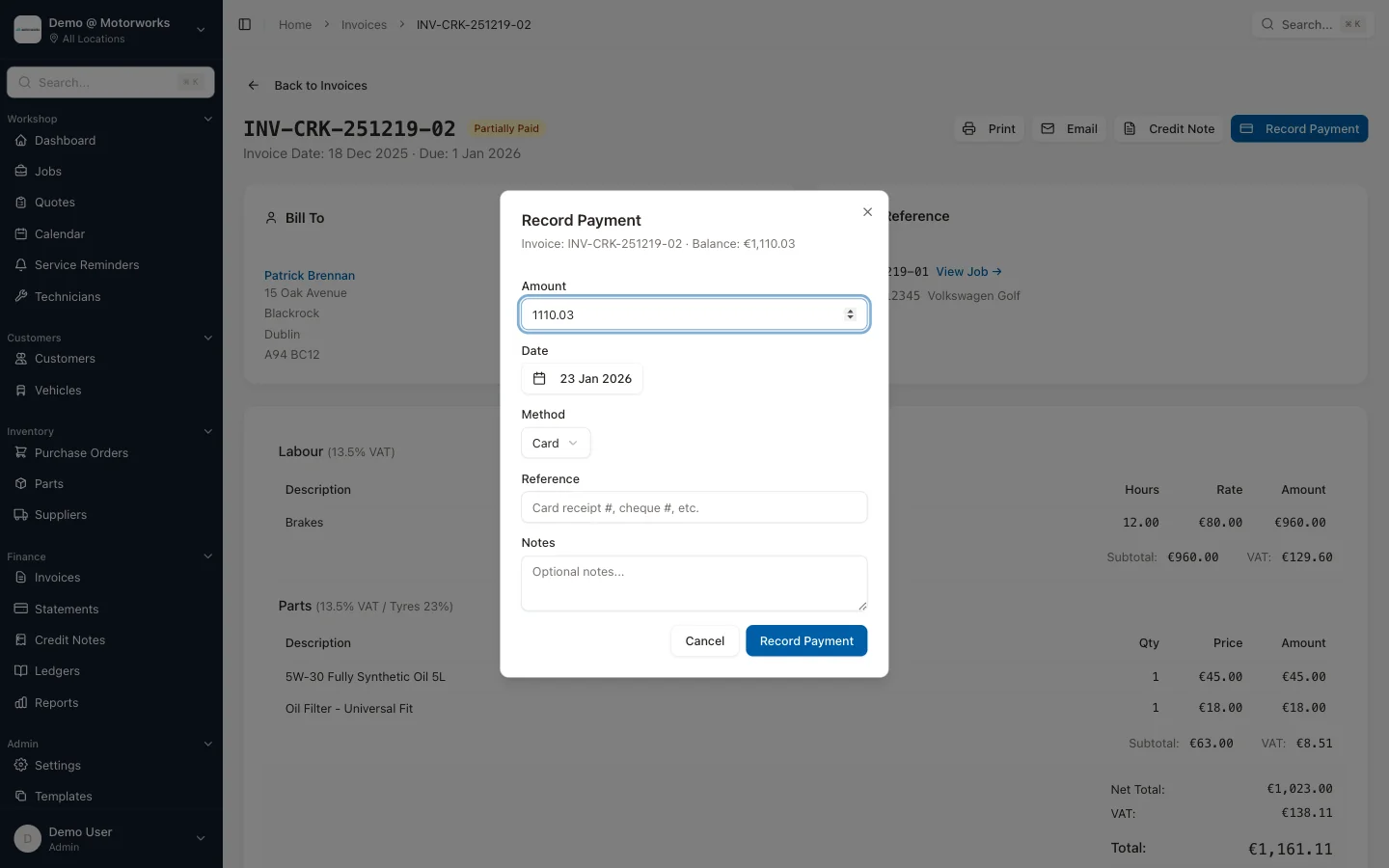
Chasing payments shouldn’t be part of running a garage. MotorWorks includes digital invoicing with quote-to-invoice in one click, account statements and credit notes, a customer portal where customers can view and pay invoices themselves, partial payment tracking, and aged debt reporting — all in one system. Book a demo to see how it works in practice.