There is no universal best garage management system. A product that suits a fast-fit centre may frustrate a commercial workshop, while a dealership platform can be far more system than an independent garage needs.
The useful comparison is not a row of vendor ticks. It is whether the software can handle the garage’s real work, preserve reliable records and remain usable when the workshop is busy.
This guide gives Irish garages a practical evaluation method without inventing competitor features, pricing or weaknesses.
Define the workflow before viewing the dashboard
Choose one representative job and write down how it should move:
- Customer and vehicle are identified.
- Work is booked and assigned.
- A technician records findings.
- Additional work is priced and authorised.
- Parts are ordered, received and fitted.
- Labour and time are recorded.
- The job becomes an invoice.
- Payment or account balance is recorded.
- Vehicle, customer and document history remain searchable.
Ask every vendor to demonstrate that same scenario. A prepared dashboard can look impressive while avoiding the difficult transitions where information is normally retyped or lost.
Check the job card in detail
A digital job card should be more than a status label. Look for:
- customer request and vehicle details
- technician assignment
- tasks and repeatable templates
- labour, parts and time entries
- internal notes and customer-facing notes
- attachments and inspection findings
- clear status history
- printable output where needed
Open an old completed job and confirm that it still makes sense. The value of a vehicle history comes from the underlying records, not simply from a list of visit dates.
Test quotes and customer approval
The CCPC advises consumers to obtain a detailed written quote and not to permit additional work without approval. Garage software should help staff retain the proposed scope, approved version and later decisions.
During the demo, add an inspection defect after the original quote. Check whether the system can:
- price the additional item
- record approval, decline or deferral
- preserve the original proposal
- carry approved work into the job
- keep a follow-up date for deferred work
Our garage quotes and authorisation guide describes the full process.
Examine parts and supplier controls
Parts management is a common point of friction because ordering, receiving, fitting, returning and paying are different events.
Ask the vendor to show:
- purchase order linked to a job or stock requirement
- partial receiving
- job issue and unused-part return
- append-only stock movement history
- supplier invoice reference and duplicate protection
- supplier credit and payment allocation
- stocktake adjustment with a reason
If the demonstration jumps from “ordered” to “on the invoice,” ask what happens when half the order arrives or the wrong part goes back.
See our parts and purchase-order guide for a test scenario.
Verify Irish VAT support without accepting a slogan
Revenue currently lists qualifying motor-vehicle repair services at the reduced rate, while identifying items including batteries, mirrors, media players and tyres as standard-rated even within a repair. Tyre fitting is standard-rated and puncture-repair service is reduced-rated.
The system should support line-level VAT, configurable defaults, mixed-rate invoices, linked credit notes and reporting by rate. It should not claim that every part follows one universal rule.
Use the Revenue links in our VAT guide for Irish garages and have the garage’s accountant review the proposed configuration.
Check Irish vehicle data and due dates
Ask which registration data provider is used, what fields are returned and what happens when the provider has no record. A good workflow lets staff review returned data rather than treating every lookup as infallible.
For NCT and CVRT dates, distinguish between:
- a date returned by a provider
- a date entered from a customer document
- an estimate calculated by the application
The source and verification status matter when a reminder is sent. The NCT rules guide explains the current official frequency and early-testing rules.
Review invoicing, payments and corrections
Create an invoice containing labour, an excluded standard-rated part and a part payment. Then correct the price using the documented credit-note process.
Check that the system retains:
- unique sequential invoice and credit-note numbers
- VAT breakdown by rate
- original and correction relationship
- partial payment and remaining balance
- customer statement
- delivery, failure or bounce events where supported
- structured export for the accountant
The PDF is the visible end product. The underlying records are what make it reliable.
Ask how reporting is calculated
“Profit report” can mean several different things. Ask which costs are included, how technician time is valued, how credit notes affect the period and whether every report respects the selected location.
Useful workshop views include:
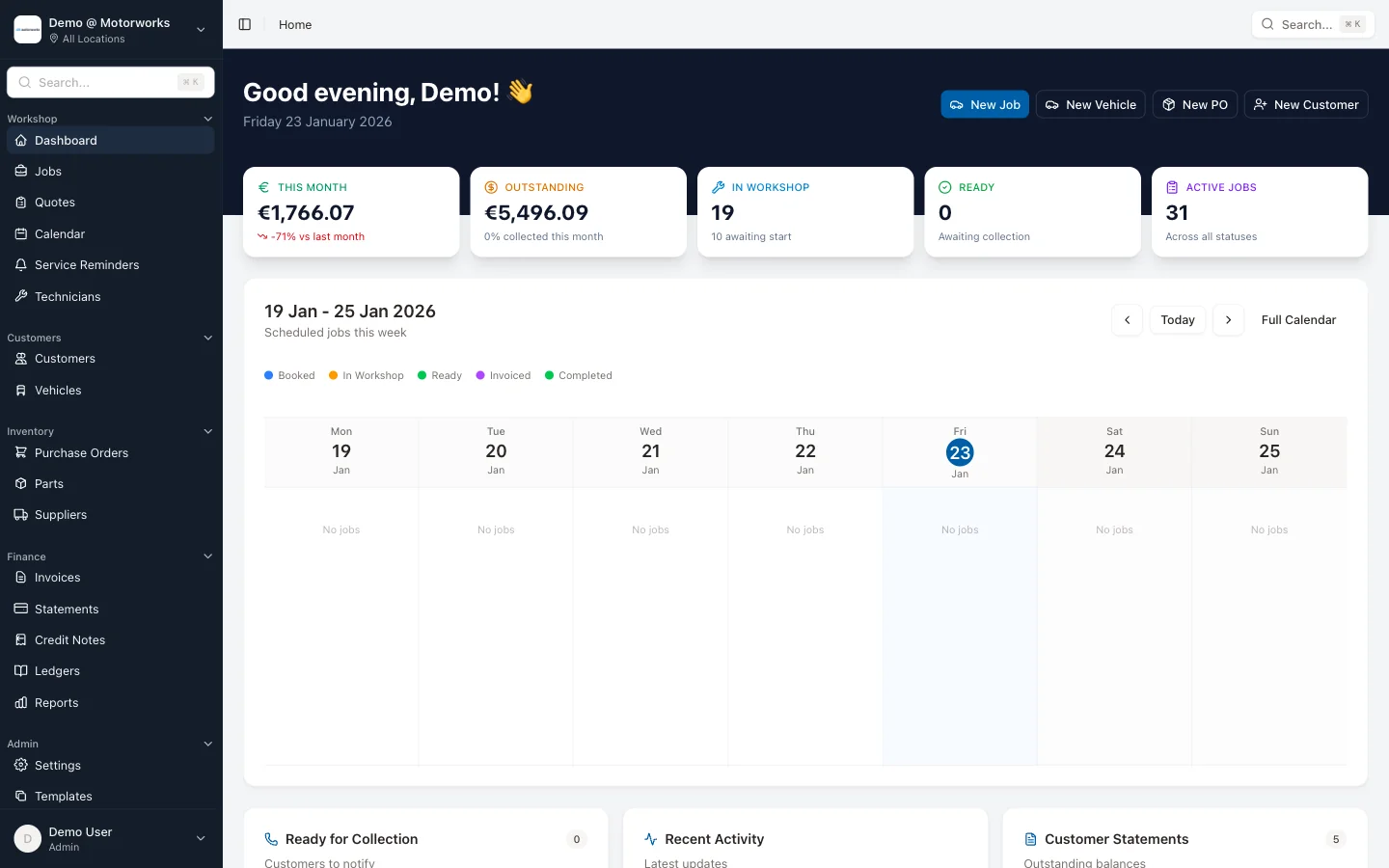
- open jobs and time in status
- quoted versus recorded labour
- parts sold and recorded cost
- invoices, payments and aged balances
- purchasing and supplier balances
- stock movement and adjustment history
- vehicle-sale preparation and margin where relevant
Run one report back to the source jobs. A total that cannot be explained is decoration, not management information.
Evaluate daily speed and accessibility
Workshop software is used repeatedly under time pressure. Test:
- keyboard navigation and search
- filterable, sortable tables
- stable layouts that do not shift during use
- clear empty, loading and error states
- mobile or workshop-floor access
- role and location permissions
- performance on a realistic data set
Count the steps for common actions. A feature may exist but still be too awkward to use consistently.
Test data isolation and access control
For a cloud service, ask how the provider separates garages and locations. A user should not see another tenant’s customer, vehicle, email settings or documents because a URL or identifier was changed.
Also ask about:
- multi-factor authentication
- admin impersonation controls and audit history
- user offboarding
- permission roles
- document-download authorisation
- backups and incident response
- independent security testing
Security deserves its own evidence. A padlock icon in the footer is not evidence.
Understand migration and exit before signing
Request a sample import using anonymised or controlled data. Check how the system handles customers, vehicles, invoice history, line items, payments and relationships between them.
Ask for:
- dry-run validation
- rejected-row report
- duplicate handling
- reconciliation totals
- named responsibility for clean-up
- usable exports if the garage later leaves
A migration should have acceptance criteria. “We imported the spreadsheet” is not enough if vehicles are attached to the wrong customers.
Compare total cost, not the headline price
Include:
- subscription
- onboarding and migration
- training
- user, location or usage charges
- messaging and third-party data costs
- paid modules
- support level
- contract and cancellation terms
Motorworks starts from €200 per month and does not meter users, locations or jobs. The final subscription and onboarding cost is confirmed after reviewing the setup and migration.
Where Motorworks fits
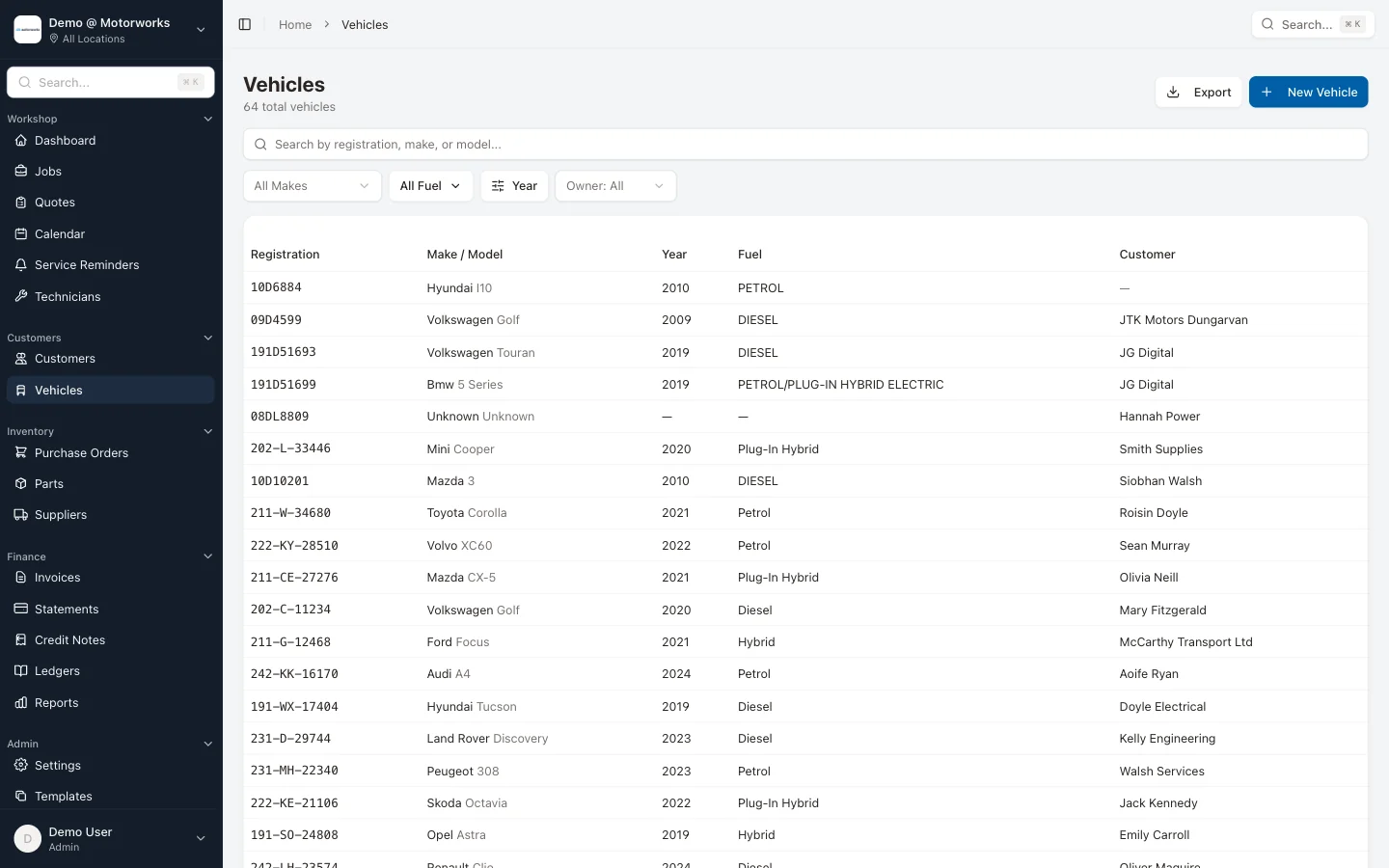
Motorworks is intended for Irish independent repair workshops, fast-fit operations, commercial-vehicle garages and garages with a vehicle-sales arm. Its current feature set includes:
- digital jobs, scheduling and technician time
- inspections and defect follow-up
- quotes, invoices, credit notes, statements and payments
- parts, stock and purchasing
- supplier accounts and aged creditors
- customer portal and document history
- NCT, CVRT and service-reminder workflows
- reports and structured exports
- managed Android beta access
- multi-location operation
- vehicle sales lifecycle
It is not dealership manufacturer-warranty software, a payment processor or a substitute for the garage’s accountant.
Book a demo and bring the representative job you used for the checklist. The best decision will come from testing the complete workflow, not counting feature names.
Product scope reviewed on 2 September 2026. Verify every vendor’s current features, pricing, security evidence and contract directly with that vendor before deciding.